Hair Color Correction: Damage Limits, Test Strands, and Salon Boundaries

Direct answer: start hair color correction by identifying the unwanted result, documenting every prior service, and deciding whether the hair can tolerate another process. Use test strands to compare a limited correction plan with the current condition. Move the service to a qualified colorist when the history is uncertain, the result has multiple bands, the hair shows significant weakness, or the target requires repeated removal and lightening.
Correction is not one product or one recipe. It is a sequence of diagnosis, risk limits, small-scale evidence, controlled application, reassessment, and maintenance.
Define the problem before selecting chemistry
Describe what is visibly wrong without jumping to a product: too dark, too warm, too cool, patchy, banded, stained, overlightened, underlightened, or different at roots and ends. Record the intended endpoint in ordinary light. “Fix everything” is not a usable target because each zone may need a different decision.
Separate cosmetic preference from urgent scalp or hair concerns. Pain, blistering, swelling, breathing difficulty, persistent burning, or another concerning reaction requires package-directed response and appropriate professional guidance, not another color layer.
Build a complete service history
List permanent color, demi-permanent color, direct dye, henna or other plant color, lightener, remover, relaxer, perm, keratin service, metallic-salt possibility, heat exposure, and approximate dates. Include at-home and salon services, even when a color seemed to fade.
Bring product names, shades, developer strengths, ratios, photos, and ingredient lists when available. Unknown history is itself a risk factor because a strand can react differently from the visible surface.
Map the hair by zones
Divide the hair into new growth, previously colored mids, porous ends, darker bands, lighter patches, and any fragile perimeter. Check elasticity, breakage, roughness, tangling, and whether wet strands feel unusually weak. These observations do not diagnose the fiber, but they help set a conservative boundary.
The American Academy of Dermatology coloring guidance notes that greater lightening can cause more damage and recommends manufacturer testing. A lighter target may therefore require a narrower plan or professional evaluation.
Choose the smallest correction that addresses the actual issue
If the color is slightly too warm or dull, a compatible deposit-only gloss or tonal adjustment may be enough. The hair gloss guide explains how to compare color deposit, shine, starting base, and upkeep without assuming that gloss can erase every unwanted pigment.
If the hair is too dark because of artificial pigment, a remover may be considered only for the pigment type and condition the product addresses. If the problem is uneven lightness, adding one more whole-head process can deepen the unevenness rather than correct it.
Color remover and lightener are not interchangeable
A remover may target certain artificial color molecules, while lightener changes natural and artificial pigment through a different process. Neither guarantees a return to the original shade. Underlying warmth, old bands, porosity, and repeated color can become more visible after removal.
The hair dye remover guide provides a decision framework for remover scope, strand testing, rinse demands, and stop conditions. Follow the exact product rather than substituting a generic correction recipe.
Use test strands as a decision gate
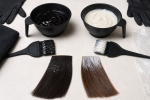
Select representative strands from more than one zone when the history or appearance differs. Follow the candidate product’s full ratio, timing, application, and rinse directions on the test area. Observe lift or deposit direction, uneven response, warmth, elasticity, roughness, breakage, and whether the target remains realistic.
A successful hidden strand does not guarantee the same result across the head. A failed or ambiguous strand is evidence to stop, revise the target, or consult a professional; it is not a reason to increase strength immediately.
Keep preliminary testing separate from strand testing
The FDA hair-dye safety page directs consumers to follow labels, complete the preliminary test every time, wear gloves, use the stated timing, rinse thoroughly, and avoid coloring an irritated or damaged scalp. It also notes that a reaction can occur even when the preliminary test does not show one.
A preliminary test addresses reaction precautions within labeled use. A strand test addresses color and fiber response on a limited section. One cannot replace the other.
Control banding instead of covering it blindly
Banding occurs when roots, mids, and ends have different histories or pigment loads. Map where each band begins and ends. A whole-head formula can make the darkest zone darker, the lightest zone more porous, or the warmest zone more visible.
Targeted correction often requires professional formulation, precise placement, and different processing decisions by zone. Do not use a single online swatch to calculate that work.
Protect roots and avoid unnecessary overlap
New growth can respond differently because it has less artificial pigment and sits near scalp warmth. Previously lightened lengths may not tolerate the same process. Keep formulas within their intended zone and avoid dragging lightener or permanent color through fragile ends unless the exact plan and product directions support it.
The shade and developer guide connects starting level, target, developer, ratio, and strand evidence. It does not provide a universal correction formula.
Know when deposit is the safer cosmetic direction
When the hair has reached its damage limit, a darker, softer, or more neutral deposit target may be more realistic than additional lift. That does not mean every direct dye, demi-permanent color, or gloss is suitable. Verify formula compatibility, expected fade, porosity behavior, and future removal consequences.
Do not promise that a darker deposit will look perfectly even or restore fiber condition. It changes appearance; it does not reverse structural damage.
Set damage limits before starting
Write down stop conditions: unusual heat, intense or persistent burning, scalp pain, swelling, unexpected smoke or expansion, excessive stretch, mushy wet texture, rapid breakage, or a test strand that cannot tolerate the process. Follow package response directions and seek qualified help where appropriate.
Do not extend timing, increase developer, add heat, stack products, or repeat the service immediately to chase a target. The next safe decision may be to pause and maintain rather than continue correcting.
Use salon boundaries for complex corrections
Choose a qualified colorist when the service involves unknown box color, repeated black or vivid dye, henna or possible metallic salts, multiple light and dark bands, severe porosity differences, prior relaxer or perm, scalp concerns, or a major lightening goal. A consultation should include history, examination, test strands, target options, limits, time, and maintenance.
The salon consultation guide lists questions for service scope, records, product expectations, scheduling, and escalation. A booking is not proof that a requested result is achievable.
Plan correction across more than one appointment
A staged plan may use the first appointment to remove limited artificial pigment, even selected zones, or establish a wearable interim tone. Later decisions should depend on the new condition and fresh strand evidence, not a fixed calendar promise.
Photograph each stage in consistent lighting and record formulas, ratios, timing, zones, and response. This prevents the next service from being planned against an incomplete memory.
Maintain the result without restarting the problem
Use the compatible cleansing, conditioning, heat, and color-refresh directions for the final formula. Watch how porous zones fade compared with healthier roots. Refresh only the area and pigment type that need it; repeated whole-head overlap can recreate darkness or unevenness.
Adjust expectations when the correction reveals warmth or fades unevenly. Maintenance is part of the plan, not evidence that the first service failed.
Hair color correction checklist
- The unwanted result and realistic endpoint are described by zone.
- Every known color, lightener, remover, relaxer, perm, and heat service is recorded.
- Scalp condition, elasticity, breakage, porosity differences, and fragile areas are reviewed.
- The smallest compatible correction is selected before stronger options.
- Preliminary testing and representative test strands are completed for their separate purposes.
- Roots, bands, mids, and ends have explicit placement and overlap boundaries.
- Stop conditions are written before products are mixed.
- Unknown history, major banding, significant weakness, or repeated lift triggers a salon consultation.
- Records and consistent photos are preserved for the next decision.
Hair color correction is complete only when the result is wearable, the hair and scalp remain within the chosen limits, and the next maintenance step is clear. If those conditions cannot be established from current evidence, pause rather than adding another uncontrolled process.