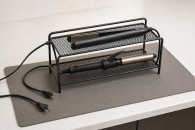
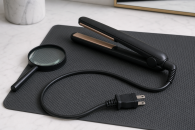
Flat Iron for Natural Hair: Heat and Plate Guide

A useful flat iron for natural hair has adjustable temperature control, plates that meet evenly, a size that fits your sections, and controls you can operate without repeatedly heating the same hair. No flat iron is damage-proof. Technique, hair condition, dryness, section size, heat level, frequency, and any product used with heat matter as much as the device.
Quick answer: what should you compare?
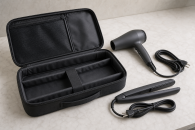
Prioritize a visible temperature dial or digital control instead of a single maximum-heat switch. Narrow plates can offer control around short hair and roots; wider plates can cover longer, dense sections more quickly. Rounded edges may make bends or curls easier, while straight edges suit a simple smoothing pass. The plates should close without a large gap or snagging point, and the cord, shutoff feature, weight, and handle should fit how you style.
| Feature | Why it matters | Practical check |
|---|---|---|
| Adjustable heat | Lets you use only the heat needed | Controls are readable and do not change accidentally |
| Plate width | Affects section size and root access | Narrow for precision; wider for long, dense lengths |
| Plate alignment | Uneven contact can encourage repeated passes | Plates meet consistently without obvious gaps |
| Edge shape | Changes how easily the tool creates bends | Rounded for versatility; straighter for direct smoothing |
| Handling | Heavy or awkward tools reduce control | Comfortable grip, swivel cord, and stable controls |
What heat setting is appropriate for natural hair?
There is no universal temperature for all natural hair. The American Academy of Dermatology advises using flat irons on dry hair at a low or medium setting and limiting frequency because excessive heat can damage any hair type. Its hair styling without damage guidance recommends no more often than every other day for flat irons generally.
AAD guidance for Black hair is more conservative: use a ceramic comb or iron, choose the lowest temperature that produces the intended style, and thermally straighten no more than once a week. Read the complete Black hair care tips. These are risk-reduction principles, not a promise that a certain setting or schedule will prevent damage.
Prepare the hair before the iron
- Begin with clean, conditioned hair and remove tangles gently.
- Allow the hair to dry fully before using the flat iron.
- Follow the label for any heat-protecting or styling product you use.
- Divide the hair into manageable sections so each pass is controlled.
- Start at a lower setting and raise it only when the style cannot be achieved with a deliberate pass.
Natural hair includes loose waves, curls, coils, chemically untreated hair, and many combinations of density and strand width. A setting that works for one section or person may be excessive for another. Curly and coily hair can also be more prone to dryness and breakage; the AAD’s curly hair care guidance emphasizes moisture, gentle detangling, and reduced breakage.
Section size and pass count matter
Sections that are too thick may heat unevenly and encourage multiple passes. Extremely thin sections can make the routine unnecessarily long. Choose a section that fits inside the plate and can move through without snagging. Keep the iron moving at a controlled pace instead of clamping one spot for a prolonged period.
One deliberate pass at the lowest effective setting is a more useful goal than chasing a perfectly straight result with repeated high-heat passes. Stop if hair smells scorched, feels unusually rough, breaks, or the tool pulls. Let the hair cool before deciding whether another pass is necessary.
Plate material does not make a tool damage-proof
“Ceramic,” “titanium,” “tourmaline,” and “ionic” are common marketing terms, but they do not by themselves establish safe use or a guaranteed result. Plate coating, construction, heat consistency, sectioning, and user technique all contribute. Compare the complete device, warranty, instructions, temperature range, and return policy rather than choosing from one material word.
For finer or more fragile hair, see our flat iron guide for fine hair. Its lower-heat and limited-pass principles are also useful when a section of natural hair is already fragile.
Flat ironing is different from chemical smoothing
A flat iron used by itself is not the same as a salon smoothing treatment. If a straightening or smoothing solution is applied before heat, evaluate that product separately. The FDA warns that some hair-smoothing products can contain or release formaldehyde-related ingredients when heated. Read the ingredient list and warnings and ask a salon professional about the product and ventilation. The FDA’s hair smoothing and formaldehyde guidance explains this specific risk.
Do not assume a flat iron, “keratin” service, or smoothing formula is interchangeable with another. If a retail smoothing product lacks an ingredient list, the FDA recommends not purchasing it.
How often should you flat iron?
Use the lowest frequency that meets your styling goal. Repeated heat can accumulate damage even when the hair looks smooth immediately afterward. Stretching the style with wrapping, loose protective methods, or reduced manipulation may help avoid another full pass, but avoid tight styles that pull at the hairline.
A mousse can support a different low-tension style between heat sessions. See our mousse guide for curly hair for hold and definition choices, not as a substitute for a heat-protectant label.
When should you stop and reassess?
Pause heat styling when the hair is breaking, unusually dry, thinning, or the scalp is painful or inflamed. Do not flat iron wet hair unless a device is explicitly designed and labeled for that use, and still follow its instructions. Persistent breakage, scalp symptoms, or hair loss should be assessed by a qualified professional rather than addressed by increasing heat or adding another styling product.
For non-iron drying options, our professional hair dryer guide covers heat and attachment choices.
Bottom line
Choose a flat iron for natural hair by temperature control, plate fit, alignment, handling, and clear instructions. Use it only on dry, prepared hair, work in controlled sections, select the lowest effective heat, limit frequency, and distinguish ordinary flat ironing from chemical smoothing products used with heat.