How to Choose and Use Hair Color Wheels at Home

Direct answer: choose a clear hair color wheel that places yellow opposite violet, orange opposite blue, and red opposite green. Use it only after estimating hair depth and identifying the visible unwanted or desired tone in neutral light. The opposite color indicates a neutralizing direction, while neighboring colors help describe warmth and tonal movement. The wheel does not specify how much pigment to use, which product to buy, whether hair must be lightened, or how a particular formula will process.
Color wheels simplify relationships between hues. Hair is more complex because depth, artificial color, exposed underlying pigment, porosity, gray, product concentration, and processing all affect what becomes visible.
Choose an accurate wheel layout
The wheel should show primary, secondary, and useful intermediate hues in continuous order. Check the three core complementary pairs: yellow and violet, orange and blue, red and green.
A rotating two-layer design can help isolate a selected hue and its complement. A fixed wheel is sufficient when the segments are large and clearly separated. Avoid decorative wheels with irregular spacing or missing blue-green, blue-violet, red-orange, and yellow-orange transitions.
Printed color varies with ink and lighting, so the geometry is more important than exact saturation. The wheel should remain legible without relying on brand-specific shade names.
Separate depth from tone first
Depth describes how light or dark hair appears. Tone describes the visible color direction within that depth. A warm level six and a cool level six share depth while reflecting differently.
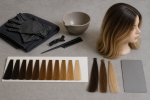
Estimate roots, mid-lengths, and ends separately with a level chart before using the wheel. A very dark section can contain red warmth that is less visually obvious than orange on a lighter section.
The shade-chart guide helps distinguish manufacturer level and tone codes from general color-wheel relationships.
Identify the visible tone in neutral light
View dry hair in indirect daylight or a neutral light source against a gray or white background. Warm bulbs can make neutral hair look golden or orange. Cool light can suppress warmth.
Describe what is actually visible: pale yellow, yellow-orange, orange, red-orange, red, violet, blue, green, or a muted mixture. Do not select a complement based only on the desired final shade.
Examine several strands because porous ends, bands, highlights, and roots can show different tones. One correction direction may not fit every zone.
Read complementary pairs correctly
Violet sits opposite yellow, so violet direction can reduce visible yellow. Blue sits opposite orange, and green sits opposite red. Intermediate tones call for blended directional thinking: blue-violet relates to yellow-orange, for example.
Neutralization means reducing the visual dominance of a tone. It does not automatically create gray, ash, beige, or brown. The final appearance depends on remaining depth and the full pigment balance.
Adding too much complementary pigment can create dull, muddy, khaki, greenish, bluish, or violet results. The wheel shows direction, not dose.
Understand exposed pigment during lightening
As darker hair lightens, underlying red, red-orange, orange, yellow-orange, and yellow become visible at different stages. The exact path varies with natural pigment, previous color, product, saturation, and condition.
A wheel can name the observed warmth, but it cannot determine whether the hair has reached the depth required for the target. Trying to neutralize strong orange at a depth that is too dark for a pale target can produce a muted dark result rather than blonde.
The American Academy of Dermatology notes that lightening more than three shades generally requires stronger peroxide and can cause more damage. Major changes deserve professional planning.
Use the wheel for desired tone too
The wheel is not only for cancellation. Neighboring warm hues help define gold, copper, and red directions. Neighboring cool hues help distinguish violet, blue-violet, and blue influence.
For a golden brown target, identify whether the desired warmth is yellow-gold or has moved into orange-caramel. For auburn, decide how much red and orange should remain. Use the wheel as vocabulary, not a mixing recipe.
The red hair color ideas guide provides practical examples of warm tonal families and placement.
Account for artificial color history
Previous permanent dye, direct dye, toner, henna, metallic salts, and color remover can leave pigments that do not behave like natural underlying warmth. A visible green or blue cast may result from accumulated direct pigment, not a simple opposite-tone problem.
Color generally does not lift old dark artificial color to a clean lighter result. The wheel cannot diagnose bands or establish compatibility between product systems.
Record history and use professional assessment for unknown color, black dye buildup, uneven bands, or fragile hair.
Translate direction into a product-system decision
After identifying depth and tone, read the chosen manufacturer’s shade system and instructions. Ash, pearl, beige, matte, neutral, and natural labels do not contain identical pigments across brands.
Use only the directed developer, ratio, timing, and application sequence. Do not mix a blue or violet household product into hair color based on the wheel.
The hair color application guide connects tone direction with product choice, strand testing, timing, and safety boundaries.
Use a strand test to verify the plan
Complete every label-required allergy alert or skin test before each use, then test a hidden representative strand using the exact formula, ratio, saturation, and timing.
Evaluate the strand dry in neutral light. Ask whether the unwanted tone decreased, the target depth remained correct, and porous areas absorbed too much cool pigment.
If the result is still warm, do not exceed timing or add more complement blindly. Reassess depth, pigment concentration, and starting history.
Keep the wheel clean and color-accurate
Store the wheel away from direct sun, heat, steam, active color, sprays, and wet tools. Fading or staining changes its usefulness. Keep rotating layers aligned and free of product residue.
Clean only as the manufacturer directs. Solvent and water can damage printing or warp layers. Replace a wheel with faded segments, missing colors, loose fasteners, stains, or unclear opposites.
Safety boundaries
The U.S. Food and Drug Administration advises following all hair-dye directions, completing the directed skin test before every use, wearing gloves, keeping dye away from the eyes, observing processing time, and rinsing the scalp well. Color theory does not replace label directions.
Do not use scalp hair dye on eyebrows or eyelashes. Do not proceed on an irritated, scratched, sunburned, or damaged scalp. A correct complementary pair cannot prevent reaction or damage.
Common color-wheel mistakes
- Choosing a complement before identifying depth.
- Judging tone under warm bathroom light.
- Using one tone direction for banded hair.
- Assuming opposite colors specify equal mixing amounts.
- Neutralizing intentional gold or copper completely.
- Ignoring old direct dye or permanent color.
- Transferring tone names across brands.
- Skipping the strand test.
Final color-wheel checklist
- Verify accurate hue order and complementary pairs.
- Estimate depth before tone.
- Observe dry roots, mids, and ends in neutral light.
- Name the visible unwanted or desired hue.
- Use the opposite color only as directional guidance.
- Translate direction through one product system’s instructions.
- Verify with a representative strand test.
- Keep the wheel clean, aligned, unfaded, and dry.
Sources and scope
The FDA hair dyes guidance supports the label, skin-test, glove, timing, eye-area, scalp-condition, and adverse-reaction boundaries in this guide. The American Academy of Dermatology coloring guidance supports conservative shade changes and damage-reduction limits. Neither source prescribes a color wheel, neutralization formula, pigment quantity, toner, developer, brand, or outcome.