Ash Hair Color Additives: Formula, Directions, and Compatibility Guide

Direct answer: use an ash hair color additive only after identifying the exact unwanted undertone and confirming that the product belongs to the same color line. “Ash” can describe a cool shade family, a concentrated blue- or green-leaning modifier, or another line-specific formula. It is not one universal anti-brass ingredient. Check the exposed yellow, orange, red-orange, or red tone; the hair level and porosity; the additive’s pigment direction; its approved amount; and how it affects the color-to-activator calculation. Complete every directed skin test and evaluate a precisely measured strand test after it is fully dry.
An ash additive can shift a compatible formula cooler, but it cannot remove artificial color, lighten a dark base, repair damage, or make an uneven canvas uniform. Excess cool pigment can create a dull, smoky, greenish, bluish, violet, or overly dark result, especially on porous or very light hair.
Define ash within the exact product line
Read the product identity, shade code, directions, and technical chart. Determine whether the item is an ash shade, a concentrated mix tone, a booster, a corrective additive, or a ready-to-use direct pigment. Identify the stated color family rather than relying on the gray appearance of the cream or packaging.
Some ash families lean blue, some green, some blue-violet, and some combine balanced cool pigments. The same letter or number can mean different things across brands. A formula written for one line cannot be transferred to another simply because both products use the word ash.
The direct hair color formula guide helps distinguish ready-to-use pigment from oxidative systems. Resolve that class before choosing an activator, ratio, or mixing sequence.
Name the unwanted undertone precisely
View clean, dry hair in neutral light. Separate yellow from yellow-orange, orange, red-orange, and red. Also note whether the warmth is natural underlying pigment, faded artificial color, mineral or product buildup, uneven lightening, or several zones with different histories.
A simplified color wheel can help frame the question: violet relates to yellow, blue relates to orange, and green relates to red. This relationship is not a recipe. The product’s actual pigments, concentration, hair level, base shade, porosity, and approved use determine whether an ash additive fits the situation.
Using a blue-heavy ash on pale yellow hair can push the result away from the intended beige or neutral direction. Using a weak violet-leaning product on strong orange may leave the main warmth visible. Diagnose the canvas before selecting the label.
Match level, shade family, and service goal
Record the natural level, current artificial level, target level, gray percentage, highlights, banding, and porous areas. An ash additive used at a deep brunette level may have a different role from a cool modifier used on pale blonde hair. Follow the manufacturer’s level restrictions and shade-family chart.
Decide whether the goal is neutralization, a deliberately smoky reflect, moderation of a warm shade, or maintenance of a previous cool result. Those tasks can require different products and amounts. The purple hair dye shade and base guide shows how base depth, formula class, saturation, and fading influence a cool pigment decision.
Ash color is not automatically appropriate for gray hair. White and resistant gray strands may show cool reflect differently from pigmented hair. If the line requires a natural or neutral series for gray blending or coverage, do not replace that background formula with concentrated ash unless the technical chart supports it.
Keep every component compatible
Match the additive to the manufacturer, line, formula class, base shade, and named activator. Do not add direct blue dye to permanent color, mix an oxidative corrector into conditioner, or substitute an ash shade from another range. Similar visible colors do not establish ingredient, pH, activation, or ratio compatibility.
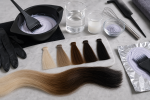
Do not infer a recipe from the editorial image. Powder, water, clear liquid, conditioner, developer, masks, or household pigments are outside the formula unless the exact product directions name them. An ash appearance in a bowl does not prove what pigments or components are present.
Check whether the additive may be used alone, only combined with a base shade, or only within a stated maximum. Confirm whether it is permitted in permanent, demi-permanent, direct, or gloss services and whether heat is prohibited or specifically directed.
Calculate the formula in reproducible units
Write the base shade, ash additive, any approved neutral or clear component, and activator as separate entries. Use the measurement method specified by the manufacturer: weight, volume, approved drops, or another defined unit. Do not switch casually between grams, milliliters, and visual lengths of color.
Determine whether the ash additive counts toward the total color portion used to calculate activator. If the line directs the user to combine base shade plus additive before applying the stated ratio, calculate from that total. If the chart provides a fixed maximum or a different method, follow it. There is no universal ash-to-color ratio.
Concentrated pigments make small errors visible. “Add a little ash” is not a reproducible formula. Record exact amounts before application, mix in the required order, and do not add water or extra developer to change consistency.
Account for porosity and previous color
Compare roots, midlengths, highlights, ends, and fragile perimeter sections. Porous, prelightened, or weathered hair can accept cool pigment rapidly and may look darker or smokier than stronger areas. Old color can also block or redirect the intended effect.
An ash additive cannot correct banding by itself. A natural root, warm midlength, and pale porous end are three different canvases. One full-head formula may leave warmth in one zone and overcool another. Use separate representative strand tests when the histories materially differ.
If the hair stretches excessively when wet, breaks with gentle handling, feels gummy, or has an uncertain chemical history, pause. A color correction should not be improvised on a compromised canvas.
Complete skin and strand testing
Follow every preliminary skin-test instruction supplied with the hair dye. The U.S. Food and Drug Administration’s hair-dye guidance advises consumers to follow package directions, wear gloves, observe timing, rinse thoroughly, avoid use on an irritated or damaged scalp, and complete the directed preliminary test before each use. Adding a small amount of ash does not remove those precautions.
A strand test evaluates the complete formula. Choose a hidden section that represents the unwanted undertone, level, previous color, gray, and porosity. Measure the test formula accurately, saturate evenly, process for the directed interval, rinse as directed, and dry it fully before judging.
Review warmth, coolness, depth, opacity, evenness, hair feel, and contrast with adjacent sections. If the strand appears dull, greenish, violet, blue, too dark, patchy, or still materially warm, do not guess at a larger batch. Recheck the pigment direction, amount, base shade, level, and canvas.
Apply the tested formula methodically
Prepare gloves, accurate measuring tools, a nonmetallic bowl or applicator when directed, clips, timer, protective covering, and enough product for complete saturation. Follow the specified mixing order so the concentrated additive is distributed evenly.
Apply to clean, dry or towel-dried hair according to the instructions. Use thin subsections and the sequence supported by the strand tests. Resistant roots and porous ends may not need the same exposure, but do not invent separate timings or formulas without product support.
Start timing at the point named by the manufacturer. Do not extend processing, increase developer strength, or add heat to force neutralization. Keep scalp hair dye away from eyelashes and eyebrows. The red hair color placement guide helps readers distinguish a deliberate warm design from warmth that a cool formula is meant to moderate.
Recognize stop conditions
Stop before mixing if the ash product is not approved for the line; its pigment direction, maximum amount, level range, or activator method is unknown; labels are missing; prior chemistry is uncertain; the scalp is irritated, scratched, sunburned, or damaged; or the hair is breaking or gummy.
During use, stop and rinse as directed if there is intense burning, swelling, blistering, breathing difficulty, spreading rash, eye exposure, or another concerning reaction. Seek appropriate medical help for a serious reaction. The American Academy of Dermatology’s hair coloring and chemical-service guidance supports manufacturer testing and conservative changes rather than stacking stressful services.
Rinse, assess, and document
Rinse with the method and water temperature specified for the system, keeping runoff away from the eyes. Use only the directed cleanser, conditioner, or finishing step. Judge the result when the hair is fully dry in consistent light; wet hair can appear deeper and cooler.
Record the line, base shade, ash additive, exact amounts, activator, ratio, starting undertone, porosity zones, timing, application sequence, and dry result. Track whether porous areas lose cool pigment differently through washing. Do not save mixed oxidative color for later use.
Ash additive checklist
- The exact ash product and its blue, green, violet, or combined direction are known.
- The unwanted undertone is identified by zone in neutral light.
- The level, base shade, formula class, maximum amount, and activator method match the directions.
- No powder, water, conditioner, household pigment, or unrelated corrector is inferred from appearance.
- Gray distribution, previous color, banding, and porosity are mapped.
- Directed skin testing and fully dried representative strand tests are complete.
- The plan includes accurate measurement, saturation, timing, rinsing, and stop rules.
A useful ash formula begins with the actual undertone and exact product directions. When pigment direction, compatibility, amount, canvas, or strand evidence is uncertain, delay the service rather than adding more cool pigment.