Violet Hair Color Correctors: Formula, Directions, and Compatibility Guide

Direct answer: use a violet hair color corrector only when the unwanted undertone is yellow or yellow-leaning and the exact product is approved for the chosen color line. Violet is not a universal answer for orange, red-orange, red, dark artificial color, or uneven lightening. Confirm whether the corrector is a direct pigment, oxidative additive, toner, violet shade, or maintenance product; identify its permitted level range, maximum amount, activator method, and timing; then complete directed skin testing and a fully dried strand test.
Violet and yellow sit opposite each other in a simplified color-wheel model, but that relationship does not provide a recipe. Pigment concentration, formula chemistry, base depth, existing artificial color, porosity, gray distribution, and exposure determine the visible result. Too much violet can create a lilac, gray, dull, dark, or uneven cast.
Confirm that the exposed tone is actually yellow
View clean, dry hair in neutral light. Separate pale yellow, strong yellow, yellow-orange, orange, red-orange, and red. Check roots, midlengths, highlights, ends, and the hairline independently. A section can contain more than one undertone because lightening history and porosity differ.
Violet is most directly related to yellow. Strong orange generally points to a different corrective direction, while red requires another assessment. If the base is too dark for the yellow to be visually dominant, adding violet may create little useful change or may muddy the formula.
Do not confuse product buildup, mineral discoloration, faded direct dye, or old oxidative color with exposed underlying pigment. A violet corrector cannot remove those materials. Clarify the history before deciding that more pigment is the answer.
Identify the violet product class
Read the product identity, component list, directions, and technical chart. Determine whether it is a concentrated mix tone, a violet shade, a direct-dye diluter system, an oxidative toner, a ready-to-use mask or shampoo, or another product. Similar purple appearance does not establish the same chemistry or use.
The direct hair color formula guide helps distinguish ready-to-use pigment from oxidative color that requires an activator. Do not add a direct violet dye to permanent color, use a shampoo as a formula additive, or combine products from unrelated lines unless the exact directions permit it.
A violet maintenance product can deposit a small amount during washing or conditioning, but it does not provide the same controlled formula as an approved salon-style toner or additive. Follow its own frequency and contact-time directions rather than leaving it on longer to force a result.
Match level and starting canvas
Record the natural level, current artificial level, degree of lightening, gray percentage, highlights, and porosity zones. Pale blonde, gray, white, beige, yellow-blonde, and yellow-orange hair can show the same violet formula differently. A visible purple product does not imply that every light base needs the same amount.
Very pale and porous sections can accept violet rapidly and may look lavender or gray before stronger areas change. Deeper or warmer sections may retain yellow or orange. One full-head formula can therefore overcool the ends while leaving the midlengths warm.
The purple hair dye shade and base guide explains how starting depth, pigment load, saturation, and fade affect a purple result. The same canvas variables matter when violet is used for correction rather than as a fashion color.
Keep the formula inside one compatible system
Match the corrector to the manufacturer, line, formula class, base shade, and named activator. Check whether it can be used alone or only added to a compatible shade or clear base. Observe any level restrictions, maximum quantity, gray guidance, or prohibited combinations.
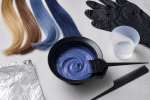
Do not infer a recipe from the editorial image. Water, clear liquid, conditioner, masks, developer, powder, or household violet pigment are outside the formula unless the exact directions name them. A transparent measuring cup does not mean water belongs in the mixture.
Do not substitute a permanent-color developer for a dedicated toner activator. Do not increase developer strength to remove yellow; developer changes the oxidative system and is not a neutral diluent.
Calculate the corrector precisely
Write each component and unit: base shade or toner, violet corrector, approved clear if used, and activator. Use weight, volume, approved drops, or the measurement method named by the manufacturer. Do not mix units casually or estimate by the color visible in the bowl.
Determine whether the violet corrector counts toward the color portion used to calculate activator. If the directions include base plus corrector in the total, calculate from that amount at the stated ratio. If the chart gives a fixed maximum or a separate method, follow it. No universal number of drops works across brands, levels, or canvases.
Record the formula before application. A measured strand result can then be reproduced or adjusted. “A little purple” is not enough information to diagnose an overtoned or undertoned result.
Use representative strand tests
Follow every preliminary skin-test instruction supplied with the hair dye. The U.S. Food and Drug Administration’s hair-dye guidance advises consumers to follow package directions, wear gloves, observe timing, rinse thoroughly, avoid use on an irritated or damaged scalp, and complete the directed preliminary test before each use.
A strand test answers the formula question. Choose hidden strands representing pale porous ends, warmer midlengths, natural or gray roots, and other materially different zones. Measure the proposed mixture accurately, apply the planned saturation, process for the directed interval, rinse as instructed, and dry the strands completely.
Judge remaining yellow, violet cast, depth, brightness, gray appearance, evenness, and hair feel in neutral light. Wet hair can look darker and cooler. If one zone becomes lilac or gray while another remains warm, a single formula or timing plan is not supported.
Plan application and timing by zone
Prepare gloves, accurate measuring tools, a nonmetallic bowl or applicator when directed, clips, timer, protective covering, and enough formula for complete saturation. Follow the specified mixing order so concentrated violet is distributed evenly.
Apply to clean, dry or towel-dried hair as directed. Use thin subsections and the sequence supported by the strand tests. Porous ends may need different exposure from stronger roots only when the product directions allow the plan. Do not repeatedly overlap fragile lightened hair.
Start timing at the point stated by the manufacturer. Do not extend contact time, add heat, or increase the corrector amount to force neutralization. Keep scalp hair dye away from eyelashes and eyebrows.
Distinguish correction from purple color
A correction aims to moderate visible yellow while preserving the chosen depth and design. A purple fashion shade intentionally makes violet visible. The dark purple hair dye guide helps compare base depth, formula, saturation, and fade when purple itself is the goal.
If the intended result is beige, silver, pearl, neutral blonde, or another nuanced finish, the formula may require more than adding violet. Background level, missing warmth, gray content, and the line’s shade design all matter. Do not use concentrated violet to substitute for a complete shade plan.
Know when to stop
Stop before mixing if the violet product is not approved for the line; its formula class, level range, maximum amount, activator, or timing is unknown; the yellow diagnosis is uncertain; labels are missing; prior chemistry is unclear; the scalp is irritated or damaged; or the hair is gummy or breaking.
During use, stop and rinse as the label directs if there is intense burning, swelling, blistering, breathing difficulty, spreading rash, eye exposure, or another concerning reaction. Seek appropriate medical help for a serious reaction. The American Academy of Dermatology’s hair coloring and chemical-service guidance supports manufacturer testing and conservative changes rather than stacking stressful services.
Rinse, assess, and track fading
Rinse with the method and water temperature specified for the formula, keeping runoff away from the eyes. Use only the directed cleanser, conditioner, or finishing step. Judge the result after the hair is fully dry in consistent light.
Record the product line, base formula, violet amount, activator, starting undertone by zone, timing, application order, and dry result. Track whether porous areas lose violet faster or retain a visible cast. Do not save mixed oxidative color for later use.
Violet corrector checklist
- The exposed undertone is yellow or yellow-leaning, not merely described as brassy.
- The product class, compatible line, level range, maximum amount, activator, and timing are known.
- Roots, midlengths, highlights, gray, and porous ends are mapped separately.
- No water, conditioner, shampoo, mask, powder, or unrelated purple pigment is added unless directed.
- Directed skin testing and fully dried representative strand tests are complete.
- The formula is measured and the application sequence follows zone evidence.
- Overviolet, gray, dull, uneven, damaged-hair, scalp, and reaction stop conditions are defined.
A useful violet correction begins with a visible yellow target and an exact compatible formula. When the undertone, product class, amount, canvas, or strand evidence is unclear, delay the service instead of adding more purple.