Cassia Powder for Hair: Formula, Directions, and Compatibility Guide

Direct answer: before using cassia powder on hair, verify the complete botanical and ingredient list, then follow that product’s mixing liquid, rest period, application time, and compatibility directions. Cassia is not colorless henna and is not automatically the same plant across every package. On pale, white, or gray hair, some cassia formulas may add a translucent pale-gold cast; on medium or dark hair, visible color change may be minimal. Cassia does not lighten natural or artificial pigment.
A product called neutral henna, colorless henna, herbal gloss, or cassia blend may contain cassia, another botanical, henna, colorants, fragrance, salts, or conditioning ingredients. The marketing name cannot replace the ingredient list.
Confirm the exact botanical identity
Read the botanical name and every additive. Cassia products may identify a species such as Senna italica or another accepted cassia/senna naming convention, while similar-looking powders may use different plants. Do not infer identity from pale green color, scent, fineness, or a seller’s claim.
If the package lacks a complete ingredient list, conflicts with the seller description, or was transferred into an unmarked bag, stop. Keep the original package or a complete image of the ingredients and directions.
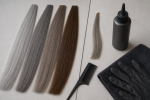
The pale yellow-green powder and green-brown paste in the editorial image show a mixing context only. They do not identify a brand, prescribe a ratio, or prove what is in a loose powder.
Separate cassia from henna and indigo
Pure henna contributes a transparent orange-to-copper-red direction. Indigo contributes a cool blue direction and is often paired with a warm botanical base for darker results. Cassia should not be substituted for either merely because all three can be sold as plant powders.
A cassia blend that contains henna can add warmer color than a single-ingredient cassia formula. A blend containing indigo can create a cooler result. Read the full list rather than relying on “neutral,” “gold,” “blonde,” or “conditioning” in the product name.
The direct hair color guide describes ready-made pigment deposit, which is a separate formula class. Do not add direct yellow, gold, orange, or another dye to cassia paste to force a botanical powder toward a swatch.
The warm hair color guide helps distinguish gold, copper, orange, auburn, and red. Cassia’s possible pale-gold effect should not be described as a copper-red henna result.
Set a realistic color goal from the starting canvas
Map natural level, gray percentage, white strands, highlights, permanent and demi-permanent color, direct dye, lightener, prior henna, indigo, cassia, other plant color, metallic or compound color if known, porosity, and fragile zones.
On white or very pale blonde hair, a subtle warm cast may be visible. On darker blonde or light brown hair, the result may be difficult to separate from existing warmth. On medium brown through black hair, cassia should not be selected to create visible lightening.
Use a level-and-tone reference such as the hair color chart guide to document the base, but do not use a conventional chart to predict a botanical overlay.
Follow the exact mixing-liquid directions
Use only the liquid, temperature, and amount range specified by the package. Some products call for water; others provide a different line-specific method. Do not assume lemon juice, vinegar, tea, coffee, oil, conditioner, yogurt, peroxide, developer, or another household ingredient improves every cassia formula.
Highly acidic or heavily supplemented mixtures can change handling, scalp comfort, deposit, and the usefulness of the strand test. Begin with the simplest directed formula.
Use a clean bowl and compatible nonmetallic tool when directed. Add liquid gradually to reach the stated paste consistency. The image’s bowl and water are not a ratio guide.
Respect rest, storage, and use windows
Follow the product’s stated mix-to-application sequence. Some powders may call for a covered rest; others may be used after mixing. Do not borrow a henna dye-release schedule or an indigo fresh-use window.
Record powder amount, liquid, temperature, mix time, rest start, rest end, application start, and rinse time. Discard a mixture with contamination, mold, unexpected odor, or unknown storage history.
Do not refrigerate, freeze, save, or reactivate paste unless the exact directions explain how and for how long.
Complete preliminary and strand tests
Follow every package-directed patch, allergy, sensitivity, and preliminary test. The U.S. Food and Drug Administration’s hair-dye guidance advises following directions, wearing gloves, observing timing, rinsing thoroughly, avoiding use on a damaged scalp, and completing directed preliminary testing.
Test hidden strands from white or gray hair, natural pigmented hair, highlighted sections, artificial color, previous plant color, and porous ends. Use the exact powder batch, liquid, rest method, saturation, enclosure, and time planned for the full application.
Rinse and dry fully, then evaluate at the interval named by the label. Check pale-gold deposit, unexpected copper or green, uneven pickup, roughness, tangling, and breakage. A damp strand or wet paste is not the final color decision.
Test repeated-use buildup
Even a subtle formula can build differently on pale, porous, or repeatedly coated lengths. If maintenance involves more than one application, repeat the strand test at the intended spacing and document the dry result after each stage.
Stop when the lightest acceptable result is reached. Do not reapply the full length automatically because the roots are new or because a conditioning effect seems reduced.
Apply with controlled sections
Prepare gloves, clips, protective covering, bowl, nonmetallic tool, tint brush or directed applicator, timer, and rinse pathway before mixing. Plant paste can stain fabrics and porous surfaces even when the hair result is subtle.
Use consistent subsections and directed saturation. Do not rub gritty paste harshly into the scalp, allow it to enter the eyes, or leave it on an irritated, abraded, sunburned, or otherwise damaged scalp.
Follow the stated enclosure and maximum time. Do not add heat, extend processing, or let paste dry hard on the scalp unless the exact directions allow that method.
Do not use cassia as an unverified conditioner
A “conditioning” or “strengthening” description does not establish that cassia repairs structural damage, prevents breakage, suits every texture, or can replace cleansing and conditioning care. Hair may feel coated, rough, tangled, or different after a powder application.
Assess slip, flexibility, tangling, dryness, residue, and breakage on the strand test. If the result is undesirable, do not compensate by adding oil, conditioner, protein, or another plant powder to the full batch without exact compatibility directions.
Preserve history before later chemical services
Keep the ingredient list, directions, date, batch, liquid, additives, and application zones. Disclose every cassia, henna, indigo, compound plant color, and unknown powder before permanent color, lightener, a perm, relaxer, or smoothing service.
Do not assume a product is chemically irrelevant because it created little visible color. Unknown additives or a mislabeled blend can matter during a later service. Use representative compatibility strands before applying new chemistry.
Unexpected heat, smoke, odor, discoloration, gummy texture, severe tangling, or breakage is an immediate stop signal. The American Academy of Dermatology’s coloring and perming guidance supports manufacturer testing and conservative spacing around chemical changes.
Rinse and document
At the directed time, loosen and rinse the paste with the stated water temperature and finishing method. Keep runoff out of the eyes and avoid pulling dried material through tangled hair.
After complete drying, record any gold cast, root-to-length difference, residue, roughness, tangling, and breakage. Separate a color decision from a temporary wet-hair appearance.
Cassia powder checklist
- The exact botanical and every additive are documented.
- Cassia, henna, indigo, and compound plant powders are not treated as interchangeable.
- White, gray, blonde, brown, artificial color, highlights, porous ends, and plant-color history are mapped.
- The mixing liquid, rest, storage, enclosure, and time follow the exact directions.
- No universal lightening, copper-red color, repair, or conditioning claim is assumed.
- Directed preliminary testing and fully dried repeated-use strand tests are complete.
- Root maintenance and full-length buildup are planned separately.
- The product history is preserved before later color, lightener, perm, relaxer, or smoothing services.
- Reaction, contamination, unexpected color, residue, roughness, tangling, and breakage have stop rules.
Cassia powder is most predictable when its botanical identity, subtle color limits, mixing method, and buildup are documented. If the ingredient list or strand evidence is uncertain, do not use the full head to discover what the powder contains.