Henna vs Oxidative Hair Color: Ingredients, Commitment, and History

Direct answer: choose a verified henna product when warm red-orange deposit without lightening fits the starting base and the long-term plant-color history is acceptable. Choose oxidative hair color when a manufacturer-defined shade, activator, and process fit a controlled deposit or lift task. These systems are not interchangeable: they use different ingredients, preparation, color mechanisms, removal assumptions, and future-service records.
Do not choose from the word “natural,” a package swatch, or the idea that one category is automatically gentle. Confirm the exact ingredient list, directions, starting base, test results, buildup, and later color plans.
Verify what the product actually contains
Pure henna color is associated with Lawsonia inermis, but retail powders can include other plants, colorants, salts, fragrance, or undisclosed material. Oxidative color normally uses a color component and a specified developer, but ratios and ingredients vary by line. Reject an unlabeled bulk powder, mystery mixture, or separated tube without complete directions.
The FDA hair-dye guidance explains that hair-color products can cause reactions and that users should follow directions and directed preliminary testing. It does not certify every henna or oxidative product or predict an individual result.
Henna deposits warmth but does not lift
A verified henna product can add warm red, orange, auburn, or copper direction depending on starting color, gray percentage, formula, saturation, and repeat use. It does not make a dark natural base lighter. On dark hair, the shift may appear mainly in strong light; on pale or gray strands, warmth can be much more visible.
The level and tone guide helps document starting depth and undertone without treating a plant powder as a conventional numbered shade.
Oxidative color can deposit or lift within its system
Permanent and demi-permanent oxidative systems use line-specific color and activator chemistry. Some are intended primarily for deposit, while some permanent formulas can change natural pigment within stated limits. Existing artificial color, however, is not reliably lifted by placing another ordinary color over it.
Use only the named activator, ratio, vessel, application order, processing time, and rinse for the exact line. Do not borrow a developer strength or mixing rule from another product.
Gray hair can produce different patterns
Henna may look brighter and warmer on gray strands than on pigmented strands, producing dimension rather than one opaque shade. An oxidative line may offer a gray-coverage method, but coverage still depends on shade, formulation, resistant areas, saturation, timing, and directions. Neither category guarantees a uniform result.
The gray transition guide separates natural gray pattern, colored lengths, tonal goals, and upkeep by zone.
Map the complete color history
Record natural roots, gray, henna, indigo, compound plant color, direct dye, permanent or demi color, lightener, remover, relaxer, perm, and unknown services. A result on untouched roots cannot predict old colored ends. Unknown plant additives are especially important before lightening or another chemical service.
Keep the product identity, ingredient panel, lot, mixture, date, timing, and zone result. A photograph of the box alone is not enough if the contents or directions are missing.
Use separate reaction and strand checks
Complete every package-directed preliminary test at the stated time. Use representative strand tests, when permitted, to evaluate color direction, depth, saturation, texture, rinse behavior, and timing on roots, gray, old color, and porous ends. A strand test does not replace a reaction test, and neither guarantees whole-head evenness.
Stop for a concerning reaction, unexpected heat, severe tangling, breakage, or an incompatible test result rather than strengthening the mixture or extending time.
Compare preparation and application burden
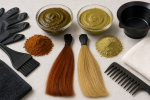
Henna directions may include a specified liquid, resting interval, dense paste, long saturation process, containment, and extensive rinse. Oxidative color usually has a timed mixing and application window after activator is combined. Either requires complete sectioning, gloves, surface protection, enough product, and uninterrupted timing.
Do not add acids, oils, salts, developer, bleach, or internet-recipe ingredients to henna unless the manufacturer explicitly defines that system. Do not save mixed oxidative color for later use.
Expect different buildup behavior
Repeated henna can deepen warm deposit on mids and ends while new roots remain lighter. Repeated oxidative overlap can also create darker bands, altered tone, dryness, or uneven porosity. Maintenance should distinguish new growth from previously colored lengths instead of automatically repeating a whole-head application.
Use consistent dry photographs and records to decide whether roots, faded lengths, or no area actually needs another service.
Removal and correction are limited
Henna should be treated as a committed color history because removal can be incomplete and later lightening may be unpredictable, especially when ingredients are unknown. Oxidative color also leaves artificial pigment and structural history that ordinary color cannot simply erase. A remover, lightener, or correction is a separate service with separate risks.
The color-removal guide explains why product identity, target pigment, current condition, and test strands must come before correction.
Protect future services
Disclose all plant powders, additives, color products, developers, dates, and reactions before lightener, remover, permanent color, relaxer, or perm. A professional may need test strands or may decline a service when identity or compatibility is uncertain. The phrase “body art quality” or “natural” does not replace ingredient evidence.
The American Academy of Dermatology coloring guidance notes that chemical services can contribute to dryness and brittleness. Current hair and scalp condition remain stop boundaries.
Henna versus oxidative color table
| Decision | Verified henna product | Oxidative hair color |
|---|---|---|
| Main mechanism | Warm plant-color deposit | Line-specific color plus activator |
| Lift | No lift of the starting base | Product-specific deposit or limited natural lift |
| Gray result | Often brighter warm dimension | Coverage or blending only as the line directs |
| Mixing | Verified powder, liquid, rest, and timing | Exact color, activator, ratio, and timed use |
| Future change | Preserve exact plant and additive history | Preserve formula, developer, and overlap history |
Final selection checklist
- The exact ingredients, directions, lot, and permitted use are available.
- Natural roots, gray, old color, lightener, and unknown history are mapped.
- The desired task is warm deposit, deposit with activator, or supported lift.
- Reaction testing and representative strand checks answer separate questions.
- Buildup, maintenance, correction limits, and future services are accepted.
Choose henna for a verified warm-deposit commitment or oxidative color for a verified activator-based task. Stop when ingredients, history, tests, compatibility, or future color plans are unclear.