On-Scalp vs Off-Scalp Lightener: Follow the Intended Use

Direct answer: use a lightener on the scalp only when the exact product, developer, ratio, application method, and directions explicitly permit on-scalp use. Off-scalp lightener belongs on isolated hair sections away from skin. Never convert an off-scalp product into an on-scalp one by lowering developer, changing the mixture, or shortening time.
The label decides the placement boundary
Product name, texture, or package color cannot establish permitted use. Read the complete directions for on-scalp or off-scalp placement, approved developer, ratio, maximum timing, heat restrictions, and retouch method. The FDA hair-dye guidance supports following directions and preliminary precautions but does not approve a specific lightener or technique.
On-scalp use adds skin proximity
An on-scalp formula is applied near the scalp only within its stated method. Skin condition, abrasions, irritation, recent scratching, and prior reactions matter before mixing. Do not place product on broken or inflamed skin. More warmth at the root area can also change processing speed, so sectioning and timing must be prepared before application starts.
Off-scalp use needs reliable isolation
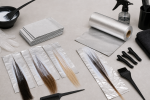
Foils, papers, boards, or another permitted support keep selected hair separated from skin and adjacent strands. Isolation must remain stable as the section is saturated and folded or supported. Product expansion, slippage, leakage, and overloaded packets can move lightener beyond the intended area. Check the manufacturer’s containment and heat rules.
Developer cannot rewrite intended use
Use only the developer type and strength approved for the exact lightener and placement. A weaker developer does not prove that an off-scalp powder is suitable for skin contact, while a stronger developer does not ensure faster or cleaner lift. Measure the ratio and product quantity; do not estimate by bowl texture.
Starting history controls the plan
Map natural roots, old permanent color, direct dye, plant color, previous lightener, bands, breakage, relaxer, perm, and unknown services. Natural roots and artificial lengths can respond differently. The level guide helps document starting depth and tone without predicting lift.
Strand evidence comes before full placement
Use a representative test strand when the product and plan allow it. Reproduce the formula, developer, section size, saturation, support, and timing. Observe lift, warmth, elasticity, breakage, and whether the section stays isolated. A successful strand cannot prove scalp tolerance or whole-head evenness, but a failed test is a stop signal.
Timing begins with the actual process
Prepare sections, tools, protective materials, enough product, and the timer before mixing. Follow the stated timing reference and inspection method; do not reset the clock for every section or extend earlier sections while later ones catch up. Rinse at the directed endpoint even if the package image has not been reached.
Heat is product specific
Do not add a dryer, cap, foil enclosure, heated room device, or another heat source unless the exact system permits it. Containment can retain warmth even without an external device. Unexpected heat, swelling mixture, strong irritation, or rapid change requires immediate attention under the product response directions.
Overlap creates a separate risk
A root retouch should distinguish natural regrowth from previously lightened hair. Repeated lightener on fragile overlap can create uneven lift, loss of elasticity, or breakage. Use clean sections and a visible boundary. The gray transition guide helps map natural and colored zones.
Aftercare cannot undo excessive processing
Rinse and complete the directed shampoo, neutralizing, conditioning, or post-lightening step. Cosmetic softness does not prove that the fiber is undamaged. Delay toner or another service if the hair stretches, feels gummy, tangles severely, or breaks. A pale vivid target still depends on base condition and lift, as the light-blue color guide explains. Correction is a new decision, not an automatic next step.
Plan the rinse route before application
Know how the client or user will reach water, remove foils or supports, protect eyes and clothing, and rinse the scalp and lengths without spreading product. Keep clean gloves and towels ready. Do not walk through a room with open, leaking sections or improvise a sink position after timing ends. A complete rinse plan is part of placement safety, not an afterthought.
Audit the decision before mixing
State the exact product, intended placement, developer, ratio, starting zones, target, section order, timer reference, inspection interval, and stop conditions aloud or in writing. If any item is missing, preparation is incomplete. This short audit also reveals when an apparently simple root task actually includes old lightener, artificial color, irritated skin, or an unsupported off-scalp product.
Know when professional control is appropriate
Complex banding, scalp sensitivity, unknown plant or metallic color, extensive overlap, major lift, or fragile hair can exceed a controlled home task. The American Academy of Dermatology coloring guidance notes that chemical services can contribute to dryness and brittleness. Current condition remains a stop boundary.
Decision table
| Decision | Option one | Option two |
|---|---|---|
| Placement | Permitted skin-adjacent application | Isolated hair away from skin |
| Containment | Section control near the root | Foil, paper, board, or permitted support |
| Developer | Exact on-scalp system | Exact off-scalp system |
| Heat | Only when directions permit | Containment and external heat both matter |
| Retouch | Protect prior lengths | Prevent packet leakage and overlap |
Final checklist
- The exact product explicitly states the intended placement.
- Developer, ratio, timing, heat, and containment match the directions.
- Scalp condition and complete chemical history are documented.
- Representative strand evidence supports lift and fiber condition.
- Isolation, overlap, rinse, and emergency stop steps are prepared.
Choose by intended use, not by powder color, texture, developer strength, or desired speed. Confirm the placement boundary again immediately before mixing. If the label, scalp condition, history, isolation, rinse route, or strand result is unclear, do not proceed.