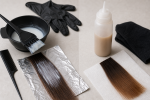
Pre-Cut vs Roll Hair Foil: Section Size, Waste, and Workflow

Direct answer: choose pre-cut foil when consistent dimensions and fast pickup fit a repeatable section plan. Choose roll foil when custom lengths reduce excess material for varied hair lengths or techniques. Foil format does not determine lift, safety, or quality; section control, formula, saturation, containment, timing, and clean handling do.
Measure the real section before choosing
Record typical width, hair length, fold allowance, root support, and whether ends need a second fold. A pre-cut sheet that is too short can expose product, while an oversized sheet adds bulk and can slide. Roll foil allows custom length but requires accurate preparation. Test the fold with dry hair before chemical timing begins.
Pre-cut foil standardizes pickup
A prepared stack reduces cutting during application and can make packet size more consistent. It is useful when many sections share one length and width. Standard size becomes a disadvantage when short face-framing pieces, long dense hair, or unusually wide panels require repeated trimming, doubling, or waste.
Roll foil adapts to variable lengths
A roll can be cut for short roots, long lengths, partial placement, or specialty folds. The operator must prepare enough sheets in advance and cut safely without contaminating tools or delaying application. A jagged or crushed edge can make folding less stable. Keep the roll clean and away from mixed color.
Width controls edge protection
The sheet should support the selected hair and leave enough clean margin to fold or secure without squeezing product outward. Very narrow foil can leak at the sides; excessive width can crowd adjacent packets. Section density and product expansion matter as much as foil width. Do not compensate for a weak packet by overfolding the hair.
Thickness and texture affect handling
Foils vary in stiffness, embossing, grip, and fold memory. A heavier sheet may support long sections but add bulk; a light sheet may conform easily but crumple or slip. Product-specific heat and containment directions still govern use. A metallic sheet is not permission to add external heat.
Prepare before mixing
Count planned sections, add a reasonable contingency, cut roll sheets, organize sizes, and place them where gloved hands can reach them. Cutting after color is mixed consumes processing time and can transfer product to the roll or cutter. Keep clean and used materials physically separate throughout the service.
Waste is more than unused length
Compare trimmed scraps, doubled short sheets, contaminated unused foil, failed packets, and unused pre-cut inventory. Roll foil can reduce length waste only when cutting is controlled. Pre-cut foil can reduce labor and errors even if a small margin remains. Record actual use instead of assuming one format is environmentally superior.
Packet stability protects placement
A stable fold keeps the section flat, product inside the intended zone, and neighboring hair separate. Do not crease so aggressively that hair is bent or product is forced toward the scalp. Check packets for slippage, swelling, or leakage according to the technique and formula without repeatedly reopening every section.
Timing must not be lost to foil preparation
Lightener and oxidative color have defined processing windows. The FDA hair-dye guidance supports following directions and tracking time. Neither foil format justifies extending early packets while later ones are still being cut or applied. Use a section order that can be executed consistently.
Record placement for a future retouch
Document foil length, width, weave or slice, angle, spacing, starting zone, and final result. Photographs and a simple map reduce guesswork at the next service. The red placement guide shows why placement and upkeep matter independently of shade.
Foil cannot correct a weak formula plan
Starting level, artificial color, developer, ratio, saturation, and hair condition control the chemical task. The level guide supports documenting the base. The AAD coloring guidance notes that chemical services can add dryness and brittleness.
Cleanup preserves the next workflow
Dispose of used foil under local rules, clean reusable tools, wipe the work surface, and protect the clean roll or remaining stack from chemical residue. Do not return a touched sheet to the clean supply. A neat station reduces contamination and helps the next application begin with known materials.
Run a dry workflow trial
Before mixing, use dry hair or a swatch and unused foil to rehearse section pickup, sheet length, fold direction, hand position, and placement order. Time a representative group without rushing. The trial can reveal that the chosen pre-cut size is too short, that a roll sheet needs a different length, or that the planned number of packets exceeds the realistic application window.
Keep foil format separate from formula choice
A stiffer foil does not make a runny formula placement-safe, and a custom long sheet does not justify an oversized section. Select formula, developer, section density, and containment under their own directions. Then choose foil dimensions that support that plan. If correction is already involved, review the color-removal guide rather than expecting foil format to solve the pigment history.
Decision table
| Decision | Option one | Option two |
|---|---|---|
| Best fit | Repeated standard sections | Variable lengths and custom folds |
| Preparation | Stack and organize | Measure, cut, and organize |
| Waste risk | Oversized sheets or unused stock | Scraps, miscuts, or contamination |
| Timing | Fast pickup | Requires advance cutting |
| Records | Standard size is easy to repeat | Custom dimensions must be documented |
Final checklist
- Section width, length, fold allowance, and hair density are measured.
- Enough clean foil is prepared before chemical mixing begins.
- Packet margins, stability, expansion, and leakage are controlled.
- Waste includes scraps, contamination, failed packets, and labor.
- Dimensions and placement are recorded for the next retouch.
Choose pre-cut foil for repeatable dimensions and roll foil for measured customization. The better format is the one that supports clean, stable, timely sections without changing the product’s chemical directions.