Tint Brush vs Applicator Bottle: Matching the Tool to the Formula

Direct answer: choose a tint brush and bowl when visible, targeted placement and controlled surface saturation fit the formula. Choose an applicator bottle when the manufacturer permits bottle mixing and a flowable formula needs efficient root or all-over distribution. The tool must match the product directions; transferring a thick, expanding, or bowl-only formula into a bottle can create inaccurate mixing and unsafe pressure.
Directions override tool preference
Read whether the product specifies a bowl and brush, bottle, nozzle, shaker, or supplied applicator. Use the exact mixing sequence, ratio, and venting instructions. The FDA hair-dye guidance emphasizes following directions and timing. Familiarity with one tool does not authorize changing the delivery system.
Viscosity decides whether a bottle can flow
A fluid color can move through a nozzle and along a part, while a thick cream, clay lightener, or expanding mixture may clog, spit, or remain unmixed. Do not thin a formula with extra developer, water, conditioner, or oil to make it bottle-compatible. A test with unmixed substitute material cannot prove chemical compatibility.
A brush supports visible placement
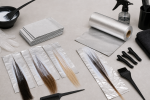
A brush can load roots, panels, foils, balayage surfaces, or controlled mids while the operator sees the amount and edge. Bristle width, stiffness, and product load influence saturation. Repeated dry brushing can remove product or create weak spots. Use sections small enough to inspect and saturate without scraping the scalp.
A bottle supports continuous lines
A pointed nozzle can place flowable color along parts and help distribute product through defined zones. Flow depends on nozzle opening, squeeze pressure, angle, formula thickness, and remaining volume. Flooding one part does not saturate the interior. Use gloved fingers or the directed method to distribute without uncontrolled rubbing.
Mixing accuracy is not optional
A bowl allows separate measurement before combining and visual scraping of the sides. A bottle may use marked volume or supplied components, but markings and residual product must be considered. Never estimate a ratio by color or bottle fullness. Close, vent, shake, or roll only as the manufacturer directs.
Application speed changes the result
Bottle delivery may be faster on repeated roots, while brush placement may be slower but more visible. Prepare sections and practice the order before mixing. Do not select the fastest tool if it causes missed areas, overlap, or a processing-time gap between the first and last zones.
Root retouches need overlap control
Both tools can overlap onto old color. A brush can paint a narrow boundary; a nozzle can trace a part but may release too much product. Map natural regrowth and previously colored lengths under good lighting. The level guide helps document zone differences.
Foils and specialty placement favor a brush
Foil, board, or freehand placement usually requires a product and brush designed for controlled loading. An applicator bottle can leak beyond the selected section and is not a substitute for isolation. Use the placement tool specified by the service and formula rather than combining convenience features from unrelated methods.
Direct dyes still need tool matching
Some direct colors are thick enough for a brush; others use a nozzle bottle. Vivid pigment can stain skin, counters, towels, combs, and the tool itself. The direct-color guide separates shade, base, saturation, transfer, testing, and fade.
Cleanability affects reuse
Reusable brushes, bowls, and bottles need complete cleaning and drying under material and product guidance. Narrow nozzles and seams can retain residue. Do not reuse a container when its identity is uncertain, plastic is degraded, or residue could alter the next mixture. Keep measurement tools separate from food use.
Test the whole workflow
A representative strand test should reproduce formula, tool, section size, saturation, timing, and rinse. A good color result with a brush does not prove a bottle will distribute the same amount. Record tool, section pattern, quantity, and missed or overloaded zones before full application.
Condition and reaction remain boundaries
Neither tool changes scalp sensitivity or fiber limits. Stop for a concerning reaction, unexpected heat, severe tangling, elasticity loss, or breakage. The American Academy of Dermatology coloring guidance notes that chemical services can contribute to dryness and brittleness.
Compare accuracy by measured output
For a brush, note how many sections one measured bowl quantity saturates and whether edges remain visible. For a bottle, note how much volume remains after each zone and whether the nozzle delivers a stable line. These observations are more useful than calling one tool precise. The purple color guide shows why vivid formula, base, and saturation remain separate from tool preference.
Prepare a tool-failure fallback
Keep a clean compatible brush and bowl available when an approved bottle nozzle clogs, and keep enough measured product information to continue without guessing. If a bottle swells, leaks, or cannot vent as directed, stop rather than forcing the cap. If a brush sheds, bends, or cannot load the formula evenly, replace it before applying to another section.
Decision table
| Decision | Option one | Option two |
|---|---|---|
| Formula | Creamy or placement-focused | Flowable and bottle-approved |
| Control | Visible edges and selected panels | Continuous parts and broader distribution |
| Mixing | Measured bowl combination | Approved bottle sequence and venting |
| Risk | Dry brushing or slow sections | Clogs, flooding, or pressure |
| Cleanup | Open surfaces are easy to inspect | Nozzle and seams need close cleaning |
Final checklist
- The manufacturer permits the chosen bowl, brush, or bottle system.
- Formula viscosity, ratio, mixing, venting, and timing are verified.
- Sections are small enough for complete saturation and overlap control.
- The full tool workflow has been reproduced in a representative test.
- Reusable tools can be cleaned, dried, and identified reliably.
Choose the brush for visible targeted control and the bottle for approved flowable distribution. Do not modify the formula to fit a preferred tool, and stop when mixing, pressure, saturation, or overlap cannot be controlled.