Balayage Board vs Freehand Application: Support, Saturation, and Control

Direct answer: choose a balayage board when a stable surface helps support long, dense, fine, or highly mobile sections and makes product loading easier to see. Choose unsupported freehand application when the section can remain controlled in the hand and the planned surface painting does not need a rigid base. The board changes physical support, not the lightener’s chemistry, lift range, or safety directions.
Define freehand accurately
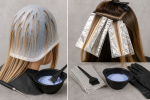
Freehand describes painting selected hair outside a closed foil packet, but operators may still use a board, paddle, mesh, cotton, film, or another permitted separator. This comparison focuses on a rigid board versus a section supported only by the hand and body position. Confirm the exact product allows the chosen open-air or supported method.
A board creates a visible working plane
The section rests against a flat or curved surface so the brush can load product with less movement. This can make the center, edges, and underside easier to inspect. A board that is too short, narrow, slippery, or sharply edged can bend hair, pull the section, or force an unsuitable angle. Match board dimensions to the hair and placement.
Unsupported freehand relies on body control
The operator controls tension with fingers, hand angle, elevation, brush pressure, and section weight. This can allow quick movement and a soft transition, but fatigue or an unstable section can change saturation. Do not compensate by gripping hair tightly, repeatedly brushing a dry edge, or painting a section too thick to inspect.
Product consistency must suit the method
A formula that dries, swells, drips, or transfers can move beyond the intended surface. Use only the ratio and consistency created by the exact lightener and developer directions. Do not add powder, developer, clay, conditioner, or another ingredient to make a product behave like a preferred balayage formula.
Saturation controls lift distribution
The bright area generally needs enough product around the selected fibers, while the transition area may use lighter surface loading under the technique. A board can provide resistance for loading; unsupported freehand can reveal how the section falls naturally. Neither method makes an oversized section fully saturated. Check the interior without scraping product away.
Transition edges require deliberate placement
Write where brightness begins, how wide the transition should be, and whether the target is ribbons, tips, face framing, or diffuse surface lightness. Feathering is not random brushing. The color placement guide shows why location, contrast, and upkeep are separate from shade.
Starting base remains the chemical limit
Natural hair, artificial color, plant dye, previous lightener, bands, and porous ends can respond differently under identical paint. The level guide helps document depth and undertone. A board cannot make artificial color lift like natural hair.
Timing includes section speed
Prepare partings, tools, board position, product quantity, separators, and timer before mixing. The FDA hair-dye guidance emphasizes following directions and tracking time. If unsupported sections slow down or board transfers require repeated repositioning, the first and last areas can receive materially different processing.
Prevent cross-contact between sections
Place completed sections so wet product does not touch untreated hair, skin, clothing, the board handle, or adjacent finished work. Clean or replace the board as required when changing formulas or moving from a heavily loaded section. Unsupported freehand also needs a clean resting plan; letting painted hair fall freely can spread product.
Test the complete motion
Use a representative strand and reproduce board or hand support, section thickness, brush load, transition, timing, and open-air conditions. Observe lift, warmth, edge, saturation, dryness, and fiber condition. A test painted on foil does not prove the same formula will behave on an open board or unsupported section.
Record the retouch map
Photograph the finished dry placement and record partings, elevation, board size, section width, painted depth, transition start, formula, and timing. The color-change guide reinforces documenting base and formula rather than relying on a visual label. Retouch records reduce accidental overlap.
Condition and complexity set stop points
Fragile overlap, unknown color, multiple correction bands, or a major lift target can exceed a controlled freehand task. The AAD coloring guidance notes that chemical services can contribute to dryness and brittleness. Stop for unexpected heat, severe irritation, elasticity loss, gummy feel, or breakage.
Clean support improves repeatability
Remove chemical residue from a reusable board according to its material instructions, inspect edges and grip, and dry it before storage. Do not use a cracked, warped, or contaminated board. For unsupported work, clean gloves and controlled hand placement are equally important. Physical support should reduce variation rather than introduce residue into the next section.
Decision table
| Decision | Option one | Option two |
|---|---|---|
| Support | Rigid visible surface | Hand and body position |
| Best fit | Long, mobile, or dense sections | Stable sections with controlled fall |
| Saturation | Resistance helps loading | Brush and hand must stabilize fibers |
| Transition | Visible against the board | Judged in natural fall |
| Retouch | Record board and placement map | Record hand angle and placement map |
Final checklist
- The exact product permits the open-air or supported method.
- Board dimensions or hand support match section length and density.
- Formula, ratio, section size, saturation, and timing remain unchanged.
- Completed sections cannot transfer product to skin or neighboring hair.
- Strand evidence and a retouch map support the placement.
Choose a board for stable visible support and unsupported freehand for a section that can remain controlled without it. Confirm the support choice in a dry rehearsal. Stop when the formula, section, saturation, transfer, timing, or overlap cannot be managed.