Blue Powder Hair Lightener: Formula, Directions, and Compatibility Guide

Direct answer: blue powder hair lightener is an activated lightening product, not blue hair dye and not a finished toner. Use only the developer, ratio, scalp or off-scalp placement, enclosure, and processing time specified for the exact powder. The blue color may be part of the product’s visual or tonal design, but it does not promise removal of orange, a cool blonde result, or a particular lift level. Complete directed preliminary testing and exact strand tests before wider use.
The dry powder color does not identify its strength or full chemistry. Natural level, artificial-color history, powder and developer measurements, section thickness, saturation, enclosure, temperature, and time determine the exposed canvas. Judge results after rinsing and complete drying, not by the color of the bowl.
Understand what the blue color can and cannot mean
Blue and orange oppose each other in a simplified color-wheel model, so a manufacturer may include blue-violet colorants for a stated visual or tonal purpose. That relationship does not provide a formula or prove that the lightener will neutralize every orange stage.
At different levels, hair can expose red, red-orange, orange, yellow-orange, or yellow. Blue is not the direct opposite of all of them. Residual artificial color, minerals, direct dye, and uneven porosity can also influence the visible result.
Do not add blue direct dye, blue shampoo, toner, food coloring, or another pigment to strengthen the powder’s color. The blue hair dye base and fade guide covers intentional blue deposit, which is a separate process.
Identify the exact powder system
Read the product identity, components, warnings, developer family, strength range, ratio, measuring method, mixing order, scalp permission, enclosure options, check intervals, maximum time, and rinse directions. Blue powders from different lines are not interchangeable.
Check whether the powder is compact, dust-reduced, standard powder, part of a kit, or designed for a named technique. Follow its own transfer and ventilation rules. A blue color does not remove the need to minimize airborne powder.
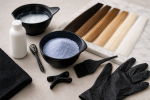
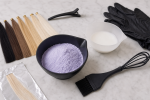
The editorial image shows contained pale blue powder, opaque white developer, and a mixed cream. It does not identify a brand, strength, ratio, or ingredient list.
Map starting level and color history
Record natural level, permanent and demi-permanent color, direct dye, plant color, metallic or compound color if known, prior lightener, highlights, gray, bands, breakage, elasticity, and porosity. Separate roots, midlengths, ends, hairline, old highlights, and fragile sections.
Natural hair can expose predictable families of warmth by level, but artificial color can behave differently. A dark artificial band may remain orange or red-orange while natural hair changes more quickly. Blue powder cannot be assumed to lift through that band evenly.
If the target is an intentional light blue shade, the dry lightened base matters. The light blue hair dye base guide helps readers assess starting warmth and porosity after lightening; it is not a powder-lightener recipe.
Check scalp and hair condition
Confirm whether the exact product permits on-scalp use, off-scalp use, both, or only a named placement. Follow any different developer limits, minimum scalp distance, enclosure rules, and maximum times.
Do not apply to an irritated, abraded, sunburned, or otherwise damaged scalp. Never use scalp lightener on eyelashes or eyebrows.
Test hair condition before mixing. Severe roughness, gummy texture, excessive stretch, breakage, or inability to withstand gentle handling is a stop signal. Blue pigment or a bond additive does not establish suitability for compromised hair.
Use the approved developer and ratio
Choose only the developer family and strength listed for the starting canvas, target, and placement. A matching volume number does not make a developer from another line compatible.
Measure powder and developer by weight or volume as directed. Keep one unit system and write down the batch. If the line offers different ratios for scalp, foil, open-air, or freehand application, use only the ratio assigned to the chosen method.
Do not add water, conditioner, shampoo, oil, toner, direct dye, or extra developer to alter the color or consistency. If the ratio is wrong, discard and remake the mixture according to the directions.
Control powder transfer and mixing
Open and measure the powder in the ventilation conditions specified on the label. Keep the bowl close to the container, transfer gently, avoid dropping powder from height, and do not position the face above the bowl.
Add developer in the stated order and mix with the specified nonmetallic tool. Wet the powder carefully rather than whisking dry material rapidly. Blend until the directed consistency is uniform.
Do not infer activation from the mixture becoming pale blue, darker blue, white, warm, bubbly, or thick. Follow the measured formula and timing.
Complete separate safety and strand tests
Follow every preliminary test and precaution supplied with the system. The U.S. Food and Drug Administration’s hair-dye guidance advises following package directions, wearing gloves, observing timing, rinsing thoroughly, avoiding a damaged scalp, and completing directed preliminary testing.
Choose hidden strands representing natural roots, old permanent color, direct-dye residue, dark bands, resistant sections, previous highlights, and porous ends. Use the exact powder, developer, ratio, section size, saturation, backing, enclosure, and time intended for the service.
Rinse at the target or maximum time and dry completely. Evaluate achieved level, residual orange or yellow, unexpected gray or blue cast, banding, breakage, elasticity, roughness, and whether a later toner or blue dye goal fits the canvas.
Distinguish lightening from a blue final shade
A blue powder mixture can rinse away without leaving an intentional blue result. Conversely, porous or very pale hair may show an unexpected cool cast from some systems. Use the dry strand evidence rather than assuming either outcome.
The blue hair dye formula guide helps select a later direct or oxidative blue color after the base is known. Do not combine that color with lightener in one improvised step.
Prepare sections before activation
Arrange gloves, timer, clips, protective covering, nonmetallic bowl, brush, separators, and enough fresh mixture. Complete sectioning before mixing so the batch is applied within its working period.
Use consistent subsection size and directed saturation. Keep lightener off hair that should remain dark and avoid unsupported overlap on established pale sections. Root heat, bands, and fragile ends may require separate placement decisions supported by strand tests.
Follow enclosure and heat limits
Confirm whether foil, film, mesh, cotton, open air, or another separator is allowed. Do not infer foil permission from the image or from another blue powder. Enclosure and scalp heat can change temperature, moisture, expansion, and processing speed.
Do not add external heat, wrap the entire head, mist drying product, or place new mixture over a slow section unless the instructions provide that step.
Time to the label, not the visible warmth
Start timing at the event named by the manufacturer and inspect only at permitted intervals. Do not repeatedly scrape or stretch hair to view progress.
Stop at the maximum time even if orange remains. Continuing until the hair looks neutral in the bowl can exceed the formula limit because blue mixture color can mask the true underlying canvas.
Recognize stop conditions
Stop before mixing if powder identity, developer, ratio, scalp permission, enclosure, maximum time, color history, or target is unknown. Also stop for a damaged scalp, weak hair, incompatible prior chemistry, or strand tests showing severe banding, unexpected color, breakage, gummy texture, excessive roughness, or insufficient condition.
During use, rinse as directed for intense burning, swelling, blistering, breathing difficulty, spreading rash, eye exposure, unexpected heat, inhalation concern, leakage toward the scalp, severe breakage, or another concerning reaction. Seek appropriate medical help for a serious reaction. The American Academy of Dermatology’s hair coloring guidance supports manufacturer testing and conservative spacing of chemical changes.
Rinse and record the dry canvas
Remove separators carefully and rinse at the specified time and temperature, keeping runoff away from the eyes. Use only the named cleanser, conditioner, or finishing step.
After complete drying, record starting level and history by zone, powder and developer amounts, ratio, placement, saturation, enclosure, check times, rinse time, dry level, warmth, cool cast, and hair condition. Discard mixed lightener as directed.
Blue powder lightener checklist
- The blue powder is understood as an activated lightener, not blue dye or a finished toner.
- Powder identity, developer, ratio, dust controls, scalp permission, enclosure, and maximum time are known.
- Natural hair, artificial color, direct dye, bands, highlights, and fragile ends are mapped.
- No water, conditioner, shampoo, oil, blue dye, toner, or unrelated developer enters the mixture.
- Directed preliminary testing and fully dried representative strand tests are complete.
- Sectioning, saturation, overlap, separator, heat, timing, and later tone are planned separately.
- Reaction, inhalation concern, heat, leakage, banding, unexpected cast, breakage, and maximum-time stop conditions are defined.
A blue powder lightener is useful only as its own complete measured system. If the blue color obscures the true canvas or the formula and strand evidence do not support the target, stop rather than extending time or adding pigment.