Bottle vs Bowl Hair Color Application: Which Method Fits the Formula?

Direct answer: use a bottle when the exact hair color system is designed to mix, activate, and dispense through that container; use a bowl and brush when the formula directs or supports open mixing and deliberate section placement. Do not transfer an activated formula simply because another method feels faster.
The formula, viscosity, ratio, activation method, timing, and intended zones decide the tool. Bottle versus bowl is not a universal home-versus-salon or beginner-versus-professional rule.
Read the mixing method before choosing the applicator
Some kits place developer in an applicator bottle and direct the color component to be added, closed, and mixed there. Other systems supply tubes or measured components for a nonmetallic bowl. Preserve the exact sequence, ratio, and container requirements.
The FDA hair-dye guidance emphasizes label directions, gloves, preliminary testing, timing, rinsing, and damaged-scalp precautions. It does not authorize transferring formulas between tools.
Choose a bottle for compatible flowing formulas
A nozzle bottle can place a line of product at roots and distribute a sufficiently fluid mixture across larger zones. The closed container may reduce open-bowl splashes during movement, but squeezing can create sudden output, air spurts, or excess product at one point.
Keep the nozzle aimed at the permitted application area. Do not put the tip against irritated skin or use pressure to force a mixture that has become too thick to dispense.
Choose a bowl for visible brush control
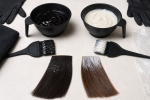
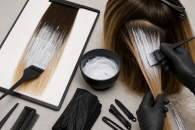
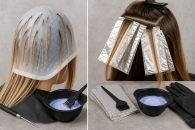
A bowl allows the user to see the mixture and load a tint brush in controlled amounts. This can support panels, regrowth lines, selected pieces, or different placement decisions by zone. It also leaves the formula open to spills, contamination, and inconsistent brush loading if the workspace is poorly organized.
The shade and developer guide shows why color, developer, ratio, and timing remain one system. A bowl does not permit freehand ratio changes.
Do not make container shape a chemistry assumption
A bottle formula is not automatically liquid, weak, fast, or full-head only. A bowl formula is not automatically cream, strong, professional, or suitable for lightening. Read the product class and intended use rather than inferring from packaging.
The formula and shade guide separates direct-color use from developer-based systems. Similar-looking color products can require different tools and handling.
The at-home color selection guide connects formula class, starting base, testing, and section planning. Use that decision sequence before selecting a bottle or bowl.
Compare root placement
A bottle nozzle can draw narrow lines along parts, but output may spread beyond the regrowth boundary. A brush can paint a visible root zone, yet wide strokes can also overlap previously colored hair. Use sections that expose the full regrowth line and control the product amount.
Do not drag either applicator through lengths unless the package and service plan require it.
Compare saturation through mids and lengths
A bottle may distribute product quickly along a section, while hands in gloves or another permitted method complete contact. A brush may provide visual placement but require more subdivisions. Neither method proves that interior strands are saturated.
Check the full section without repeatedly combing or pulling fragile hair. More product at the surface does not correct a dry interior.
Keep the original activation container when required
Do not open a bottle after activation to pour the mixture into a bowl unless the manufacturer explicitly permits it. Do not cap and save mixed reactive color for later use. Pressure, oxidation, storage, and disposal directions belong to the exact system.
If a nozzle clogs or the bottle swells, stop and follow the package response instructions rather than puncturing, heating, or forcing the container.
Plan timing around the complete application
Lay out sections, clips, gloves, protective materials, timer, and rinse path before mixing. A bottle can appear fast but still require careful parting. A bowl can provide control but increase loading and placement time.
Start and track timing as the package directs. Do not give early sections an uncontrolled extra interval because later sections were difficult to reach.
Use tests for formula and tool evidence
Complete the directed preliminary test every time. When permitted, a strand test can show whether the chosen tool places and saturates the actual mixture within the required timing and how the starting hair responds.
The American Academy of Dermatology coloring guidance supports manufacturer testing and warns that greater lightening can increase damage. A tool cannot make an unsuitable formula appropriate.
Compare cleanup and contamination
Bottles can drip from the nozzle, leak at the cap, or retain material in threads. Bowls and brushes can leave exposed residue on rims, handles, counters, and clips. Keep both systems away from eyes, children, pets, food, and ordinary grooming tools.
Discard mixed formula and single-use materials as directed. Clean reusable tools only when the product allows reuse and preserve their identity for hair color rather than food or household tasks.
Use a formula-first decision table
| Question | Bottle | Bowl and brush |
|---|---|---|
| Does the package specify the tool? | Use the supplied or directed bottle | Use the directed compatible bowl and brush |
| Is the mixture nozzle-compatible? | Only when it dispenses as designed | Useful for formulas intended for brush loading |
| Is boundary placement critical? | Control nozzle output and flow | Control brush load and stroke width |
| Is full saturation visible? | Not from nozzle lines alone | Not from surface painting alone |
| Can mixed product be stored? | Not unless explicitly directed | Not unless explicitly directed |
Bottle versus bowl checklist
- The product class, components, ratio, activation, and directed container are verified.
- The mixed viscosity fits the allowed tool without dilution or thickening.
- Sections expose roots, mids, and ends that actually require product.
- Nozzle output or brush loading can be controlled within boundaries.
- Application and timing can be completed as directed.
- Testing, gloves, rinsing, cleanup, disposal, and stop conditions are ready.
Use the method designed for the formula and service. Stop when container compatibility, pressure, ratio, timing, or zone placement is unclear.