Hair Color Intensifier Concentrates: Formula, Directions, and Compatibility Guide

Direct answer: use a hair color intensifier concentrate only when the current directions approve it for the exact color line and explain how much may be added. Intensifiers are highly pigmented modifiers used to strengthen, shift, or counter a tone within a compatible formula. They are not automatically stand-alone hair color, and more concentrate does not create a more accurate result. Confirm whether the product is oxidative or direct, how it counts toward the color portion, its maximum addition, the required activator ratio, and the permitted shades and levels. Then perform every directed skin test and a fully dried strand test.
Names such as intensifier, concentrate, booster, mix tone, corrector, additive, pigment drop, and pure tone can describe different chemistries. A blue direct-dye concentrate and a blue oxidative mix tone may look similar in a bottle but require completely different use. The exact label and technical sheet control the formula.
Identify the concentrate’s role before choosing a color
Start with the product identity rather than its visible color. Determine whether it is designed to increase vibrancy, deepen an undertone, neutralize an unwanted tone, customize an approved shade, or support another named purpose. Check whether the concentrate may be used alone, only mixed into color, only mixed into clear, or only added within a stated level range.
An intensifier changes the added pigment balance; it does not erase the starting canvas. Blue may visually counter some orange in a suitable formula, violet may influence yellow, and green may influence red, but those simplified color-wheel relationships do not supply a recipe. The result also depends on base level, existing artificial color, pigment density, porosity, processing system, and the product’s specific dye components.
The direct hair color formula guide helps separate ready-to-use pigment from color that relies on oxidative activation. Resolve that distinction before selecting any concentrate or mixing method.
Keep the intensifier inside its approved color family
Match the concentrate to the manufacturer, line, formula class, and named partner products. Do not put a direct-dye booster into permanent color, add an oxidative mix tone to a conditioning mask, or combine concentrates from unrelated ranges because their visible hues appear alike. Ingredients, pH, dye technology, viscosity, preservative systems, and activation can differ.
Read whether the concentrate is compatible with all shades or only selected families. Some ranges limit an additive by hair level, color series, gray percentage, or service type. Others provide a maximum number of drops, grams, centimeters, or a percentage of the total color portion. Stay within the unit and ceiling printed for that exact product.
Do not substitute artist pigment, food color, fabric dye, cosmetic pigment, developer, shampoo, conditioner, or another household material. A hair-color concentrate is not a generic colorant, and an unapproved addition can change spread, saturation, processing, scalp exposure, and the final pigment balance.
Calculate the formula without losing the activator ratio
Write each component and unit before opening the color. Record the base shade amount, intensifier amount, any approved clear amount, their combined color portion, and the required activator amount. Use a scale or the measurement method specified by the manufacturer. Do not mix weight and volume casually, and do not assume that one drop from every dispenser has the same mass.
Check whether the concentrate is included in the color total used to calculate activator. If the directions count base shade plus intensifier as the color portion, calculate from that combined amount at the stated ratio. If the technical chart gives a different method, follow it exactly. This describes how to read the formula, not a universal mixing rule.
Small measurement errors matter more with concentrated pigment. A formula written only as “a little blue” cannot be reproduced or diagnosed. Record grams, approved drops, or the exact line-specific unit. Mix thoroughly enough to distribute the concentrate, but do not add extra liquid merely to change consistency.
Map the canvas and undertone
Document the natural level, artificial color, highlights, prelightened sections, gray distribution, warmth, coolness, banding, and porosity. View the hair dry in neutral light. A concentrate that balances one section may overcorrect another if the base or porosity differs.
Highly porous lengths can accept cool or vivid pigment rapidly and may become darker, duller, or less even than stronger roots. Lightened ends can show a concentrated modifier more visibly than a deeper natural base. An intensifier cannot make an uneven canvas uniform, restore missing warmth automatically, or remove old dye.
Use the purple hair dye shade and base guide to compare base depth, formula class, saturation, transfer, and fade in a vivid-pigment decision. The same principle applies here: the pigment is only one part of the visible result.
Separate neutralizing from increasing vibrancy
A concentrate used to neutralize should be selected against the actual unwanted tone, not against a generic idea that hair is “brassy.” Orange, yellow-orange, yellow, red-orange, and red are different visual problems. The appropriate modifier and amount can change with level and product line. Too much complementary pigment can create a dull, overly cool, greenish, violet, or otherwise unintended cast.
A concentrate used to increase vibrancy follows a different goal. Adding red, copper, violet, blue, or another intense tone may make that family more visible, but it can also alter depth, opacity, staining, transfer, and fade. It may amplify an undertone already present in the base. Do not use neutralizing and intensifying language interchangeably when writing the formula.
The red hair color placement guide connects pigment choice with starting canvas, depth, placement, contrast, and maintenance. An intensifier can modify a formula; it cannot replace the design decision.
Perform skin and strand testing
Follow every preliminary skin-test direction supplied with the color and concentrate. The U.S. Food and Drug Administration’s hair-dye guidance advises consumers to follow package directions, wear gloves, observe timing, rinse thoroughly, avoid use on an irritated or damaged scalp, and complete the directed preliminary test before each use. Diluting a concentrate into another shade does not remove those precautions.
A strand test evaluates the complete measured formula on the actual hair. Select a hidden section representative of the base, prior color, porosity, and intended placement. Mix a small amount only as the directions allow, saturate consistently, process for the stated time, rinse as directed, and dry the strand fully. Review tone, depth, vibrancy, neutralization, evenness, feel, and contrast with adjacent hair.
If the strand is muddy, overly cool, unexpectedly warm, too vivid, too dark, patchy, or rough, do not make an unmeasured full batch. Recheck the concentrate identity, maximum amount, activator calculation, underlying tone, shade selection, and porosity plan. A different base shade or a more even canvas may be required.
Mix and apply the approved formula carefully
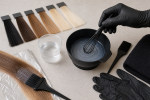
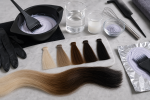
Prepare gloves, accurate measuring tools, a nonmetallic bowl or applicator when directed, clips, timer, protective covering, and enough product for complete saturation. Protect nearby surfaces because concentrated pigment can stain. Follow the manufacturer’s mixing order; some formulas disperse the modifier into the base shade before activator, while others specify another sequence.
Apply to clean, dry or towel-dried hair according to the instructions. Use thin subsections and the tested application order. Natural roots, resistant gray, lightened lengths, and porous ends may not need identical exposure, but do not invent separate formulas or processing times without product support.
Start timing at the point named in the directions. Do not add heat, exceed the maximum processing interval, overlap fragile hair repeatedly, or apply a concentrate directly to the scalp when it is approved only as a formula additive. Keep scalp hair dye away from eyelashes and eyebrows.
Know when to stop
Stop before mixing if the concentrate is not approved for the color line; the maximum amount or activator method is unknown; labels are missing; components are expired or compromised; prior color chemistry is uncertain; the scalp is irritated, scratched, sunburned, or damaged; or the hair is breaking, gummy, or unable to tolerate another service.
During use, stop and rinse as the label directs if there is intense burning, swelling, blistering, breathing difficulty, spreading rash, eye exposure, or another concerning reaction. Seek appropriate medical help for a serious reaction. The American Academy of Dermatology’s hair coloring and chemical-service guidance supports following manufacturer precautions and making conservative changes rather than stacking stressful services.
Rinse, assess, and preserve the formula record
Rinse with the method and water temperature specified for the system, keeping runoff away from the eyes. Use only the directed post-color cleanser, conditioner, or finishing step. Judge the final tone when the hair is fully dry in consistent light, because wet hair can look deeper and hide unevenness.
Record the base shade, concentrate, exact amounts, activator, ratio, starting canvas, timing, placement, and dry result. Note staining, transfer, wash behavior, and the response of porous areas. Do not save mixed oxidative color for later use, and follow storage directions for any opened unmixed concentrate.
Intensifier concentrate checklist
- The concentrate is approved for the exact color line and formula class.
- Its purpose is defined: intensify, shift, neutralize, or another named use.
- The permitted shades, level range, unit, and maximum addition are known.
- The concentrate is counted correctly in the color and activator calculation.
- The starting level, undertone, old color, gray, banding, and porosity are mapped.
- Directed skin testing and a fully dried representative strand test are complete.
- The application plan includes accurate measurement, saturation, timing, rinsing, surface protection, and stop rules.
A sound intensifier formula is precise and reproducible. If the product family, maximum amount, activator method, canvas, or strand result is uncertain, delay the service rather than guessing with concentrated pigment.