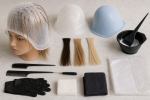
How to Choose and Use Hair Color Processing Caps at Home

Direct answer: choose a hair color processing cap only when the exact product directions permit covering the hair. The cap should be intact and non-perforated, large enough to contain the coated sections without compressing them, and secure at the elastic edge without painful pressure. Use a disposable clear cap for simple contamination control or a manufacturer-approved reusable cap when its material can be fully cleaned and dried. A processing cap covers hair; it does not pull strands through holes, set processing time, or authorize added heat.
This distinction matters. A highlighting cap has holes and a hook for selecting strands. A processing cap is an unbroken cover placed over hair after application. Confusing the two can expose hidden hair, disturb placement, or introduce a tool that the selected formula never called for.
Confirm that a cap belongs in the method
Read the complete product directions before buying or opening a cap. Some color, gloss, conditioning, or direct-dye methods may permit a loose cover. Other oxidative color or lightener instructions may require open-air monitoring or prohibit heat and occlusion. A generic salon habit does not override the exact label.
Identify why the cap is being considered. It may help contain coated hair, reduce contact with clothing or nearby surfaces, or keep sections organized during a label-supported waiting period. It should never be used to extend timing, intensify a formula, hide leakage, or compensate for poor section control.
The at-home hair color planning guide helps assess formula, starting condition, quantity, timing, visibility, and rinse access before any covering decision.
Compare disposable and reusable caps
Disposable clear plastic
A thin clear cap makes the hair arrangement visible and avoids post-service cleaning. Choose a cap with an intact seam and elastic that opens without tearing. Very thin material can cling to coated hair, split at the edge, or slide upward. A disposable cap is single-use once it contacts hair product, skin, contaminated gloves, or rinse water.
Reusable waterproof cap
A reusable cap may be thicker and easier to position. Its value depends on a nonporous interior, durable seams, colorfast material, and cleaning instructions compatible with the products used. Inspect fabric-laminated or insulated designs carefully: an absorbent lining can retain residue and moisture.
Insulated designs
An insulated cap changes the thermal environment even without a powered heater. Use it only when the exact product permits that type of covering. Do not infer that warmth improves every formula. Lightener, oxidative color, direct dye, and conditioning products have different directions and risk boundaries.
Choose size and elastic fit
Estimate the volume of hair after sectioning and coating. Long, dense, clipped, or coiled hair needs more interior space than short fine hair. The cap should contain the full hair mass without pulling coated strands across the face, compressing clips against the scalp, or smearing one planned zone into another.
The elastic should sit beyond the coated hairline when possible and remain stable during normal movement. It should not leave painful pressure, obstruct vision, cover the nose, catch earrings, or interfere with breathing. Test fit on dry arranged hair before mixing.
Oversized caps can sag onto the neck or slide into product. Undersized caps may lift, split, or squeeze product through the edge. Choose based on usable depth and opening circumference rather than package terms such as standard or extra large.
Prepare the cap and work area
Inspect the cap in bright light. Reject holes, weak seams, stretched elastic, sticky surfaces, flaking coatings, odor that persists after permitted cleaning, or residue from a previous use. Place a clean cap in the clean-tool zone and keep it away from mixed product until the hair is ready to cover.
Protect clothing and surfaces as the label directs. Arrange gloves, non-metal tools when required, towels, timer, mirrors, and rinse access. Complete every label-required allergy alert or skin test before each use and a representative strand test before the full service.
The hair color selection and application guide helps separate formula decisions from the narrower question of whether a cap is compatible.
Place the cap without disturbing sections
Finish the directed application and inspect the hairline, ears, neck, and section boundaries. With clean controlled hands, open the elastic fully and lower the cap over the arranged hair. Avoid dragging the edge through fresh product or folding coated hair onto unplanned areas.
Keep the cap loose enough that product is not squeezed toward the scalp or face. Do not twist a disposable cap tightly against the head. Do not place metal clips, sharp ends, or rough tools where they can puncture the material.
Once positioned, verify that the cap edge is stable, the face and eyes are clear, and no product is leaking. If leakage occurs, follow the product cleanup directions. Adding a second cap is not a reliable repair for poor fit or excess product.
Monitor time and condition
Start and stop timing exactly as the product directs. A cap can make visual monitoring less convenient, so use a clear cap or lift the edge only when the instructions allow inspection. Do not leave the cap in place beyond the stated time because the hair looks unchanged through plastic.
Do not use a dryer, heated towel, thermal bonnet, heating pad, or other external heat unless the exact directions explicitly permit it. Stop if the cap causes painful pressure, excessive heat sensation, product leakage, or a concerning reaction.
The U.S. Food and Drug Administration advises following every package direction, completing the directed skin test before each use, wearing gloves, keeping dye away from the eyes, observing processing time, and rinsing the scalp well.
Remove and dispose or clean
Remove the cap in the direction that keeps residue away from the face. Hold the elastic away from skin and avoid snapping it. Continue immediately with the directed rinse, shampoo, or conditioning sequence.
Discard a disposable cap after one service. Do not turn it inside out, rinse it, and store it for reuse. Contamination and stretched material are not reliably corrected by a quick wash.
For a reusable cap, follow its cleaning instructions promptly. Clean the interior, elastic channel, seams, and outer surface with permitted products, rinse when allowed, and dry completely before storage. Store it open or in a shape that prevents trapped moisture and permanent creases.
Know when replacement is due
Replace a reusable cap when elastic no longer holds, the interior becomes porous or sticky, seams separate, coatings flake, stains obscure cleanliness checks, odors persist, or the material can no longer be dried fully. A cap that fits one hair volume may also be unsuitable after a major length or density change.
Keep reusable processing caps separate from shower caps, highlighting caps, and ordinary thermal bonnets. A labeled storage location can prevent mix-ups, but the cap itself should remain free of handwritten product claims or timing instructions that may become outdated.
Safety and professional-help limits
The American Academy of Dermatology notes that lightening more than three shades generally requires stronger peroxide and can cause more damage. Covering the hair does not make major lift, overlapping lightener, black artificial color, fragile hair, banding, or corrective work safer for home use.
Do not use scalp hair dye on eyebrows or eyelashes. Do not proceed on an irritated, scratched, sunburned, or damaged scalp. A cap cannot prevent allergy, irritation, breakage, uneven color, or leakage.
Common processing-cap mistakes
- Using a perforated highlighting cap as a processing cover.
- Covering hair when the exact product does not permit it.
- Choosing a cap too small for coated hair and clips.
- Assuming an insulated cap is equivalent to a thin plastic cover.
- Adding unapproved external heat.
- Extending processing time because the hair is covered.
- Reusing a disposable cap.
- Storing a reusable cap damp or contaminated.
For broader placement and upkeep planning, see the hair color ideas guide. Inspiration should define a result direction, not determine whether occlusion is allowed.
Final processing-cap checklist
- Verify label permission for covering the hair.
- Choose intact non-perforated material.
- Match cap volume and elastic opening to arranged hair.
- Test fit before mixing.
- Place without smearing sections or squeezing product.
- Use no unapproved heat and follow exact timing.
- Discard single-use material or clean reusable material fully.
- Replace damaged, porous, loose, or difficult-to-clean caps.
Sources and scope
The FDA hair dyes guidance supports the label, skin-test, glove, timing, eye-area, scalp-condition, and adverse-reaction boundaries used here. The American Academy of Dermatology coloring guidance supports conservative shade changes and damage-reduction limits. Neither source endorses a processing-cap material, fit, insulation level, cleaning method, brand, or promised result.