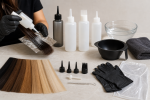
How to Choose and Use Wide Tint Brushes at Home

Direct answer: a wide tint brush is most useful when you need to cover broad, controlled sections of hair with a bowl-mixed product. Choose one with even synthetic bristles, moderate stiffness, a comfortable non-slip handle, and a tail that can separate the section size you plan to use. A wider brush can speed up saturation on long or dense hair, but it does not replace careful sectioning. Follow the exact color label for mixing, permitted tools, allergy precautions, application order, timing, and rinsing.
The right brush is a workflow choice, not a promise of a better color result. Width changes how much area each stroke covers. Bristle density changes how much mixture the brush holds and releases. Handle shape affects control when gloves become damp. Understanding those differences helps you choose a tool that matches the job instead of buying the largest brush by default.
Decide whether a wide brush fits the application
Wide brushes are designed for broad strokes. They can be efficient for coating mids and ends, refreshing long sections when the product instructions permit it, applying a lightener to a wide foil section, or working through dense hair with a deliberate sectioning plan. They are less precise around a hairline, short regrowth, narrow highlights, or areas where you must avoid overlap.
A standard-width or narrow brush may be easier for detailed root work. Some users keep two dedicated brushes: a smaller one for edges and regrowth, and a wider one for lengths. That is useful only when the formulas and work zones are clearly separated. Do not switch brushes between different mixtures without a cleaning and organization plan.
Before choosing any tool, read the product instructions. Some at-home systems use an applicator bottle rather than a bowl and brush. If the label supplies or specifies a method, use that method. The at-home hair color planning guide places brush choice inside the larger sequence of preparation, sectioning, timing, and safety.
Compare width, bristle density, and stiffness
Brush width should match the section width you can saturate evenly. A wide brush across an overly thick section may coat only the surface. A very narrow brush across large sections can slow the application enough to create avoidable timing differences. The section must remain thin enough for the product to reach the intended strands from the required sides.
Dense bristles hold more mixture, but excessive density can make a thick formula difficult to release. Sparse bristles may leave streaks and require repeated passes. Look for rows that are straight, evenly cut, and securely fixed in the brush head. Run a clean, dry brush across a hair swatch or paper towel before use to see whether the bristle edge makes a consistent line.
Stiffness controls the balance between spreading and flexibility:
- Soft bristles flex easily and can feel gentle, but may fold under a thick mixture.
- Medium bristles usually balance loading, spreading, and edge control for many bowl applications.
- Firm bristles can move dense product but may push too aggressively or create uneven pressure if the user works too quickly.
There is no universal best stiffness. Product texture, section size, hair density, and the required application method all matter. A strand test also helps you rehearse the tool angle and stroke before a full application.
Inspect the handle and sectioning tail
A good handle remains controllable with gloves. It should be long enough to keep your hand away from the loaded brush head but not so long that it catches nearby bowls or foil. Matte or lightly textured surfaces can be easier to grip than glossy, rounded handles. Avoid sharp molding seams that become uncomfortable during a long application.
Many tint brushes end in a pointed tail for parting. The point should separate hair without scratching the scalp. Use the tail to lift and organize sections, not to drag firmly across skin. If a product must be kept away from an irritated or damaged scalp, a pointed tool does not change that boundary.
A built-in comb edge can help align a clean section, but it can also collect product and make cleaning harder. Decide whether the comb has a real role in your process. Extra features are not useful when they reduce grip, add residue traps, or make the brush head too bulky for the intended area.
Prepare a controlled work area
Set out the exact product directions, gloves, timer, clips, protective covering, dedicated non-metal bowl when required, and enough brushes for the planned zones. Keep phones, faucets, door handles, food surfaces, children, and pets away from the active work area. Divide the hair before mixing so the application can begin without stopping to untangle or search for clips.
The U.S. Food and Drug Administration advises consumers to follow all label and package directions, complete the directed skin test before every use, wear gloves, keep hair dye away from the eye area, observe the stated processing time, and rinse the scalp well. A tint brush improves placement but does not remove the possibility of irritation or an adverse reaction.
Use only the components, ratio, and container method stated by the manufacturer. For a detailed comparison of bowl capacity and material, see the companion guide on choosing hair color mixing bowls. That new page is part of the same tool workflow and should be linked publicly after this batch is published.
Load and use a wide tint brush
Hold the brush near the balanced center of the handle rather than gripping at the very end. Dip only the bristle portion into the mixture and scrape one side lightly against the bowl edge if the label-directed consistency allows it. Overloading increases drips; underloading encourages repeated dry strokes that may not saturate the section.
Place the section on a suitable support when required, then use controlled strokes from the designated starting area toward the ends. Do not assume every product should touch the scalp or begin at the roots. Application order varies with the product, target, existing color, and whether the job is a first application or a retouch. Follow the package sequence.
After the first pass, turn or lift the section as appropriate and check the opposite side. The goal is visible, even coverage without scraping, repeatedly combing the same fragile area, or spreading mixture beyond the planned zone. Wipe accidental product from tools and protected surfaces promptly according to the product directions.
If your decision is still between permanent color, demi color, direct dye, or another route, review the hair color selection and application guide before choosing the brush. Tool selection should follow the formula and reader task, not lead them.
Use the brush for roots, lengths, foils, and glosses
Root retouch
A wide brush can work on broad root sections, but precision matters more than speed. Use thinner sections and a controlled amount of mixture. A smaller brush may be preferable around the face, ears, and short growth. Avoid dragging color repeatedly onto previously processed lengths unless the instructions specifically call for that overlap.
Mid-lengths and ends
The wide head can cover larger surfaces efficiently. Work in sections that allow access to the interior strands. Porous ends may absorb color differently from roots, so a uniform brush stroke does not mean every zone needs identical timing or product exposure.
Foil or isolated sections
Match the brush width to the foil and the selected hair section. Keep the loaded edge within the support area and maintain separation from neighboring hair. If the brush is wider than the section, it increases the chance of crossing the boundary.
Gloss or deposit refresh
A wide brush can distribute a bowl-mixed gloss when that method is directed, but some glosses use bottles or different application systems. Consult the exact instructions and compare the goal with the hair gloss color and fit guide.
Clean, dry, and replace the brush
Dispose of unused mixture as directed. Do not leave a brush sitting in active color longer than necessary. Rinse and clean the bristles, ferrule area, handle, tail, and any comb teeth using a method suitable for the product and tool material. Wear gloves during cleanup while residue remains.
Spread the bristles gently to inspect the base. Product trapped where the bristles enter the head can harden and affect the next application. Let the brush dry fully with air reaching the bristles before storing it in a clean, dedicated kit. Keep it separate from food or craft tools.
Replace the brush when bristles shed, bend permanently, split into uneven clumps, remain sticky, retain residue, or detach from the head. Replace a cracked handle or a sharp, damaged tail. A brush that has lost its straight edge can no longer make the controlled stroke it was selected to provide.
Final selection checklist
- Confirm that the product instructions allow a bowl-and-brush method.
- Match brush width to section width and precision needs.
- Choose even synthetic bristles with useful density and stiffness.
- Check the handle with a gloved hand.
- Inspect the tail for controlled, non-scratching sectioning.
- Use a separate brush when formula zones must remain distinct.
- Practice loading and stroke control on the strand-test section.
- Clean immediately, dry completely, and replace damaged tools.
A wide tint brush earns its place by making broad sections easier to cover without sacrificing visibility or control. The label still determines the formula, sequence, timing, and safety steps; the brush only helps execute that plan.
Sources and scope
The FDA hair dyes guidance supports the label, skin-test, glove, timing, eye-area, scalp-condition, and adverse-reaction boundaries in this article. The American Academy of Dermatology coloring guidance supports conservative color changes and following manufacturer instructions. Neither source ranks tint brushes or promises a particular cosmetic outcome.