Indigo Powder for Hair: Formula, Directions, and Compatibility Guide

Direct answer: before using indigo powder on hair, confirm that the complete ingredient list identifies the exact botanical formula, then follow that product’s one-step or two-step directions, mixing liquid, application window, timing, and compatibility warnings. Pure indigo powder is commonly associated with Indigofera tinctoria and can add a cool blue deposit. It does not lighten hair and does not create a predictable natural black result on every starting color by itself.
For brown-to-black botanical color, indigo is often used with a documented henna base or in an exact henna-indigo blend. Direct indigo on pale, white, or gray hair can look blue, green, or uneven. The starting canvas, sequence, ingredient ratio, freshness, saturation, and fully settled strand result must decide the plan.
Verify the powder’s complete identity
Read the botanical name and every additional ingredient. A package may contain pure indigo, a henna-indigo blend, another plant powder, salts, gums, direct dyes, oxidative colorants, fragrance, or an undisclosed mixture. Product color, scent, seller terminology, and a “natural black” name do not prove composition.
If the package lacks a complete ingredient list, has conflicting directions, or was transferred into an unmarked container, stop. Do not use a loose green powder as a hair-color experiment.
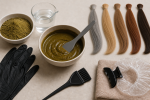
The green powder and fresh green paste in the editorial image represent an ingredient and handling context. They do not identify a brand, specify a ratio, or imply that paste color matches the final hair color.
Understand what indigo adds to the starting color
Indigo contributes a cool blue direction. Over a warm orange-copper henna base, that cool deposit can create a brown or deeper result because the visible color is a combination of layers. On pale hair without enough warm base, the same cool direction can remain blue-green.
On medium or dark brown hair, indigo may deepen or cool the appearance without making every strand uniform. It cannot remove natural pigment, permanent dye, direct dye, or dark bands. It cannot turn black hair lighter.
Use a level-and-tone framework such as the hair color chart guide to document the canvas and target. A conventional swatch chart does not predict a botanical overlay.
Choose one-step or two-step use from the label
In a one-step method, indigo and henna or another specified component may be combined in a manufacturer-directed formula and applied together. In a two-step method, a complete henna application creates a warm base before a separately mixed indigo application.
These methods are not interchangeable. A one-step brown blend may not create the same depth as a two-step sequence, and a two-step formula cannot be compressed into one bowl merely to save time. Follow the exact powder identities, proportions, preparation order, rinse boundary, and timing.
Do not substitute cassia, direct dye, permanent color, charcoal, coffee, or another dark powder for either component. Do not use an online ratio when the exact product provides different instructions.
Map gray and previous color by zone
Record natural level, gray percentage and pattern, white temples, resistant roots, permanent and demi-permanent color, direct dye, lightener, highlights, previous henna, previous indigo, other plant color, metallic or compound color if known, porous ends, and unknown history.
Gray hair can display a cool deposit much more clearly than adjacent dark strands. Previously henna-colored lengths may have enough warm base for a brown result while new gray roots do not. Repeated indigo on the midlengths can also make them much darker than new growth.
For readers who do not want full dark coverage, the gray hair transition guide provides a separate framework for preserving contrast and blending selectively.
Follow the exact mixing directions
Use only the stated liquid, temperature, and amount range. Many indigo products use water and call for a paste that can be distributed evenly, but the precise method belongs to the label. Do not automatically add acid because some henna methods use an acidic liquid.
Lemon juice, vinegar, baking soda, salt, tea, coffee, conditioner, oil, peroxide, and developer are not universal indigo additives. If a product permits a specific salt or other component, use only the named type and amount.
Use a clean bowl and compatible nonmetallic tool when directed. Mix enough for the planned sections. Do not use the photograph as a ratio reference, and do not thin a drying paste with an unapproved liquid during application.
Respect the fresh-use window
Indigo handling often differs from henna handling. A product may call for application soon after mixing rather than a long covered rest. Follow the exact mix-to-application window and do not let a prepared bowl sit while another service is completed.
Record powder amount, liquid, temperature, mix time, application start, application finish, and rinse time. Discard paste that is outside its stated use window or has unknown storage history.
Do not refrigerate, freeze, save, or reactivate mixed indigo unless the current directions explicitly authorize that method. A paste that remains green does not prove that its coloring performance is unchanged.
Complete every preliminary test
Follow all package-directed patch, allergy, sensitivity, and preliminary tests. The U.S. Food and Drug Administration’s hair-dye guidance advises following directions, wearing gloves, observing timing, rinsing thoroughly, avoiding use on a damaged scalp, and completing directed preliminary testing.
A previous use of henna does not establish that a separate indigo powder is suitable. Do not use hair color on eyebrows or eyelashes. Stop before application for an irritated, abraded, sunburned, or otherwise damaged scalp.
Build a sequence-specific strand test
Test hidden strands from gray roots, natural pigmented hair, henna-coated lengths, artificial color, highlights, and porous ends. Use the exact product batch, water, optional approved additive, one- or two-step sequence, section size, saturation, enclosure, and timing.
For a two-step plan, complete the henna step on the test strand, rinse as directed, then follow the stated interval and exact indigo step. A strand tested with indigo alone does not validate the two-step result.
Rinse and dry the strand fully. Evaluate the immediate color and again after the label’s stated settling or oxidation period. Note blue or green cast, brown depth, blackening, gray visibility, patchiness, transfer, roughness, tangling, and breakage.
Repeat the test if the maintenance plan will add more indigo later. Buildup can deepen lengths beyond the initial result even when the new-growth formula is unchanged.
Apply quickly but methodically
Prepare gloves, clips, protective covering, bowl, nonmetallic mixing tool, tint brush or directed applicator, timer, and rinse pathway before mixing. Protect fabrics and porous surfaces because botanical color can stain.
Use consistent subsections and directed saturation. Thick paste must reach the interior of each section without being forced into the eyes or rubbed harshly into the scalp. Keep track of the first and last section so application time does not silently extend the earliest area beyond the limit.
Do not add heat, extend the maximum, let the paste dry hard on the scalp, or leave it overnight unless the exact directions allow that method.
Control roots and previous buildup separately
After an initial result, distinguish uncolored new growth from indigo-coated lengths. A full-head maintenance application can make the midlengths and ends darker, cooler, or more opaque even when only the roots need color.
If the product directions and strand tests support root-focused maintenance, define the boundary and avoid casual overlap. If lengths need a permitted refresh, give that step its own formula and time rather than dragging root paste through automatically.
Photograph the fully dry result in consistent lighting and record every henna and indigo application. Visual fading does not necessarily mean all deposit is gone.
Do not correct a cool result with unplanned chemistry
If pale hair becomes blue-green or an area turns too dark, do not immediately apply bleach, permanent color, developer, a direct-dye remover, or another botanical layer. Identify the exact history and test any correction on representative strands.
The direct hair color guide explains a different pigment-deposit class. It does not authorize adding direct orange, red, blue, or black dye to indigo paste.
Preserve history before future chemical services
Keep the original package or a complete image of the ingredient list, directions, date, batch, sequence, and application zones. Disclose every indigo, henna, blend, compound plant color, and unknown powder before permanent color, lightener, a perm, relaxer, or smoothing service.
Do not assume clarifying shampoo, visible fading, or months of growth makes the colored lengths equivalent to untreated hair. Lightener over indigo can expose unpredictable cool tones or react poorly with an unknown compound formula.
Unexpected heat, smoke, odor, unusual discoloration, gummy texture, severe tangling, or breakage during a compatibility strand test is an immediate stop condition. The American Academy of Dermatology’s coloring and perming guidance supports manufacturer testing and conservative spacing around chemical changes.
Rinse, settle, and document
At the directed time, rinse with the stated water temperature and finishing method, keeping runoff out of the eyes. Do not scratch the scalp or pull dried paste through tangled lengths.
Use only the directed cleanser or conditioner. After complete drying and the stated settling period, document gray coverage, blue-green cast, brown or black depth, root-to-length balance, transfer, staining, tangling, roughness, and breakage.
Indigo powder checklist
- The exact botanical and every additive are documented.
- Pure indigo, henna-indigo blends, compound powders, and unknown black-color products are separated.
- The plan specifies a label-directed one-step or two-step method.
- Gray, henna base, artificial color, highlights, prior indigo, porous ends, and unknown history are mapped by zone.
- The mixing liquid, optional additive, temperature, use window, enclosure, and time follow the exact directions.
- Directed preliminary testing and sequence-specific, fully settled strand tests are complete.
- No acid, salt, peroxide, developer, direct dye, household ingredient, or other powder is added without exact authorization.
- Root maintenance and full-length buildup are planned separately.
- The complete plant-color history is preserved before later color, lightener, perm, relaxer, or smoothing services.
- Reaction, contamination, blue-green cast, excessive darkening, unexpected heat, roughness, tangling, and breakage have stop rules.
Indigo powder is most controllable when its identity, warm base, sequence, fresh-use window, and long-term buildup are documented. If the ingredient list, application window, or strand evidence is uncertain, do not proceed on the full head.