How to Choose and Use Hair Color Stain Remover Wipes at Home

Direct answer: choose a hair color stain remover wipe that explicitly permits use on the intended intact skin area and is compatible with the color service directions. Use one moist, intact wipe on a small fresh mark along the outer hairline, working away from the eyes, eyebrows, lips, and broken or irritated skin. Apply light passes instead of prolonged rubbing, then follow any directed rinse or cleanup. Discard the wipe immediately. These wipes are for limited external cleanup; they do not remove color from hair, reverse a color result, neutralize every ingredient, or make skin contact harmless.
A stain remover wipe is different from a color remover used on hair, a makeup wipe, household cleaning wipe, disinfectant, or baby wipe. The decision begins with intended use, ingredient disclosure, location limits, moisture, texture, and single-use handling.
Read the intended-use directions
Confirm that the package identifies hair-color stains on skin as an intended use. Check warnings, prohibited areas, contact time, rinse directions, storage, and what to do after a reaction. A familiar wipe format does not establish cosmetic compatibility.
Do not use a wipe meant for counters, tools, floors, nails, or hair strands on facial or neck skin. Do not combine several cleanup products unless their directions permit that sequence.
The hair dye remover guide explains why correcting color in the hair is a separate decision from cleaning a small mark on skin.
Review ingredients and personal limits
Read the current ingredient list and any fragrance, alcohol, oil, preservative, or exfoliating component disclosures. Avoid ingredients you know you cannot use. Fragrance-free does not guarantee that a wipe is suitable for every person.
If the directions call for a preliminary check, complete it as specified. Do not assume that the hair-dye allergy alert test also evaluates the wipe, or that a wipe test replaces the dye test.
Use only on intact skin. Scratches, dermatitis, sunburn, recent exfoliation, active irritation, and a prior reaction are reasons to stop and follow appropriate product or professional guidance.
Compare moisture and fabric texture
A useful wipe is evenly moist without dripping. A dry edge creates friction, while excess liquid can run toward the eye, ear, neck, or hair. The sheet should unfold without tearing and remain cohesive during light passes.
Smooth nonwoven fabric can reduce abrasion. Heavy embossing may increase mechanical action but also friction. Choose texture for controlled cleanup, not aggressive scrubbing.
Reject wipes that are dried out, discolored, contaminated, stuck together, unusually odorous, or from a damaged seal. Do not rehydrate a dry wipe with water or another product.
Choose size for controlled spot use
A small folded wipe provides a clean edge for a narrow hairline mark. A large sheet may be useful when folded into several clean surfaces, but it is easier to drag across unaffected skin. Size should support precision rather than broad facial wiping.
Prepare enough wipes before application, but keep the container closed. One stained surface should not be repeatedly folded inward and returned to clean skin. Use a fresh area or a new wipe as directed.
The at-home color planning guide helps prevent stains through controlled sectioning, brush loading, protective clothing, and organized cleanup.
Clean fresh marks promptly and gently
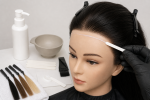
Put on clean label-directed gloves and move coated hair away from the area. Start at the outer edge of the mark and use short light passes. Keep movement away from the eye and away from clean hair.
Do not hold the wipe on skin longer than directed. Do not scrub until the skin becomes red. If color remains after the permitted use, stop rather than escalating pressure or adding household products.
Use a mirror and good neutral lighting. A faint residual tint can appear stronger under warm light; irritated skin should not be mistaken for remaining dye.
Keep wipes away from sensitive areas
Do not use on eyelids, lash lines, eyebrows, inside the ear, nostrils, lips, mouth, or other mucosal areas unless the exact product expressly permits that location. Scalp hair dye should never be used on eyebrows or eyelashes.
If product enters the eye, follow the hair-color label’s eye-exposure directions immediately. A stain wipe is not an eyewash. Seek appropriate assistance when symptoms or directions require it.
Do not clean a large spill across the face with repeated wipes. Stop the service and follow the original product’s exposure instructions.
Separate clean and used materials
Dispense a wipe without touching the remaining stack with contaminated gloves. Close the lid or seal immediately to preserve moisture and cleanliness. Keep clean wipes away from the active bowl, brushes, used towels, and hair clippings.
Place each used wipe directly into a lined waste container. Do not set it on a counter, reuse its reverse side on another person, or flush it unless the manufacturer and local system permit that disposal route.
Wash and dry hands after glove removal, even when the wipe appeared intact and no reaction occurred.
Store the container correctly
Keep wipes in their original closed container at the directed temperature, away from heat, sunlight, freezing, children, pets, and food. Store the opening upward when required to reduce leakage and drying.
Discard expired wipes and containers with broken seals, unreadable directions, altered odor, mold, discoloration, or uncertain identity. Do not transfer wipes into an unlabeled jar.
Know the limits of stain cleanup
The U.S. Food and Drug Administration advises following hair-dye directions, completing the directed skin test before each use, wearing gloves, keeping dye away from the eyes, observing processing time, and rinsing the scalp well. Cleanup after contact does not replace prevention.
The American Academy of Dermatology notes that lightening more than three shades generally requires stronger peroxide and can cause more damage. A wipe has no role in determining hair lift, formula strength, or suitability for corrective work.
Stop using the wipe if burning, swelling, hives, blistering, persistent redness, or other concerning symptoms occur. Follow product directions and seek appropriate help rather than continuing to rub.
Common stain-remover wipe mistakes
- Using a household or surface-cleaning wipe on skin.
- Assuming the wipe is suitable near eyes or lips.
- Scrubbing dry or irritated skin.
- Using one contaminated surface repeatedly.
- Mixing the wipe with alcohol, bleach, or improvised cleaners.
- Returning a used wipe to the container.
- Rehydrating a dried sheet.
- Confusing skin cleanup with hair color correction.
The hair color application guide provides broader formula, section, timing, and safety context.
Final wipe checklist
- Verify intended use on the exact intact skin area.
- Read ingredients, warnings, and rinse directions.
- Check seal, moisture, texture, and expiration.
- Move hair and keep cleanup away from eyes and lips.
- Use short light passes on a small fresh mark.
- Stop at irritation or the label’s use limit.
- Discard each wipe after one use.
- Close and store the original container correctly.
Sources and scope
The FDA hair dyes guidance supports the label, skin-test, glove, timing, eye-area, scalp-condition, and adverse-reaction boundaries used here. The American Academy of Dermatology coloring guidance supports conservative shade changes and damage-reduction limits. Neither source endorses stain-remover wipe ingredients, texture, effectiveness, brand, or suitability for an individual.