Ribbon Highlights: Placement, Sectioning, and Upkeep Guide

Direct answer: ribbon highlights are deliberately visible bands of lighter or contrasting color separated by enough base-colored hair to keep each ribbon distinct. Plan them by deciding where the bands should appear in the finished hairstyle, matching their width and direction to the haircut, testing every materially different canvas, preserving negative space, and maintaining roots, tone, and ends as separate jobs.
Unlike a fine blended highlight, a ribbon should remain readable from a normal viewing distance. That does not require identical stripes. The most convincing maps use changes in width, spacing, and starting height to follow movement while retaining a clear rhythm of light and depth.
Define the finished-view objective
Begin with the way the hair is usually parted and worn. Photograph it loose, tucked, gathered, straightened, and in its natural texture when those views matter. Mark the areas where a ribbon should be obvious, partially visible, or hidden. A band placed under a heavy top layer may disappear when the hair is loose, while one placed directly on the part can dominate every view.
Choose whether the result should frame the face, travel through the crown, emphasize the mid-lengths, or repeat around the perimeter. Write the priority views before drawing sections. This keeps the map tied to a visible outcome instead of to a foil count.
Choose ribbon width and negative space together
Ribbon width controls how graphic the highlight appears, but the darker hair between ribbons is equally important. Narrow gaps can merge several bands into one pale field. Wide gaps produce stronger contrast and allow each band to stand alone. Record both measurements rather than describing a map only as fine, medium, or bold.
Use narrower bands near sparse temples or short layers and broader bands where dense lengths can support them. Preserve enough base at the root and interior to prevent an unintentionally solid blonde result. If maximum brightness is the goal, confirm that the intended look is still ribbons rather than an all-over lightening service.
Map sections to haircut movement
Follow the fall of the cut. Horizontal sections can create strong stacked bands, diagonal sections can travel with face-framing layers, and curved or pivoting sections can support movement around the head. Release each proposed section and observe where it lands before committing to the complete map.
Layered cuts may split one ribbon into several visible ends. Blunt cuts can concentrate a band near the perimeter. Waves and curls rotate the surface, so keep natural curl groups intact where possible and check the map dry. The long hair styles guide can help compare how braids, half-up styles, and low-tension gathered looks reveal different placement zones.
Audit the starting canvas by zone
Record natural level, permanent color, direct dye, previous lightening, exposed undertone, gray distribution, porosity, elasticity, and breakage risk at the root, mid-length, and ends. A band crossing all three zones may not support one formula or one processing time.
Identify old highlight lines and pale ends before sectioning. Reusing the same broad ribbon without accounting for previous placement can widen the light area or overlap fragile hair. Dark artificial color may also lift unevenly. Revise the target, map, or service approach when the canvas cannot support a clean continuous band.
Strand-test representative ribbons
Test a section with the same width, saturation, previous color, and condition as the planned ribbon. If the front, crown, and ends differ, test each meaningful canvas. Record product, mixture, developer or activator, application order, timing, insulation, rinse method, and fully dry result.
Judge lift, warmth, elasticity, porosity, and whether the proposed tone remains distinct beside the base. A successful fine strand does not establish that a broad saturated section will behave identically. Use the result to adjust band width, target lightness, application order, or the decision to seek a qualified colorist.
Build a repeatable section map
Draw the part, hairline, crown, side, and nape landmarks. Number the ribbons and note width, spacing, direction, starting height, and the base hair preserved between them. Take a clear photograph of the dry map or foil pattern for later maintenance.
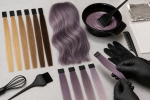
Use clean clips, a tail comb, brushes, gloves, foils or another product-supported barrier, towels, and separate timers. Maintain full saturation inside each selected band without allowing excess product to cross the section boundary. Follow current product directions for mixture, application area, processing, and rinsing.
Coordinate clocks and protect pale ends
Start resistant areas earlier only when testing and label directions support that sequence. Finer hairline sections or porous ends may need a different application time, formula, or protection plan. Do not keep a finished ribbon processing merely to make a slower section catch up.
Previously pale ends often need isolation rather than another full pass. Mark where fresh application stops and use barriers carefully. Repeated overlap can reduce strength and make the ribbon look thinner or fuzzy instead of polished. Dry the hair completely before assessing lift and connection.
Select tone for contrast and fade
A ribbon can be warm, neutral, cool, or vivid, but its tone should work with the exposed undertone and surrounding base. Extremely cool deposit on uneven yellow and orange canvases can produce inconsistent results. Porous ends may also absorb more pigment and appear darker than the root area.
Define what a toner or gloss is intended to change and test contact time where absorption differs. The hair gloss guide explains how to compare deposit, tone, shine, and washout. For a warm ribbon direction, the red hair color ideas guide provides related contrast and fade considerations.
Plan root, tone, and end upkeep separately
Root growth changes the starting height of each ribbon. A narrow root reconnect can preserve the original width without pulling lightener through the lengths. Tonal fade may need a deposit-only refresh, while dry or fragile ends may need condition-focused care and less frequent chemical handling.
Track the map, root gap, tonal shift, and end condition at each review. Wash frequency, water exposure, heat, sun, and porosity affect fade. Use moderate heat and labeled heat protection, condition the lengths, and avoid widening ribbons during every root appointment. Keep the original map and dry-result photographs available for comparison.
Follow hair-color safety boundaries
Follow the label and enclosed instructions for every product, including preliminary test directions, gloves, timing, rinsing, and restrictions. The FDA hair-dye guidance explains that reactions can occur after earlier uneventful use and that scalp hair dye should not be used on eyebrows or eyelashes. Do not apply color over an irritated or damaged scalp.
The American Academy of Dermatology coloring guidance recommends conservative shade changes and following manufacturer testing directions. These precautions do not establish one universal ribbon formula or an assured result. Major lightening, old dark dye, severe banding, or fragile hair warrants qualified professional assessment.
Ribbon-highlight checklist
- Define the finished views where ribbons should appear.
- Record band width and negative-space width together.
- Align section direction with the part, haircut, texture, and movement.
- Audit previous color, level, undertone, porosity, and condition by zone.
- Test representative broad sections rather than relying on a fine strand.
- Number the map and document starting height, spacing, and application order.
- Protect pale ends and use separate clocks where the tested canvases differ.
- Maintain root connection, tone, and end condition as separate tasks.
Ribbon highlights look intentional when visible bands and preserved depth are designed as one system. A dry-view map, representative testing, controlled saturation, and a recorded maintenance plan make the pattern easier to evaluate and reproduce.