Clay Hair Lightener: Formula, Directions, and Compatibility Guide

Direct answer: use a clay hair lightener only for the placement method, developer, ratio, starting canvas, enclosure conditions, and processing limit stated by the manufacturer. Its clay-like texture may be designed to stay where it is placed, often for selected painted sections, but texture does not prove that every formula is open-air, off-scalp, suitable for balayage, or safe to enclose. Verify the complete label, complete directed preliminary testing, and test the exact mixture on representative strands before broader use.
Clay lightener is an oxidative lightening system, not hair color, toner, dry shampoo, or cosmetic clay. It removes natural or artificial pigment to varying degrees while exposing underlying warmth. Product chemistry, developer, mixture thickness, section size, saturation, temperature, prior color, and hair condition all affect the result. No fixed level of lift can be assumed from the word “clay.”
Identify the exact placement the formula allows
Read whether the lightener is approved for on-scalp use, off-scalp use, open-air painting, enclosed sections, or a specific combination. Do not infer placement from a photograph, online technique name, or the fact that the mixture forms a shell.
A formula intended only for off-scalp work should remain at the distance and on the section types specified in its directions. A product that permits open-air painting is not automatically approved for foil, plastic film, heat, or scalp application. Enclosure can change moisture retention, heat, expansion, and processing behavior.
Map the intended result before mixing: surface brightness, ribbons, face-frame pieces, ends, or another manufacturer-supported placement. The long hair placement and care guide helps readers consider length, section visibility, friction, and upkeep without providing a chemical formula.
Separate clay lightener from other product classes
Powder, cream, oil, and clay lighteners can have different ratios, textures, swell, drying behavior, lift ranges, and scalp restrictions. Do not convert one type into another by adding thickener, conditioner, shampoo, water, oil, flour, cosmetic clay, or more powder.
Direct dye deposits ready-made pigment and does not perform the same job. The direct hair color formula guide helps distinguish deposit from oxidative lightening. Direct color should not be mixed into a clay lightener unless the lightener manufacturer expressly provides that use.
High-lift permanent color is also different: it combines lift and oxidative dye deposit within a named color system. A clay lightener should not be mixed with permanent color to create a hybrid formula.
Assess the starting canvas and color history
Record natural level, artificial-color history, direct dyes, metallic or compound dyes if known, henna or plant color, previous lightening, perms, relaxers, smoothing services, gray, bands, highlights, breakage, elasticity, and porosity. Unknown history is a stop signal, not a reason to use a stronger developer.
Natural pigment, permanent color, direct dye, and mineral discoloration may lift differently. Existing bands can become more visible as the surrounding hair lightens. Pale or porous ends may change rapidly while darker artificial sections remain warm or resist change.
The warm hair color guide helps identify gold, orange, and red directions that may appear during lightening. Exposed warmth is not proof that the lightener has failed or that processing should continue beyond the limit.
Check hair and scalp condition before mixing
Do not proceed on a scalp that is irritated, abraded, sunburned, or otherwise damaged. Even an off-scalp formula can contact skin through poor placement, movement, or rinsing. Protect the skin and workspace as directed.
Examine hidden strands for severe roughness, breakage, gummy texture, excessive stretch, or inability to withstand gentle handling. A bond additive, conditioner, or lower developer cannot establish suitability when the hair fails the condition check.
When prior chemistry and breakage patterns are complex, a licensed color professional may be needed to assess whether any additional lightening is appropriate.
Use only the named developer
Match the clay lightener with the developer type and strength allowed by the product. Check whether scalp and off-scalp placements have different limits. Do not substitute a stronger developer to chase more lift or a different brand because the bottle uses the same volume number.
Developer strength, ratio, and amount influence oxidation, consistency, spread, drying, and hair exposure. Changing one variable can invalidate the intended application behavior. A lower strength is not permission to exceed the maximum time.
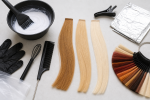
The accepted editorial image uses an opaque, unbranded developer bottle and contains no water-mixing cue. Never add water unless the exact directions explicitly require it.
Measure the ratio and consistency
Use a scale or volume measure according to the directions. Record the powder or clay-lightener amount and developer amount in one unit system. Add components in the stated order and mix in a nonmetallic bowl with the specified tool.
The correct consistency is the one produced by the approved ratio. A mixture that feels too thick should not be loosened with water or conditioner. A mixture that feels too thin should not be corrected with extra powder after guessing. Recheck the measurement and directions; discard and remake the batch when required.
Mix in a ventilated area while minimizing airborne powder as instructed. Do not place the face over the bowl or deliberately inhale dust. Clean spills using the method on the label.
Use safety testing and representative strand tests
Follow every preliminary test and precaution supplied by the lightener. The U.S. Food and Drug Administration’s hair-dye guidance advises following package directions, wearing gloves, observing timing, rinsing thoroughly, avoiding a damaged scalp, and completing directed preliminary testing.
For the color-and-condition test, select hidden strands representing natural hair, old permanent color, direct-dye residue, a dark band, prior highlights, fragile ends, and any materially different zone. Use the exact lightener, developer, ratio, section thickness, saturation, placement surface, and enclosure condition planned for use.
Check only at intervals allowed by the manufacturer and do not scrape, stretch, or repeatedly manipulate the strand. Rinse at the maximum time or earlier when the target or a stop condition is reached. Dry completely before assessing level, warmth, banding, elasticity, breakage, texture, and whether later toning would be plausible.
Control section size and saturation
Prepare clips, gloves, timer, protective covering, bowl, brush, and enough fresh mixture. Divide the hair before mixing. Thin, consistent subsections support controlled placement; very thick sections can create uneven contact and interior dark spots.
Apply the amount directed for the product and technique. A clay shell on the outside of a section does not prove that the interior is saturated. At the same time, forcing product through every hair can defeat an intended surface-painting design.
Keep the product away from unintended hair, scalp, eyes, clothing, and surfaces. Do not use scalp lightener on eyelashes or eyebrows.
Manage open-air drying and enclosure rules
Some clay formulas are designed to remain workable or form an outer shell while processing in air. Others have different instructions. Do not mist a drying section with water, add more developer on top, cover it with foil, or reapply fresh mixture unless the manufacturer provides that step.
If backing material, film, cotton, foil, mesh, or no separator is specified, follow that direction. The clear protective sheet in the editorial image represents workspace protection, not automatic section enclosure.
A dry-looking surface does not authorize extra time. Processing ends at the label maximum even when the target has not been reached.
Plan the target and later tone separately
Lightener exposes a level and undertone; it does not guarantee the finished shade. Decide in advance what dry level would support the intended toner or direct-color plan. Do not continue lightening solely to remove every trace of warmth.
If different zones reach different levels, one toner may not create an even result. Record the dry strand outcomes and choose zone-specific next steps only within compatible product directions.
Know the stop conditions
Stop before mixing if the product identity, developer, ratio, placement permission, enclosure rule, maximum time, starting history, or target is unknown. Also stop for an irritated scalp, damaged hair, incompatible prior chemistry, or strand tests showing breakage, gummy texture, severe roughness, unacceptable banding, or insufficient condition for the plan.
During use, rinse as directed if there is intense burning, swelling, blistering, breathing difficulty, spreading rash, eye exposure, unexpected heat, leakage toward the scalp, severe breakage, or another concerning reaction. Seek appropriate medical help for a serious reaction. The American Academy of Dermatology’s hair coloring and chemical-service guidance supports manufacturer testing and conservative spacing of chemical changes.
Rinse and document the result
Remove separators carefully and rinse at the directed time with the specified water temperature and method. Keep runoff away from the eyes. Use only the named cleanser, conditioner, or finishing step.
Assess the result after complete drying. Record starting level and history by zone, formula, developer, ratio, placement, section size, enclosure, check times, rinse time, dry level, exposed warmth, and hair condition. Discard mixed lightener according to the directions; never seal it for later use.
Clay lightener checklist
- The exact product class, developer, ratio, placement, scalp limit, enclosure rule, and maximum time are known.
- Natural hair, artificial color, direct dye, bands, highlights, and fragile ends are mapped separately.
- No water, conditioner, household clay, unrelated powder, or unapproved additive enters the formula.
- Directed preliminary testing and exact representative strand tests are complete.
- Section size, saturation, separator, timing, and target-level decisions are documented.
- The plan does not rely on adding heat, rewetting, extending time, or using stronger developer.
- Scalp, reaction, heat, leakage, breakage, elasticity, texture, banding, and maximum-time stop conditions are defined.
A clay lightener is useful only when its exact chemistry and placement rules fit the starting canvas. If the history, formula, or strand evidence remains uncertain, stop rather than forcing a lighter result.