Violet Powder Hair Lightener: Formula, Directions, and Compatibility Guide

Direct answer: violet powder hair lightener is a pigment-removal product whose violet color is part of the formula, not a substitute for a finished toner or purple hair dye. Use the exact developer, ratio, scalp or off-scalp placement, enclosure, and maximum time on the label. Violet relates most directly to yellow in a simplified color model, but the powder does not promise a neutral blonde result or control every orange and red stage. Verify the dry result with representative strand tests.
The mixture’s violet appearance can make the wet canvas look cooler than it will after rinsing. Starting level, artificial-color history, developer, ratio, saturation, section geometry, temperature, and timing determine the exposed level and warmth. Evaluate only after complete drying.
Separate violet powder from toner and purple dye
Lightener removes pigment through oxidation. A toner adjusts tone on a suitable canvas, while direct purple dye deposits visible pigment. These are different formula classes with separate activators, ratios, timing, and goals.
Do not add purple dye, violet shampoo, toner, conditioner, or cosmetic pigment to violet powder. The purple hair dye formula guide helps readers choose an intentional purple color after the base is known; it is not a lightener additive guide.
The dark purple hair dye guide further shows why a deep deposit goal differs from exposing a lighter canvas. A violet bowl does not mean the hair is being dyed purple.
Use the color wheel only as context
Violet and yellow oppose each other in a simplified model. This can explain why a manufacturer chooses a violet powder color, but it does not establish how much yellow the product can visually moderate or whether pigment remains after rinsing.
Hair can expose red, orange, yellow-orange, or yellow at different levels. Violet is not the direct opposite of orange or red. If the strand remains orange, extending time until the violet mixture appears to cancel it can exceed the processing limit.
The warm hair color guide helps identify gold, orange, copper, and red directions before a later tone is selected.
Read the exact powder contract
Confirm product identity, powder handling, ventilation, named developer, permitted strengths, ratio, measuring method, mixing order, scalp permission, section enclosure, check intervals, maximum time, and rinse method. Violet powders from separate lines are not interchangeable.
Check whether the product is compact, dust-reduced, standard powder, or a kit component. Powder color does not reveal lift strength, dust behavior, or scalp suitability.
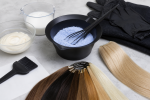
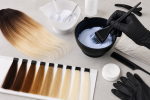
The editorial image shows contained violet powder, opaque white developer, tools, swatches, and a pale test strand. It does not identify brand, developer strength, ratio, or expected outcome.
Map the canvas before choosing a formula
Record natural level, permanent and demi-permanent color, direct dye, plant color, metallic or compound color if known, previous lightener, highlights, gray, bands, porosity, elasticity, and breakage. Separate natural roots, artificial-color midlengths, pale ends, hairline, and fragile zones.
Natural hair and artificial color can expose different warmth. A dark band may remain red-orange while natural sections become yellow. Porous pale ends may collect a temporary violet cast or sustain additional stress. One mixture cannot be assumed to make these zones uniform.
Unknown chemical history, severe breakage, gummy texture, or inability to withstand gentle handling is a stop signal rather than a reason to lower the ratio or change developer.
Confirm scalp and placement limits
Read whether the exact powder permits on-scalp use, off-scalp use, both, or a named technique. Follow any different developer, minimum scalp distance, enclosure, and time rules for each placement.
Do not place off-scalp powder at the root because the violet pigment looks gentle. Do not enclose an open-air formula because a foil appears in an image. Avoid an irritated, abraded, sunburned, or otherwise damaged scalp, and never use scalp lightener on eyelashes or eyebrows.
Measure developer and powder exactly
Use only the developer family and strength approved for the starting canvas, target, and placement. Same-volume bottles from other systems are not automatically compatible.
Measure powder and developer by the label’s weight or volume method and keep one unit system. If ratios vary by technique, select the ratio assigned to the planned scalp, foil, open-air, or freehand method.
Do not add water, shampoo, conditioner, oil, toner, purple dye, or extra developer to alter the violet shade or consistency. Remake an incorrectly measured batch rather than repairing it by eye.
Control powder handling and mixing
Work in the ventilation conditions specified for the powder. Keep the transfer distance short, move the scoop gently, and avoid placing the face above the bowl. A colored powder can still create airborne particles.
Add developer in the stated order and wet the powder carefully before mixing to the directed consistency. Do not whisk dry powder rapidly or blow residue from a surface.
Do not use mixture color, warmth, bubbles, or texture as an activation test. The measured formula and timing control use.
Complete preliminary and strand testing
Follow every preliminary test and precaution provided with the system. The U.S. Food and Drug Administration’s hair-dye guidance advises following directions, wearing gloves, observing timing, rinsing thoroughly, avoiding a damaged scalp, and completing directed preliminary testing.
Select hidden samples representing natural roots, gray, old permanent color, direct-dye residue, dark bands, previous highlights, resistant hair, and porous ends. Use the exact violet powder, developer, ratio, section size, saturation, backing, enclosure, and time planned for use.
Rinse at the target or maximum time and dry fully. Evaluate achieved level, remaining yellow or orange, unexpected violet or gray cast, banding, elasticity, breakage, roughness, and whether a separate toner could fit the actual canvas.
Plan sections and saturation
Prepare gloves, timer, clips, protective covering, nonmetallic bowl, brush, separators, and enough fresh mixture before activation. Divide the hair so application can proceed consistently.
Use uniform subsections and directed saturation. Keep product away from hair intended to remain dark and avoid unsupported overlap on established pale lengths. Root heat, artificial bands, and fragile ends may need separate placement plans.
Follow enclosure, heat, and timing instructions
Use only the foil, film, mesh, cotton, open-air, or other separator allowed by the product. Enclosure and scalp heat can change temperature, moisture, expansion, and processing speed.
Do not add external heat, wrap the entire head, mist drying product, or refresh a slow section with new mixture unless the directions provide that step.
Start timing at the named event and inspect only at allowed intervals. Stop at the maximum time even when yellow remains. Wet violet mixture can visually mask warmth and is not a reason to continue.
Keep later toning as a separate decision
After rinsing and complete drying, map the actual levels and undertones. A pale yellow zone and an orange band may require different compatible plans. One toner can respond differently across uneven porosity and level.
Do not assume no toner is needed because violet was present in the powder. Do not automatically apply purple dye because the target is cool. Use dry strand evidence and the later product’s own directions.
Recognize stop conditions
Stop before mixing if powder identity, developer, ratio, scalp permission, enclosure, maximum time, prior chemistry, or target is unknown. Also stop for a damaged scalp, weak hair, or strand tests showing severe banding, unexpected violet or gray cast, breakage, gummy texture, severe roughness, or insufficient condition.
During use, rinse as directed for intense burning, swelling, blistering, breathing difficulty, spreading rash, eye exposure, unexpected heat, inhalation concern, leakage toward the scalp, severe breakage, or another concerning reaction. Seek appropriate medical help for a serious reaction. The American Academy of Dermatology’s hair coloring guidance supports manufacturer testing and conservative spacing of chemical changes.
Rinse and document
Remove separators carefully and rinse at the specified time and temperature, keeping runoff away from the eyes. Use only the named cleanser, conditioner, or finishing step.
After complete drying, record starting level and history by zone, powder and developer amounts, ratio, placement, saturation, enclosure, timing, dry level, warmth, cool cast, and hair condition. Discard mixed product as directed.
Violet powder lightener checklist
- The violet powder is understood as lightener, not a finished toner or purple dye.
- Yellow, orange, red-orange, artificial bands, and porous pale zones are identified separately.
- Developer, ratio, powder controls, scalp permission, enclosure, and maximum time come from the exact label.
- No water, conditioner, shampoo, oil, toner, purple dye, or unrelated developer enters the mixture.
- Directed preliminary testing and fully dried representative strand tests are complete.
- Sectioning, saturation, overlap, heat, timing, and later toning are separate documented decisions.
- Reaction, inhalation concern, heat, leakage, banding, unexpected cast, breakage, and maximum-time stop conditions are defined.
Violet powder can provide a useful formula context, but it cannot replace dry undertone diagnosis or a compatible later tone. If the mixture color hides the true canvas or strand evidence does not support the target, stop rather than extending processing.