On-Scalp Hair Lightener: Formula, Directions, and Compatibility Guide

Direct answer: use a hair lightener on the scalp only when the exact product explicitly permits on-scalp application and only with its approved developer, ratio, application method, and maximum time. “Lightener” alone does not establish scalp permission. Check scalp condition, map natural regrowth and previously lightened hair, complete directed preliminary testing and representative strand tests, and keep immediate rinse instructions available before mixing.
On-scalp lightening combines oxidative chemistry with skin contact and scalp heat. Product class, developer, natural level, artificial-color history, regrowth length, section size, saturation, application speed, and timing affect the result. A cream texture, oil label, blue or violet color, or low developer number does not establish comfort or suitability.
Find explicit on-scalp authorization
Read the product identity, warnings, developer chart, ratio, application surfaces, maximum time, and rinse directions. The label should clearly allow on-scalp use for the selected combination. If directions mention off-scalp use only, do not move the formula to the root.
Check whether the product permits all-over virgin application, regrowth retouch, selected root sections, or another named method. On-scalp permission for one developer strength does not authorize every strength in the line.
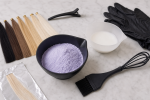
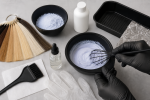
The editorial image shows a root-to-light test strand and formula tools but does not depict or authorize scalp contact. Foil shown as a tool does not establish that the on-scalp formula may be enclosed.
Inspect the scalp before product preparation
Do not apply lightener to an irritated, abraded, scratched, sunburned, recently injured, or otherwise damaged scalp. Stop when there is unexplained redness, open skin, blistering, or another condition inconsistent with the label.
Do not scratch, vigorously brush, or use an abrasive scalp product before application. Follow the manufacturer’s hair-washing and preparation directions rather than a generic rule.
Never apply scalp lightener to eyelashes or eyebrows. Keep the mixture away from the eyes, face, ears, and unintended skin.
Map natural regrowth and prior lightener
Separate natural roots from permanent color, demi-permanent color, direct dye, previous lightener, highlights, gray, bands, and porous lengths. Measure the actual regrowth rather than assuming the entire root area is natural.
Fresh natural regrowth can respond differently from previously lightened hair. Overlapping lightener onto an established pale band can increase breakage and produce uneven porosity. Dark artificial color near the root may not lift like natural pigment.
The gray transition guide helps map natural gray, old color, and regrowth boundaries before a scalp formula is chosen.
Understand scalp heat and application sequence
Heat from the scalp can change processing compared with hair farther away. Follow the exact sequence for virgin application or retouch work rather than using a generic root-first rule.
For a retouch, define the regrowth boundary and use controlled sections. Do not drag fresh lightener through old lengths to refresh brightness. For a first application, follow the manufacturer’s root, midlength, and end sequence and timing.
When the head contains natural roots, dark bands, gray, old highlights, and fragile ends, one application plan may not support an even target. Strand-test those zones separately or seek qualified color assistance.
Choose only the approved product class
Powder, cream, oil, clay, and kit lighteners can have different scalp permissions. A product approved for off-scalp balayage is not converted into scalp lightener by changing the ratio. A high-lift permanent color is also a different formula class.
Do not substitute a lightener because its texture seems gentler or its powder color appears cool. Verify the current technical directions for the exact container and components.
Use the named developer and ratio
Select only the developer family and strength allowed for on-scalp use with the exact lightener. The off-scalp chart may permit options that the scalp chart does not. A matching volume number from another brand is not proof of compatibility.
Measure lightener and developer by the stated weight or volume method. Keep one unit system and record the batch. If additives are allowed, determine whether they change the developer calculation or timing.
Do not add water, conditioner, shampoo, oil, toner, color, or extra developer to change consistency or perceived strength. A lower developer does not authorize processing past the maximum time.
Complete preliminary tests and scalp-relevant strand tests
Follow all preliminary tests and precautions supplied with the system. The U.S. Food and Drug Administration’s hair-dye guidance advises following package directions, wearing gloves, observing timing, rinsing thoroughly, avoiding a damaged scalp, and completing directed preliminary testing.
A strand test should represent natural root, gray, resistant hair, artificial-color bands, previous highlights, and porous ends. Use the exact product, developer, ratio, section size, saturation, and timing planned for use.
Dry the tested strands completely and evaluate level, exposed warmth, banding, elasticity, breakage, roughness, and whether root and old lengths can remain separate. A skin test does not predict these color and condition outcomes.
Prepare for a complete, prompt application
Arrange gloves, timer, clips, protective covering, nonmetallic bowl or approved applicator, brush, cotton or barrier materials when directed, and enough fresh mixture. Section before activation so the scalp is not exposed for inconsistent periods caused by slow preparation.
Use thin, controlled subsections and the saturation specified by the product. Keep the mixture in its intended root zone. Do not comb lightener through old lengths or press it onto the scalp more heavily to force lift.
Do not improvise heat or enclosure
Follow the exact rule for open air, cap, film, foil, or other enclosure. Scalp heat already affects processing. Do not add a dryer, heating cap, blanket, or full-head wrap unless the directions expressly allow it.
Foil near the scalp can change temperature and product movement. The foil in the editorial setup is not universal permission for on-scalp sections.
Monitor without overriding the maximum
Start timing at the event named by the manufacturer. Check only at allowed intervals and without repeatedly scraping, stretching, or disturbing the section.
Do not extend time because the target is not reached, add fresh mixture to slow areas, or increase heat. If one scalp zone changes much faster than another, follow the label’s rinse and stop guidance.
Separate lightening from later toning
On-scalp lightener exposes a level and undertone; it does not establish the finished shade. The warm hair color guide helps distinguish gold, orange, copper, and red directions after drying.
The level and tone guide helps separate target depth from tonal direction. Any later toner needs its own compatibility, scalp, and timing review.
Define immediate stop and rinse conditions
Stop before mixing if scalp permission, developer, ratio, maximum time, prior chemistry, regrowth boundary, or scalp condition is uncertain. Also stop when hair is gummy, breaking, severely rough, or strand tests show unacceptable banding or insufficient condition.
During use, rinse immediately according to the label for intense burning, unexpected heat, swelling, blistering, spreading rash, breathing difficulty, eye exposure, severe breakage, product running toward the face, or another concerning reaction. Seek appropriate medical help for a serious reaction.
The American Academy of Dermatology’s hair coloring guidance supports manufacturer testing and conservative spacing of chemical changes.
Rinse thoroughly and document
Rinse at the directed time and temperature, keeping runoff away from the eyes. Continue until the specified removal standard is met and use only the named cleanser, conditioner, or finishing step.
After complete drying, record natural level, regrowth length, gray, prior-color map, formula, developer, ratio, application sequence, timing, dry level, warmth, scalp response, and hair condition. Discard mixed lightener as directed.
On-scalp lightener checklist
- The exact product and selected developer are explicitly approved for on-scalp use.
- The scalp is intact and consistent with the label’s application conditions.
- Natural regrowth, gray, artificial-color bands, prior lightener, and fragile ends are mapped.
- The ratio, sequence, section size, saturation, enclosure, timing, and rinse plan are documented.
- No water, conditioner, oil, toner, color, unrelated developer, heat, or improvised enclosure is added.
- Directed preliminary testing and fully dried representative strand tests are complete.
- Burning, heat, swelling, rash, eye exposure, leakage, banding, breakage, and maximum-time stop conditions are defined.
On-scalp lightening requires explicit product permission, an intact scalp, exact measurement, controlled root placement, and a ready rinse plan. When any of those conditions is uncertain, use no scalp formula rather than adapting an off-scalp product.