Hair Lightener Booster Additives: Formula, Directions, and Compatibility Guide

Direct answer: add a booster to hair lightener only when the lightener manufacturer explicitly approves that exact additive, amount, developer, ratio, mixing order, placement, and processing method. “Booster” is not a standard chemistry. It may refer to an accelerator, powder packet, oil component, pigment modifier, or another line-specific part. Never assume that a booster increases usable lift, protects hair, or can be added to any bowl.
The additive changes the complete formula. It can affect component totals, viscosity, activation, saturation, timing, scalp permission, and strand results. Recalculate and retest the entire system rather than adding drops or powder to an already approved lightener recipe.
Identify the additive’s exact role
Read the name, product class, component number, directions, warnings, compatible lightener, developer, dose, and stated purpose. Determine whether the item is mandatory for the system, optional within a limited chart, or incompatible with the chosen formula.
A lightening accelerator, tonal powder, oil component, viscosity modifier, and bond-support product can look similar in a small bottle or packet but have different functions. Do not categorize an additive from color, smell, texture, or package size.
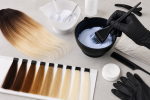
The small dropper bottle in the editorial image represents a line-specific additive only. It does not authorize drop dosing or identify the chemistry.
Separate a booster from developer and lightener
Developer activates a compatible oxidative formula. Lightener provides the main pigment-removal system. A booster is not a replacement for either unless the product directions explicitly define it as a required component.
Do not replace developer with booster, add raw peroxide, double the powder, or combine two lighteners to create more strength. Do not use a permanent-color intensifier or high-lift additive in lightener unless the manufacturer lists that use.
The level and tone guide helps define the target before any formula is built. A booster should not be chosen merely because the desired level seems far away.
Do not confuse tonal pigment with direct dye
Some additives may contain colorants for a line-specific visual or tonal purpose. That does not make direct dye a compatible substitute. The direct hair color formula guide distinguishes ready-made pigment deposit from oxidative lightening.
Never add blue, violet, red, or another direct dye to lightener to neutralize exposed warmth in one step. Plan later tone after the canvas is rinsed and fully dry.
Check the compatibility matrix
Verify the exact lightener name, developer family, permitted strengths, booster product, dose range, scalp or off-scalp use, enclosure, section type, and maximum time. Similar products in the same brand may still have different compatibility.
If a technical chart lists the additive for one powder but not another cream, oil, clay, or high-lift color, do not transfer the recipe. If the directions are missing or conflict across containers, stop until current manufacturer information resolves the system.
Recalculate the complete ratio
Determine whether booster mass or volume counts toward the lightener portion, developer portion, or neither in the published calculation. Some systems can require a changed developer amount; others can use a fixed packet or dose without ratio adjustment.
Write every component and unit: lightener, developer, booster, and any other approved part. Use weight, volume, full packet, measured drops, or another method only when the directions specify it.
Do not add extra developer by eye to restore the previous consistency. Do not thin with water, conditioner, shampoo, oil, or an unrelated liquid. If the altered mixture does not match the directions, discard and remake it.
Follow the stated mixing order
An additive can be mixed into developer first, blended with lightener, or added at another step depending on the system. Follow the exact order so concentrated material is distributed as intended.
Use the named bowl, applicator, and nonmetallic tools. Do not place a dropper directly into mixed product and return it to the bottle. Avoid cross-contamination between the booster, developer, and lightener containers.
Map the starting canvas again
Record natural level, permanent and demi-permanent color, direct dye, plant color, metallic or compound color if known, prior lightener, highlights, gray, bands, breakage, elasticity, and porosity. A booster does not erase color history or make uneven zones equivalent.
Dark artificial bands may resist change while natural roots and pale ends respond differently. Porous or previously lightened hair can reach its condition limit before the desired level. Unknown chemistry is a stop signal, not a reason to add more booster.
The warm hair color guide helps identify gold, orange, copper, and red directions exposed during lightening. A booster does not establish that all warmth will be controlled.
Recheck scalp permission
An additive can change which placement is approved. Confirm whether the complete boosted formula permits on-scalp use, off-scalp use, both, or only a named technique. Follow any different developer and timing limits.
Do not place a boosted off-scalp formula at the root. Avoid an irritated, abraded, sunburned, or otherwise damaged scalp, and never use scalp lightener on eyelashes or eyebrows.
Complete new preliminary and strand tests
Follow every preliminary test and precaution for all components. The U.S. Food and Drug Administration’s hair-dye guidance advises following directions, wearing gloves, observing timing, rinsing thoroughly, avoiding a damaged scalp, and completing directed preliminary testing.
A strand result without the booster does not validate the boosted formula. Test the exact lightener, developer, additive, component amounts, ratio, mixing order, section size, saturation, enclosure, and timing.
Use hidden strands representing natural roots, artificial-color bands, direct-dye residue, gray, resistant hair, previous highlights, and porous ends. Rinse by the target or maximum time, dry fully, and assess level, warmth, banding, elasticity, breakage, roughness, and unexpected color.
Control application and batch timing
Prepare gloves, timer, clips, protective covering, compatible bowl, brush, and separators before activation. Mix only the amount that can be applied within the product’s working period.
Use consistent subsections and directed saturation. Keep the boosted formula off areas that should remain unchanged and avoid unsupported overlap on previously lightened lengths.
Do not add booster to a batch after application has begun, refresh a slow section with a stronger bowl, or make different unrecorded doses across the head.
Do not stack boosters and protective additives
One approved booster does not authorize a second accelerator, bond product, oil, pigment, pH modifier, or viscosity additive. Check whether multiple components may be combined and how each changes the ratio.
Marketing descriptions such as strengthening, protecting, conditioning, or bond support do not establish that hair cannot break or that a more aggressive lightening target is suitable. Hair condition and strand evidence remain the limits.
Follow timing, heat, and enclosure rules
Start timing at the named event and inspect only at allowed intervals. A booster can alter processing behavior, so do not reuse timing from the unboosted formula unless the directions say to do so.
Do not add heat, wrap the entire head, switch to foil, mist drying product, extend the maximum time, or add another dose to force change. Stop at the complete system’s limit.
Recognize stop conditions
Stop before mixing if additive identity, purpose, compatible line, dose, ratio effect, mixing order, developer, placement, enclosure, or time is unknown. Also stop for a damaged scalp, weak hair, incompatible history, or strand tests showing severe banding, unexpected color, gummy texture, breakage, roughness, or insufficient condition.
During use, rinse as directed for intense burning, swelling, blistering, breathing difficulty, spreading rash, eye exposure, unexpected heat, leakage toward the scalp, severe breakage, or another concerning reaction. Seek appropriate medical help for a serious reaction. The American Academy of Dermatology’s hair coloring guidance supports manufacturer testing and conservative spacing of chemical changes.
Rinse and document the whole system
Remove separators carefully and rinse at the specified time and temperature, keeping runoff away from the eyes. Use only the named cleanser, conditioner, or finishing step.
After complete drying, record starting history by zone, every component and amount, calculation, mixing order, placement, saturation, enclosure, check times, rinse time, dry level, warmth, and hair condition. Discard mixed product according to the label.
Lightener booster checklist
- The additive’s exact identity, purpose, compatible lightener, developer, dose, and placement are documented.
- The complete ratio and mixing order account for every approved component.
- Natural hair, artificial color, bands, direct dye, highlights, and fragile ends are mapped.
- No raw peroxide, extra powder, direct dye, water, conditioner, household ingredient, or unapproved second booster enters the formula.
- Directed preliminary testing and new fully dried strand tests cover the boosted formula.
- Scalp, enclosure, heat, saturation, overlap, timing, and maximum limits are rechecked.
- Reaction, heat, leakage, banding, unexpected color, breakage, texture, and maximum-time stop conditions are defined.
A lightener booster is appropriate only when it is a documented component of one complete manufacturer-approved system. If the dose, calculation, compatibility, or strand evidence is uncertain, omit the additive and revise the plan rather than improvising a stronger bowl.