Wide-Tooth Shower Combs: Tooth Spacing, Seams, and Cleaning

Direct answer: choose a wide-tooth shower comb by actual tooth spacing, rounded tip finish, smooth molded seams, tooth flex, handle control, hanging design, cleaning access, complete drying, and replacement condition. Detangle only when the hair state and product directions permit it, divide hair into supported sections, begin at the ends, and move upward only after each lower section releases without force.
Define the exact wide-tooth shower comb task
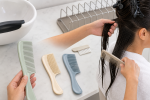
Inspect tooth spacing from base to tip, uniform thickness, rounded ends, molded part lines, flex, handle texture, hanging opening, water traps, and whether every surface is visible for cleaning. A category name or similar appearance does not establish smoothness, material durability, safe pressure, wet-or-dry suitability, or a universal hair-type fit. Inspect the actual tool in bright light before it touches hair or skin.
Match geometry to the section
Use the comb for controlled wet section detangling only when the hair, extensions, service history, and conditioner directions allow that technique. Tooth, bristle, and row spacing should allow the intended section to enter without compression. A larger tool is not automatically faster when dense hair prevents even access or when the handle cannot remain aligned.
Inspect tips, edges, seams, and recovery
Move a clean fingertip over every contact edge. Look for burrs, mold lines, sharp tips, cracks, loose parts, permanent bends, trapped residue, and roughness near the base. Apply only light empty-tool flex; the shape should recover without whitening, splitting, or leaving a tooth, row, or bristle displaced.
Prepare the hair state and work area
Distribute the permitted conditioner or detangler first, create small sections, support one section above the working point, and keep the comb, clips, rinse bowl, and clean towel within reach. Keep the tool away from eyes and from broken or actively irritated skin. Do not add water, conditioner, oil, heat, or another product unless the current hair-product and tool directions permit that combination.
Use a supported end-to-root sequence
Start below the lowest snag, use short end-to-root passes, stop at resistance, release tangles with fingers when appropriate, and never lever the comb against the scalp or force several dense sections together. The support hand limits force transferred toward the root. It does not make a resistant knot safe to pull. Pause, reduce the section, add only permitted slip, or change tools when controlled strokes do not release the lower segment.
Control pressure and stroke length
Hold the handle without squeezing hard enough to distort the tool. Use a short path that keeps the contact surface visible and predictable. Long fast strokes can hide snagging, combine multiple tangles, and transfer force before there is time to stop.
Keep scalp contact conservative
A detangling tool does not need hard scalp pressure to work through lengths. Avoid scraping, repeated rubbing, nail-like tooth contact, and leveraging the tool against the head. Stop for pain, burning, swelling, broken skin, or a sudden increase in hair release.
Separate shed hair from breakage observations
Captured hair alone does not identify why strands released. Record the section, pass count, tool position, visible strand length, knots, and prior routine. Do not turn an informal comparison into a claim that the tool prevents breakage or hair loss.
Record practical wide-tooth shower comb evidence
Record tooth spacing, section width, wetness, slip source, starting point, pass count, snagging, shed-hair removal, rinse access, and drying time. Use the same stopping rule each time. A comfortable grip or flexible row is relevant only when the tool remains controllable, does not scratch, and can be cleaned and dried after the actual routine.
Remove captured hair before washing
Work from the outside toward tooth, bristle, or row bases with fingers or a manufacturer-approved cleaning tool. Do not use blades, pins, solvents, boiling water, bleach, or another method that can scratch, enlarge, weaken, or chemically change the tool.
Clean every contact surface
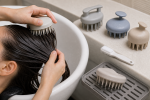
Remove captured hair after use, clean tooth bases and handle seams by the stated method, rinse away conditioner film, inspect under bright light, and hang or rack the comb where every surface drains and dries. Product film can remain where teeth meet the spine, bristles meet the base, rows overlap, or handles join. More fragrance is not evidence that these areas are clean.
Dry before storage
Shake off loose water and position the tool for drainage and airflow. Inspect seams, bases, hinges, detachable parts, hanging holes, and enclosed handle areas for droplets. Do not seal a damp tool in a drawer, pouch, or closed shower container.
Recognize the replacement point
Stop or replace the tool for bent, cracked, rough, or missing teeth; sharp seams; a slippery uncontrolled handle; persistent film; odor; discoloration with material damage; or trapped moisture. A damaged contact surface is not restored by lighter pressure, another rinse, or a styling product that temporarily masks catching.
Run a controlled wide-tooth shower comb comparison
Compare combs with the same permitted conditioner, water level, section map, support hand, starting point, pass count, rinse method, and dry-time check while changing one spacing or handle feature. Repeat on another routine day before generalizing. This is a practical handling comparison, not a laboratory measurement or proof of a universal cosmetic result.
Use related guides for separate decisions
The long-hair style guide helps with planning manageable low-tension sections. The hair-dye brush guide covers keeping wet detangling and application tools separate. Use the nail-brush guide for reviewing reusable-tool cleaning without cross-use. These guides do not replace inspection of the exact wide-tooth shower comb, its directions, or its contact surfaces.
Keep safety and claim boundaries conservative
The AAD gentle hair-care guidance supports cautious handling without endorsing a wide-tooth shower comb. The FDA hair-products overview provides cosmetics context, while the FDA cosmetics-allergen guidance supports label review without predicting individual response. Persistent pain, marked shedding, worsening breakage, swelling, hives, breathing difficulty, or significant eye exposure warrants stopping the routine and seeking appropriate help.
Log the final decision
Record tool identity, material, contact geometry, hair state, section size, support point, stroke count, snagging, pressure, captured hair, cleaning method, dry time, odor, damage, and replacement date. Keep the tool only while contact remains smooth, handling remains predictable, and every surface can be cleaned and fully dried.
Decision table
| Check | Useful evidence | Stop or revise when |
|---|---|---|
| Contact finish | Tips and edges are smooth, intact, and visible | Burrs, sharpness, cracks, or permanent distortion |
| Section control | The section enters without compression and releases in short passes | Hair catches, the tool twists, or force transfers toward the root |
| Pressure | The handle remains aligned under light controlled use | Scratching, pain, uncontrolled flex, or slipping |
| Cleaning | Hair and product release from every contact surface | Residue remains at bases, seams, rows, or cavities |
| Drying | All parts are visibly dry before storage | Droplets, odor, or trapped moisture remains |
Final checklist
- The exact wide-tooth shower comb material, geometry, intended hair state, and cleaning directions are known.
- Every tooth, bristle, row, edge, seam, and handle surface is inspected.
- Small sections are supported and worked from ends upward without force.
- Captured hair and product are removed before washing the tool.
- Damage, sharpness, uncontrolled flex, residue, odor, or trapped moisture ends use.
A wide-tooth shower comb is a spacing, finish, support, cleaning, and drying decision. The correct technique releases small end sections without force and keeps every tooth and seam smooth, clean, and fully dry.