Straight Needles for Wig Making: Selection, Use, Cleaning, and Replacement

Direct answer: Choose a straight needle for wig making by matching its length, gauge, eye, point, and finish with a visible planar seam or edge that can be reached on a stable off-head block. Push only along the needle's straight axis while the supporting hand remains outside the exit line. Do not bend the shaft to reach around a curve. Park every point in cork, reconcile the count before fitting, and replace any needle that is bent, burred, rough, corroded, or difficult to track.
Sort straight needles by axis and dimensions
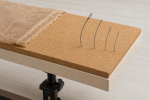
Place eyes upward in a dedicated cork strip and record overall length, shaft thickness, eye dimensions, point condition, straightness, surface finish, and quantity. Roll each unloaded shaft visually against a flat reference to reveal bending without leaving any point exposed.
Reserve straight needles for direct access
Use a straight needle only where entry and exit can be seen along a direct path through a flat or openly supported seam allowance. It is not a substitute for a curved route around a cap contour. If the shaft must flex, disappear behind a block, approach hidden hardware, or aim toward a hand, change the work position or tool decision.
Match usable length without creating hidden reach
Longer shafts can cross thicker visible layers but extend the possible point path. Shorter shafts can improve local control but may lack a usable grip. Compare length and gauge with the exact material stack, block clearance, and hand position. Do not select by length alone or push to full depth merely because more shaft is available.
Check straightness, eye finish, and point
Inspect the point for flattening, hooks, burrs, and asymmetry. Sight along the shaft and roll it visually against a flat reference while its point remains controlled. Check the eye opening and edges for roughness, cracks, or distortion. Reject any needle that wobbles, bows, catches thread, or has uncertain surface condition.
Establish a single-axis work lane
Orient the mounted block so the planned seam faces the operator and the exit area is visible. Clear hair, clips, pins, and tools from the lane. Place the supporting hand beside the material rather than behind it. Define where the point must emerge before insertion. Never push toward the block base, clamp, table, body, or an unseen cavity.
Advance with short controlled pressure
Grip the shaft by the method permitted for the needle size and move it along its axis. Use only enough pressure to cross the intended layers. Stop for deflection, scraping, a hard stop, sudden release, or material bunching. Do not rock the needle sideways, use pliers for extra force, or brace the far side with a finger.
Keep stitch depth consistent on a flat route
Capture the planned seam allowance without crossing elastic, hardware, hair fibers, or fragile unsupported mesh. Keep entry spacing, bite depth, and exit position visible. Pull thread after the point clears and support the seam while tension settles. Repeated variation indicates the material or access plan needs correction, not more speed.
Return the point to a vertical cork strip
Between uses, insert the point fully into the dedicated storage strip so the eye and straight shaft remain visible. Separate active, clean, and rejected locations. Do not lay the needle horizontally, slide it under a swatch, attach it to clothing, or leave it threaded across the worktable.
Sweep the direct work lane at closeout
Remove the unit from the sewing position only after visually tracing the entire lane and accounting for every active needle. Compare the opening count, cork-strip count, reject count, and enclosed-storage count. Search the block, floor, clothing, cap, and hair zone if totals differ. Fitting cannot begin while the count is open.
Dry the full shaft after permitted care
Use only the metal-compatible cleaning or disinfection method stated for the needle. Inspect the point and eye again after drying. Avoid oils that can transfer to lace, abrasives that alter the finish, and containers that allow straight points to overlap or protrude. Care cannot make a bowed shaft straight or a rough eye smooth.
Retire alignment and tracking failures
Replace for any bow, kink, wobble, burr, hooked or blunt point, cracked or rough eye, pitting, corrosion, coating loss, residue, uncertain cleanliness, or unexplained inventory difference. Store accepted needles in rigid fitted channels or with points fully enclosed. Dispose of rejects by an appropriate sharps-safe route.
Decision table
| Checkpoint | Continue when | Stop or replace when |
|---|---|---|
| Access | Entry and exit are visible on one direct line | Curve, blind cavity, hardware, or a hand behind the path |
| Shaft | Roll and sight checks remain straight | Bow, wobble, kink, or side deflection |
| Pressure | Short axial movement crosses intended layers | Hard stop, sudden release, rocking, or plier force |
| Parking | Eye-up shaft has point fully buried in cork | Horizontal loose needle or hidden swatch placement |
| Closeout | Opening, active, reject, and storage counts agree | Unresolved inventory or unknown point location |
Keep direct-axis sewing separate from scalp advice
The AAD sources guide later hair and scalp handling, not straight-needle selection. FDA information does not validate a shaft, eye, coating, or care method. Straight needles remain counted off-head tools whose exit line must stay visible.
- FDA cosmetic hair-product overview: It does not establish compatibility between a cleaner and sewing metal.
- AAD weave and extension precautions: Use gentle handling only after the direct work lane is cleared.
- AAD traction guidance: Evaluate the finished pin-free style for painful pulling.
Move from the sewing lane to hair decisions only after closeout
The related pages cover extension choices. None permits an open needle count or changes the requirement for a visible point path.
- hair extension selection guide: begins after all straight needles are enclosed
- hair crown extension guide: separates shade and placement from the sewing lane
- extension format overview: keeps product type outside shaft selection
Final checklist
- Length, gauge, eye, point, finish, straightness, and opening count are documented.
- The complete entry-to-exit line stays visible with no hand behind it.
- Pressure follows the shaft axis without bending, rocking, or pliers.
- Every pause places the straight needle eye-up with its point buried in cork.
- The work lane is swept and all count categories agree before fitting.
Do not infer seam or wear performance from a straight tool
Visible axial control and a closed count describe only one off-head session. They do not prove a stronger seam, painless wear, hairline protection, universal material fit, or professional construction.
Straight-needle control depends on one visible axis. Inspect, align, advance, park, sweep, recount, and enclose; never trade point visibility for reach.