Elastic Bands for Wig Caps: Selection, Use, Cleaning, and Replacement

Direct answer: Choose plain elastic for a wig cap by matching its disclosed fiber, width, thickness, construction, permitted stretch, recovery, wash limits, and edge behavior with the cap channel and seam plan. Compare a measured dry sample before and after a controlled off-head stretch instead of pulling it to maximum length. Install it without a slider or hook only where the cap design calls for fixed elastic. Replace it when recovery declines, edges fray, rubber or fiber breaks appear, the surface hardens, or the cap requires shortening to reproduce its former fit.
Create a no-hardware elastic baseline
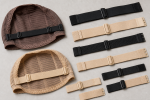
Confirm that the material is plain elastic without a slider, hook, clip, or closure. Record disclosed fiber, width, thickness, knit or woven face, relaxed length, cut-edge behavior, stretch limit, wash directions, lot, and the cap channel or seam where it may be installed.
Verify fiber and construction from disclosure
Plain elastic can be woven, knitted, braided, covered, or otherwise constructed from different fiber and elastomer combinations. Record the actual disclosure and care limits. Color, width, or a ribbed face cannot identify latex content, wash behavior, heat tolerance, stretch range, or suitability for direct contact.
Separate fixed elastic from adjustable hardware
This page concerns a continuous strip secured at a planned length. A strap with a slider, hook, loop, or tab adds hardware, adjustment travel, and anchor decisions. Do not cut hardware from an adjustable strap and regard the remaining material as equivalent plain elastic unless the cap instructions explicitly support that conversion.
Measure relaxed dimensions without tension
Let the dry sample rest flat for the stated conditioning interval, then record length, width, and thickness without pulling. Mark a defined gauge section away from cut ends. Keep the original measurement with the lot record so later stretch, washing, and wear observations can be compared with the same baseline.
Test recovery below the disclosed limit
Extend the marked gauge section only to a permitted measured length, hold for the stated short interval, release it, and record the recovered length after rest. Repeat only as the directions allow. Do not use an improvised maximum-stretch contest, body wrapping, or snap-back test. One sample does not establish lifetime elasticity.
Inspect edges and face during extension
Watch both long edges, the central face, and any covered rubber while the sample is under controlled tension. Stop for narrowing bands, ripples, exposed filaments, white stress marks, popping fibers, uneven extension, coating dust, or a section that remains longer. Trimmed fray is not a repair for structural loss.
Match width with the cap channel
Measure the available channel or seam allowance and confirm the elastic can lie flat without folding, twisting, crowding stitching, or pushing into lace and hardware. A wider strip is not automatically more comfortable or stable. Do not force elastic into a channel that compresses its edges or prevents later inspection and drying.
Set fixed length from the cap plan
Use the pattern, construction record, or qualified fitting plan to determine cut and overlap length. Mark the elastic and cap before sewing. Avoid estimating by stretching it around a person, because that combines material extension, head shape, hair preparation, and contact tolerance without isolating any variable.
Join or anchor without damaging active fibers
Follow the specified overlap, seam, stitch, and thread route. Keep needle perforations inside the permitted zone and distribute them without cutting elastomer strands. Do not burn, melt, staple, glue, or knot the elastic unless the exact material directions allow it. Inspect the joined area in relaxed and lightly extended states.
Wash as part of the cap system
Once installed, the elastic follows both its own care limits and the most restrictive compatible cap directions. Support wet fabric, avoid wringing, and keep unlisted heat, bleach, solvents, and prolonged soaking outside the process. Dry the channel, overlap, and dense stitched areas fully before measuring recovery or storing the cap.
Replace material loss rather than tightening the cap
Retire elastic for increased relaxed length, slow or uneven recovery, hardened or sticky surface, cracked exposed elastomer, frayed edges, broken cover fibers, permanent narrowing, odor, discoloration, heat damage, seam tearing, or repeated need to shorten the band. A tighter seam cannot restore degraded material.
Decision table
| Checkpoint | Continue when | Stop or replace when |
|---|---|---|
| Identity | Fiber, construction, lot, and care limits are known | Unknown strip, altered material, or missing instructions |
| Recovery | Gauge returns consistently after permitted extension | Permanent length, uneven return, pop, crack, or narrowing |
| Cap fit | Strip lies flat inside the designed channel | Fold, twist, crowded seam, or contact with hardware |
| Join | Specified overlap stays flat without cutting fibers | Torn stitch line, hard ridge, or improvised heat or glue |
| After care | Elastic and channel are clean, dry, and dimensionally stable | Dampness, hardening, stickiness, odor, or shortened workaround |
Do not turn an elastic measurement into a comfort claim
AAD sources can support avoiding excessive pulling in the completed wig, but they do not specify an elastic modulus, cap circumference, or safe wear interval. FDA hair-product information does not validate textile or elastomer composition. Use disclosures and off-head measurements.
- AAD traction information: A fixed band should not be used to justify painful tension.
- AAD extension precautions: Evaluate the completed cap and hair preparation as a system.
- FDA hair-products overview: Keep cleanser and cosmetic claims within their own labels and directions.
Finish elastic construction before selecting extensions
Hair extension and crown pages address fiber, attachment, shade, and placement after the cap structure is defined. They cannot set elastic length.
- hair crown extensions guide: keeps shade and coverage outside cap-elastic measurements
- hair extension selection guide: separates extension decisions from fixed-band construction
- hair extension type guide: routes product-format questions after cap preparation
Final checklist
- Plain elastic is identified without adjustable hardware or closure parts.
- Fiber, width, relaxed length, gauge marks, recovery, and care limits are recorded.
- The strip lies flat in the intended cap channel and seam allowance.
- Joining does not cut active fibers or create a hard folded ridge.
- Loss of recovery or structural change triggers replacement, not shortening.
Report measured recovery without promising fit
A controlled sample that returned near its recorded length describes that material and test only. It does not establish universal sizing, pressure, comfort, wear time, skin tolerance, or long-term cap stability.
Wig-cap elastic is a disclosed-material, width, recovery, channel, seam, wash, and replacement decision. Preserve measurements so gradual failure cannot be hidden by repeated shortening.