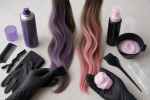
Clear vs Tinted Hair Gloss: Shine Only or Tone Adjustment?

Direct answer: choose clear gloss when the main goal is product-specific shine and surface refinement without intentional color deposit. Choose tinted gloss when a compatible starting level needs a defined tonal refresh, warmth shift, cooling effect, or limited depth change. Product names overlap, so verify formula class, developer, timing, starting range, porosity, and fade before choosing.
Neither gloss can create a lighter base, repair structural damage, guarantee gray coverage, or promise an even salon-like result.
Separate shine from tone
Write the primary task before selecting a product. Clear gloss may suit hair whose color direction is acceptable but whose appearance needs a cosmetic shine or smoothness step. Tinted gloss adds pigment and therefore changes color history, even when the change is subtle.
The hair gloss guide explains shine, color deposit, formula, starting base, and upkeep without treating all glosses as one chemistry.
Confirm formula class and activation
A clear or tinted gloss can be direct deposit, demi-permanent, developer-activated, or another manufacturer-defined system. Use only the specified activator, ratio, vessel, applicator, timing, and rinse. Do not add developer to a direct product or substitute conditioner to dilute a tint.
The FDA hair-dye guidance emphasizes following directions, wearing gloves, tracking time, rinsing, and completing directed preliminary testing for covered color products.
Clear gloss is not colorless in every context
A product sold as clear may still alter how light reflects, how coated hair feels, or how an existing color appears. It may also have its own base tone or compatibility limits. Do not assume it is chemically inactive or suitable for mixing with any tinted shade.
Use clear only as directed, including any role as a standalone product or manufacturer-approved diluter within the same line.
Tinted gloss needs a defined tone target
Identify yellow, orange, red, greenish, dull, faded, too warm, or too cool areas by zone. Select a tint only when the starting level can show the intended adjustment. Cool deposit on a base that is too dark or too warm can mute or deepen it without producing the package result.
The blonde color guide connects starting base, visible warmth, tonal direction, and maintenance without promising exact neutralization.
Porosity can make tint uneven
Porous ends may absorb cool, dark, or vivid pigment more strongly than healthier roots. Clear gloss may look more uniform, but it cannot restore lost structure. Map roots, mids, ends, pale pieces, old bands, and gray areas before full application.
Use separate strand tests when zones have materially different histories. Judge the dry result in consistent light.
Gray areas require separate expectations
Clear gloss may change shine without changing gray contrast. Tinted gloss may soften, warm, cool, or stain some gray strands depending on the exact product, shade, texture, and gray percentage. Do not translate “blend” into opaque coverage.
The gray transition guide helps separate natural gray, colored lengths, tone, and maintenance decisions.
Shine is a cosmetic result, not repair
A gloss can make the surface appear smoother or more reflective and may improve slip or feel depending on the formula. That does not reverse structural damage, remove split ends, or establish that hair can tolerate another chemical service.
The American Academy of Dermatology coloring guidance notes that chemical services can contribute to dryness and brittleness. Use current condition as a service boundary.
Use tests for separate questions
Complete every package-directed preliminary test. Use a separate strand test, when allowed, to observe shine, tone, depth, timing, saturation, porosity response, rinse behavior, and hair feel. A clear strand test still matters because formula and condition response cannot be predicted from appearance in the bowl.
A successful hidden section does not guarantee an even whole-head result.
Compare fade and commitment
Clear gloss may lose its visible shine or feel over time, while tinted gloss also leaves a color-fade history. Shade family, porosity, cleansing, heat, sun, water exposure, and prior color influence change. Do not promise a fixed number of washes.
Record product, shade or clear designation, activator, ratio, timing, date, and zone response for the next service.
Plan maintenance by the result that changed
If shine declines but tone remains correct, a clear product may fit when repeat-use directions allow it. If tone or depth has shifted, reassess the starting base before choosing another tint. Avoid automatic full-length overlap when porous ends already hold enough pigment.
Use dry photographs in consistent lighting and refresh only the zones that support the chosen formula.
Protect future color changes
Tinted gloss adds pigment that can affect later lightening, warming, cooling, or correction. Repeated cool or dark deposit can make future changes less predictable. Clear gloss can also create product history that a later service must consider.
Disclose every gloss, activator, and date to a colorist. Unknown history, severe banding, fragile hair, or a major shade change deserves professional assessment and test strands.
Clear versus tinted gloss table
| Decision | Clear gloss | Tinted gloss |
|---|---|---|
| Primary goal | Product-specific shine or surface refinement | Tonal refresh or limited deposit |
| Color history | No intentional tint, but formula still matters | Adds pigment to future history |
| Starting base | Condition and compatibility remain relevant | Level and undertone control visibility |
| Porosity | Can affect feel and apparent shine | Can affect depth and tone uptake |
| Maintenance | Respond to visible shine change | Respond to tone, depth, and zone fade |
Final selection checklist
- The primary task is defined as shine or a specific tonal adjustment.
- Formula class, developer, ratio, timing, and permitted mixing are verified.
- Starting level, gray, bands, porous ends, and prior color are mapped.
- Preliminary testing and representative strand tests answer separate questions.
- Fade, overlap, maintenance, and the next color service are documented.
Choose clear gloss for a supported shine task and tinted gloss for a supported tone task only after confirming the exact formula. Stop when activation, starting base, porosity response, gray expectation, or future color commitment is unclear.