Gel Hair Color Formulas: Formula, Directions, and Compatibility Guide

Direct answer: identify the exact gel hair color class before using it. A gel may be permanent oxidative color, demi-permanent color, direct dye, toner, or another system, and each can have different activation, developer, ratio, timing, and compatibility rules. Gel texture can combine flow with cling, but it does not guarantee saturation or prevent drips. Follow the current label, complete directed skin testing, run a representative strand test, and stop when formula identity, behavior, scalp response, or hair condition is uncertain.
“Gel” describes rheology, not one predictable result. A clear direct-color gel and an activated permanent gel should not share assumptions simply because both look translucent or glossy.
Classify the gel before planning
Read the product identity, component list, directions, and technical information. Determine whether the gel is ready to use, mixed with developer, activated by another component, or intended as an additive or toner.
The direct hair color guide provides a comparison for pigment systems that may not use oxidative developer. Do not add developer to a ready-to-use gel unless the exact formula directs it.
Confirm activation and compatibility
For oxidative gel color, match the exact developer, strength, ratio, and shade system. For direct gel, confirm whether it can be applied to natural, prelightened, or previously colored hair and whether mixing shades or diluters is permitted.
Do not combine gels from different lines because their textures seem compatible. Product pH, dye system, preservatives, and intended use may differ.
Evaluate viscosity as an application variable
A useful gel can spread under brush or bottle pressure and then cling to a section. Test the supported applicator method on a protected surface. Watch whether it strings, runs, beads, separates, or stays in a uniform film.
Do not add water, conditioner, developer, oil, or thickener to alter viscosity outside directions. Unexpected texture can signal incorrect ratio, poor mixing, storage damage, or incompatible components.
Map the starting canvas
Record natural level, artificial pigment, gray distribution, previous lightening, bands, porosity, elasticity, roughness, density, and breakage. Gel flow does not solve incompatible history or damaged hair.
Different zones can absorb gel color at different rates. Porous ends may become deeper or duller while resistant roots remain lighter, depending on the formula.
Complete skin and strand tests separately
Follow every preliminary skin-test direction and waiting period for the current product. A clear result does not establish universal suitability. Keep scalp dye away from irritated skin, eyes, eyebrows, and eyelashes.
Use a representative strand test to assess gel distribution, timing, level, undertone, coverage, porosity uptake, transfer, texture, elasticity, and breakage. Dry fully before judging color.
Prepare formula-specific tools
Follow restrictions on bowls, bottles, metal, foils, clips, brushes, caps, or heat. Use clean, dry tools with materials clearly compatible with the product. Protect surfaces and have gloves, towels, timer, cleanup materials, and rinse access ready.
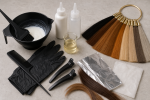
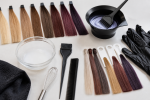
Key materials and decision points for gel formulas include a visible clear or tinted gel, compatible bowl or nozzle bottle, brush, gloves, representative swatches, sectioning tools, and surface barriers. These show viscosity and control without identifying a brand or making a result claim.
Mix without trapping uncertainty
Combine components in the stated order and ratio. Mix until the gel meets the directed uniformity, but do not whip unnecessary air into it. Scrape the compatible bowl and inspect for unmixed streaks.
Use activated mixture within its supported window. Never return it to an original container, combine it with an older batch, seal it for storage, or use unexpected color change as a timing shortcut.
Choose sections for complete contact
Gel can bridge over the surface of a thick section while leaving interior fibers dry. Use section thickness matched to density and applicator control. Check the underside and use enough product for complete target saturation.
Around the hairline and nape, reduce brush or bottle load to prevent migration onto skin. Do not massage product broadly unless directions support that method.
Plan placement by gel behavior
A clingy gel may suit controlled panels or roots; a more fluid gel may move efficiently through fine sections. The formula’s intended technique still controls. Do not use a gel near the scalp merely because it appears less likely to drip.
The red hair color ideas guide explains how starting canvas, placement, contrast, and maintenance shape a visible result beyond product texture.
Track timing and environment
Record application start, full saturation, processing start, checkpoints, and rinse. Follow ventilation and heat directions. A gel can form a surface film or dry at exposed edges if used outside its supported conditions.
Do not add heat, mist, cover, or extend time to compensate for drying or weak color unless the manufacturer directs it.
Rinse and check transfer
Follow the stated emulsifying, rinsing, cleansing, neutralizing, and conditioning sequence. Gel can remain in dense roots, behind ears, or at the nape, so rinse systematically while protecting eyes and skin.
For direct gels, document wet and dry transfer as relevant. The purple hair dye guide covers starting base, formula, saturation, fade, and transfer checks for vivid shades.
Gel-formula stop conditions
- The product class, activation, developer, ratio, or intended use cannot be confirmed.
- The gel separates, clumps, strings, heats, foams, or changes unexpectedly.
- The strand test reveals unacceptable banding, breakage, elasticity loss, or porous uptake.
- The formula migrates beyond controllable placement.
- A skin test or application produces burning, swelling, hives, blistering, or spreading redness.
- The target requires lift, correction, or chemistry outside the stated use.
Gel hair color checklist
- Classify permanent, demi, direct, toner, or additive gel.
- Confirm activation, developer, ratio, and compatible tools.
- Inspect viscosity without modifying it.
- Map chemical history, gray, porosity, bands, and damage.
- Complete directed skin and representative strand tests.
- Use thin sections and verify interior saturation.
- Control migration at hairline, nape, and porous ends.
- Track timing, ventilation, heat, rinsing, and transfer.
- Assess fully dry hair and stop for incompatibility or condition loss.
Authoritative boundaries
The FDA hair-dye guidance emphasizes package directions, gloves, preliminary tests, rinsing, irritated-skin limits, and eye-area restrictions. The American Academy of Dermatology coloring guidance supports manufacturer-directed testing and conservative chemical-service decisions.
Neither source defines one gel chemistry or promises coverage, lift, saturation, fade, or suitability. Gel is useful only when the exact formula class, activation, viscosity, canvas, placement, timing, and condition remain controlled.