Liquid Permanent Hair Color: Formula, Directions, and Compatibility Guide

Direct answer: use liquid permanent hair color only after confirming the exact oxidative formula, compatible developer, ratio, mixing container, applicator method, processing time, and intended service. Its lower viscosity can move through fine sections and applicator tips efficiently, but it can also drip, spread onto unintended zones, and make overapplication harder to see. Complete directed preliminary tests, run a representative strand test, and stop when identity, compatibility, scalp response, or hair condition is uncertain.
Liquid describes handling texture, not one standard chemistry. Products with similar flow can differ in lift, deposit, gray coverage, developer, shade calibration, and application rules.
Confirm the formula class
Read the product identity and technical directions to distinguish permanent oxidative liquid from demi-permanent liquid, toner, direct dye, color rinse, developer-only product, or additive. Do not decide from bottle shape or consistency alone.
The demi-permanent hair color guide explains how deposit-focused systems differ in activation, lift expectations, and fading.
Match the exact developer and ratio
Use only the developer line and strength specified for the shade and service. Do not substitute another developer because its percentage appears equivalent. Confirm whether the ratio is measured by weight or volume.
Liquid formulas can magnify small ratio errors when a bottle is filled by eye. Use clean, dry, compatible measuring equipment and record each quantity.
Choose bottle or bowl application from directions
Some liquid colors are designed for a nozzle applicator; others may permit bowl-and-brush use. Follow the exact supported method. A bottle can speed root lines, while a brush can provide visual placement control, but neither method is automatically better.
Check whether the applicator bottle must remain vented, be used immediately, or be discarded after mixing. Never reseal and save activated color.
Control flow before approaching hair
After mixing as directed, test the applicator flow onto a protected disposable surface if the instructions permit. Confirm that the cap, nozzle, and bottle are secure and that the mixture does not spray, pulse, or leak around the threads.
Do not enlarge the nozzle, add thickener, or dilute the color to change flow. Replace damaged application equipment with a compatible item.
Map the starting canvas
Record natural level, artificial pigment, gray percentage, resistant hairline, bands, porous lengths, previous lightening, texture, density, elasticity, and breakage. A fast-flowing formula does not make one mixture suitable for every zone.
Roots, mids, ends, and gray areas may need separate placement or formulas. Unknown chemical history and corrective work can require professional assessment.
Complete separate skin and strand tests
Follow the current product’s preliminary skin-test directions and timing. A clear result does not establish reaction-free suitability. Do not apply color to irritated skin or use scalp dye on eyebrows or eyelashes.
Run a strand test with the exact formula, flow method, saturation, and allowed time. Dry it fully to assess level, undertone, coverage, evenness, elasticity, texture, and breakage.
Prepare a spill-controlled station
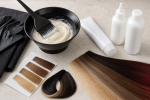
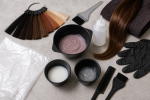
Set out gloves, stable component bottles, a compatible measuring vessel, applicator or bowl, brush if allowed, clips, timer, surface barriers, towels, and directed cleanup materials. Keep bottles upright in a shallow tray.
Key materials and decision points for liquid permanent color include unbranded nozzle bottles, a visible fluid measurement, representative swatches, gloves, clips, compatible tools, and protective barriers. They demonstrate flow and application controls without identifying a brand or promising performance.
Use sections that match the applicator
For a nozzle bottle, draw narrow partings and place a controlled line rather than flooding the scalp. Massage or distribute only as directed. For bowl-and-brush use, load enough liquid to saturate the target without throwing droplets.
Fine hair can look wet before it is evenly saturated; dense hair can hide dry interior fibers. Check the underside of sections and use the quantity guidance for the full head.
Prevent unintended overlap
Liquid color can travel past a root line or drip onto porous ends. Support each section, work in a consistent direction, and wipe bottle tips or gloves only with directed methods. Do not repeatedly pull permanent color through fragile lengths.
The demi-permanent formula guide offers a comparison when lengths need deposit or tonal refresh rather than repeated permanent exposure.
Track application and processing separately
Record first placement, each zone start, full saturation, processing start as defined by the manufacturer, checkpoints, and rinse. Use separate timers where zones differ.
Do not add heat, extend time, or apply extra product to compensate for uncertain saturation outside the supported directions.
Rinse and evaluate dry hair
Follow exact emulsifying, rinsing, shampoo, neutralizing, and conditioning directions. Control runoff around the eyes, ears, neck, sink, and tub. Dry fully before assessing shade and coverage.
The red hair color ideas guide shows how starting canvas, placement, shade, and maintenance affect the visible result beyond formula texture.
Stop conditions
- The formula, developer, ratio, shade system, or applicator directions cannot be confirmed.
- The bottle leaks, nozzle fails, or activated mixture behaves unexpectedly.
- A preliminary test or application produces burning, swelling, hives, blistering, or spreading redness.
- The strand test shows unacceptable damage, banding, or uneven uptake.
- The liquid spreads into zones that cannot be controlled accurately.
- The target requires lift or correction outside the stated use.
Liquid permanent color checklist
- Confirm permanent oxidative identity and intended service.
- Match exact developer, strength, ratio, and measurement method.
- Use only the supported bottle or bowl application.
- Test flow and inspect the applicator before approaching hair.
- Map gray, bands, porosity, damage, and previous color.
- Complete directed skin and representative strand tests.
- Use narrow sections, controlled lines, and complete saturation.
- Prevent drips and permanent-color overlap onto fragile lengths.
- Track zone timing and evaluate fully dry hair.
Authoritative boundaries
The FDA hair-dye guidance emphasizes package directions, gloves, preliminary tests, rinsing, irritated-skin limits, and eye-area restrictions. The American Academy of Dermatology coloring guidance supports manufacturer-directed testing and conservative chemical-service decisions.
Neither source prescribes a liquid formula or promises lift, coverage, shade, or longevity. Liquid permanent color is appropriate only when formula identity, developer, flow, canvas, placement, timing, and condition all remain controlled.