Progressive Hair Color: Formula, Directions, and Compatibility Guide

Direct answer: before using progressive hair color, identify the exact formula class, active coloring ingredients, application frequency, expected buildup, and compatibility warnings on that product. “Progressive” describes color that develops or deepens over repeated applications; it does not define one universal chemistry. Some products are ready to use, while others may have a different activation method. Do not add developer, mix brands, or transfer directions from a permanent, demi-permanent, direct-dye, or henna formula.
Choose the lightest acceptable stopping point, document each application, and judge the result only after the hair is clean and fully dry. Repeated use can make the result darker, less transparent, or more difficult to change than one wet application suggests.
Confirm what “progressive” means on the exact product
Read the front and back labels, ingredient list, directions, warnings, intended hair color, allowed frequency, application area, and discontinuation instructions. Determine whether the product is marketed for gradual gray blending, repeated darkening, targeted root use, or another specific purpose.
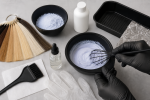
Do not identify the formula from a comb applicator, bottle shape, liquid color, or the word “gradual.” Similar-looking products may use different colorant systems and have different restrictions. The unbranded bottle and swatches in the editorial image illustrate a ready-to-use decision context only; they are not a recipe or a statement about every progressive formula.
Identify the coloring system and ingredients
Check the ingredient list and any technical description before considering compatibility. A progressive product may use a line-specific oxidative system, direct dyes, or another color-forming system. Some historical and current gradual-color products have used metallic salts or related ingredients, which can require special caution before later chemical services.
If the ingredient identity is unclear, do not assume the product behaves like ordinary permanent color. Keep the container or a clear record of the exact ingredient list and lot information. A stylist needs the product history before planning lightener, permanent color, a perm, a relaxer, or another reactive service.
The direct hair color guide explains pigment-deposit products that do not automatically share progressive-color directions. Similar shade names do not make two systems interchangeable.
Check whether the formula is ready to use
Follow the product’s exact preparation instructions. If it is supplied as one ready-to-use liquid or cream, do not add peroxide, developer, water, shampoo, conditioner, oil, or another color. If the line requires activation or multiple components, use only the named components, amounts, order, tools, and timing.
Never “strengthen” gradual color with permanent dye, direct dye, a color additive, or extra pigment. Do not pour leftover product from an applicator back into the original container when the directions prohibit it. Keep the opening and applicator clean so the stored product is not contaminated.
Set a gradual target rather than a one-step target
Progressive color is a poor match for a plan that requires one precisely predicted final shade after one use. Define an acceptable range instead: for example, soften contrast between gray and naturally darker hair while preserving some visible variation.
Use a level-and-tone reference such as the hair color chart guide to describe the starting canvas and stopping range. Do not interpret the chart as a guarantee that a gradual product will reproduce a salon swatch.
Record the result after every fully dried application. Stop adding color when the result reaches the lightest acceptable point. Another application may deepen resistant areas, porous areas, or previously coated lengths differently.
Map gray, natural color, and previous color by zone
Separate the hair into practical zones: gray roots, pigmented roots, temples, hairline, resistant patches, midlengths, porous ends, and any previously colored sections. Note permanent color, demi-permanent color, direct dye, plant color, metallic or compound color, lightener, highlights, perms, relaxers, smoothing services, and unknown history.
Gray percentage alone does not predict the result. Distribution, strand diameter, porosity, existing pigment, buildup, water quality, product residue, and application consistency can change visual coverage.
For readers who want to keep rather than conceal part of the gray pattern, the gray hair transition guide provides a separate care and blending framework.
Follow preliminary testing and scalp precautions
Complete every patch, allergy, sensitivity, or other preliminary test specified by the current package directions, using the stated timing and procedure. The U.S. Food and Drug Administration’s hair-dye guidance advises following label directions, wearing gloves, observing timing, rinsing thoroughly, avoiding use on an irritated or damaged scalp, and completing directed preliminary testing.
A previous uneventful application does not cancel the current directions. Do not use hair color on eyebrows or eyelashes. Stop before application if the scalp is scratched, sunburned, inflamed, or otherwise damaged, or if the product’s identity and instructions cannot be confirmed.
Run a strand and buildup test
Test the exact product on hidden strands that represent the important zones. Apply it with the intended amount, applicator, section size, frequency, and rinse or no-rinse method. Follow the label rather than inventing a shorter or longer exposure.
One strand application is not enough when the decision depends on cumulative darkening. Continue the test only through the number and spacing of applications allowed by the directions, documenting the dry result after each stage. Assess gray blending, level, warmth, coolness, transparency, uneven pickup, roughness, breakage, and whether the result becomes too dark.
If the strand remains sticky, develops an unexpected hue, darkens too quickly, or responds unevenly, do not correct it by adding more product to the full head.
Control application amount and overlap
Wear gloves and protect clothing and nearby porous surfaces as directed. Use consistent sections and measured application habits, even when the product does not provide a conventional mixing ratio.
Apply only to the areas permitted by the label. If directions support targeted maintenance after the initial result, distinguish new growth from previously colored lengths. Repeated saturation of the same ends can create excess buildup or a darker band.
Do not comb product through the entire head by default. A comb applicator can improve distribution, but it does not authorize scalp scratching, heavy overlap, or use beyond the stated area. Keep the product out of the eyes and follow hand-washing and surface-cleaning instructions.
Respect frequency and stopping rules
Use no more often than directed. Increasing frequency, leaving the product on longer, applying heat, enclosing the hair, or using a larger amount does not create a controlled shortcut to a darker result.
Stop the buildup schedule when the dry shade reaches the planned range, when the result becomes uneven, when the hair or scalp condition changes, or when the maximum label-directed sequence is reached. Maintenance frequency may differ from initial buildup frequency; verify it rather than repeating the initial schedule indefinitely.
Check compatibility before any later chemical service
Keep a written record of the exact progressive product and ingredients. Before using permanent color, bleach, another oxidative service, a perm, relaxer, or smoothing treatment, disclose that history and perform every compatibility and strand test required for the proposed service.
Do not assume that several clarifying shampoos remove all deposited or reactive material. Do not place lightener over progressive color merely because the visible shade has faded. Unknown ingredients, metallic-salt warnings, unexpected heat, discoloration, smoke, odor, breakage, or an abnormal strand reaction are stop conditions.
The American Academy of Dermatology’s coloring and perming guidance supports following manufacturer testing and using conservative spacing between chemical changes. It does not establish compatibility for a specific progressive formula.
Plan maintenance without automatic full-length reapplication
Photograph the fully dry result in consistent lighting and note the date, application areas, amount, frequency, and any missed or darker zones. At the next use, compare new growth with coated lengths before deciding where product belongs.
If the label allows root-focused upkeep, keep the application boundary controlled. If it requires full-head use, follow that instruction but stop when the shade or condition no longer fits the plan. Do not combine two shades or formulas unless the manufacturer provides an exact mixing direction for those products.
Recognize reaction and condition stop signals
During use, follow the package response instructions for intense burning, swelling, blistering, breathing difficulty, spreading rash, eye exposure, or another concerning reaction. Rinse as directed and seek appropriate medical help for a serious reaction.
Also stop for unexpected heat, severe tangling, gummy texture, snapping, roughness, patchy darkening, an unwanted green, gray, red, or purple cast, or color transfer that continues outside the expected care window. Do not cover a concerning result with another chemical process before identifying the cause.
Progressive hair color checklist
- The exact product, formula class, ingredients, warnings, and directions are documented.
- Ready-to-use and activated systems are not confused, diluted, strengthened, or cross-mixed.
- Gray, natural pigment, previous color, porous ends, and chemical history are mapped by zone.
- The target is an acceptable gradual stopping range, not a promised one-step shade.
- Directed preliminary testing and a repeated-application strand test are complete.
- Application amount, frequency, overlap, new-growth boundary, and maintenance rules follow the label.
- Future color, lightener, perm, relaxer, and smoothing compatibility is checked from the exact ingredient history.
- Scalp reaction, unexpected heat, breakage, abnormal strand response, uneven buildup, and excessive darkening have clear stop rules.
Progressive hair color is most controllable when each application is treated as one documented step rather than an open-ended routine. Confirm the chemistry, follow the exact directions, stop at the lightest acceptable dry result, and preserve the product history before any future chemical change.