How to Choose and Use Hair Color Swatch Rings at Home

Direct answer: choose a hair color swatch ring with realistic fibers, enough hair density to show tone, a useful range of depths and undertones, and smooth ring hardware that lets individual swatches fan or detach without snagging. Compare one swatch at a time beside dry hair in neutral daylight, first matching depth and then evaluating warmth or coolness. Keep the ring clean, dry, and consistently organized. A swatch ring is a visual reference; it does not predict how a formula will process on natural pigment, old color, gray, or porous hair.
Useful rings make color differences easier to see. Poor rings create false precision through synthetic shine, thin fibers, unclear organization, or lighting-dependent shades.
Decide what the ring must compare
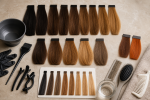
A depth ring should progress from black and dark brown through medium brown, light brown, dark blonde, and light blonde. An undertone ring should separate neutral, ash, beige, gold, copper, red, and violet directions at comparable depths.
One ring can combine both purposes, but a large mixed set becomes difficult to scan. For home planning, a concise depth ring plus a smaller undertone group is often easier to use than dozens of near-identical samples.
The shade-chart selection guide explains why swatches are directional references rather than promised results.
Compare fiber realism
Human-hair swatches can show movement and light reflection similar to hair, but their processing history may be unknown. Synthetic fibers are durable and consistent yet may reflect light differently. Material should be disclosed rather than inferred from appearance.
Hold a swatch under daylight and indoor light. Excess plastic shine, painted-looking color, or fibers that change dramatically with angle reduce its value for comparison.
Reject samples with glue residue, shedding fibers, inconsistent color within one bundle, burnt ends, dust, or odor. The attachment should not cover so much hair that only the tips can be assessed.
Check swatch density and length
Thin bundles can look lighter because the background shows through. Dense bundles reveal depth more reliably but may hide translucency. Compare sets against the same neutral background.
Enough length is needed to bend the sample and view highlights, mids, and shadow. Very short tufts show a color chip rather than hair behavior. All swatches in one comparison group should have similar density and length.
Do not compare a thick dark sample with a sparse light one without accounting for construction.
Inspect ring hardware
The ring should open deliberately and close fully. Smooth metal or durable non-shedding hardware is preferable to rough joins that catch fibers. Swatch tabs should slide without falling off.
A large ring fans many samples but can be heavy near the face. A smaller ring improves control but limits separation. Removable swatches are useful for side-by-side comparison when the attachment remains secure.
Inspect hinges, clasps, tabs, and labels before use. Replace hardware with rust, sharp edges, a loose closure, or flaking coating.
Organize without relying on memory
Keep depth in one fixed direction from darkest to lightest. Group undertones separately and maintain the same order after every use. Photograph the clean original arrangement for restoration.
If identifiers are supplied, preserve them without assuming numbering is universal across brands. A level or tone code from one system may mean something different in another.
Do not write formula promises on the swatch. Record comparison notes separately with date, lighting, starting hair, and product system.
Compare hair in neutral light
Use indirect daylight or a high-quality neutral light source. Avoid warm vanity bulbs, colored walls, direct sun, and phone filters. Place a gray or white neutral background behind the hair and swatch.
Compare dry hair at roots, mid-lengths, and ends. Hold the swatch beside the hair rather than on top of it, where underlying color and shadows can distort the result.
First ask which sample has the closest depth. Then compare undertone. Trying to match both at once encourages a warm lighter swatch to be mistaken for the same level.
Account for uneven starting hair
Natural roots, colored mid-lengths, gray strands, and porous ends may require separate references. One swatch cannot summarize a banded canvas.
Record the closest visual reference for each zone. This helps identify complexity but does not determine a formula. Old artificial color and chemical history remain essential.
The hair color application guide places swatch comparison inside formula, timing, and condition decisions.
Use swatches for preference, not prediction
Hold several candidate swatches near the face to compare depth and warmth with skin, eyes, clothing, and desired contrast. Personal preference matters more than rigid undertone rules.
A manufactured swatch usually represents a target shade under controlled conditions. It does not show exposed warmth during lift, porosity, gray resistance, developer effects, or fading.
A representative strand test with the exact product remains the evidence for how the real hair may respond.
Clean and store the ring
Handle with clean dry hands. Keep swatches away from active color, wet brushes, sprays, smoke, oils, and direct sunlight. Do not dip them into formula or use them as test strands unless explicitly manufactured for that purpose.
Follow material-specific cleaning directions. Water, solvent, heat, or detergent can alter fiber color and texture. Often dust control with careful dry storage is safer than washing.
Store the ring flat or hanging without crushing fibers. Cover it with an uncolored protective enclosure and keep each sample separated enough to avoid tangling.
Replace unreliable samples
Replace swatches that fade, stain, shed, tangle permanently, develop uneven shine, lose their attachment, or no longer match their original group. Retire the full ring when missing samples destroy the depth sequence.
Do not combine rings from different lighting, material, or numbering systems and assume they form one calibrated chart.
Safety and scope
The U.S. Food and Drug Administration advises following hair-dye directions, completing the directed skin test before every use, wearing gloves, keeping dye away from the eyes, observing processing time, and rinsing the scalp well. Swatch comparison changes none of these requirements.
The American Academy of Dermatology notes that lightening more than three shades generally requires stronger peroxide and can cause more damage. A visually appealing swatch does not make a large lift suitable for home use.
Common swatch-ring mistakes
- Comparing under warm or colored light.
- Matching undertone before depth.
- Using sparse and dense samples as equal references.
- Assuming synthetic shine matches real hair.
- Assuming a shade code is universal.
- Using one swatch for uneven roots and ends.
- Letting active product contaminate the ring.
- Assuming a visual match predicts formula outcome.
For placement and contrast examples, see the hair color ideas guide.
Final swatch-ring checklist
- Define whether depth, undertone, or both are needed.
- Inspect fiber material, density, length, and consistency.
- Check smooth, secure ring hardware.
- Preserve a fixed organization order.
- Compare dry roots, mids, and ends in neutral light.
- Match depth before undertone.
- Use a strand test for product-response evidence.
- Store clean, dry, covered, and uncompressed.
Sources and scope
The FDA hair dyes guidance supports the label, skin-test, glove, timing, eye-area, scalp-condition, and adverse-reaction boundaries in this guide. The American Academy of Dermatology coloring guidance supports conservative shade changes and damage-reduction limits. Neither source endorses a swatch material, ring, shade system, visual accuracy, brand, or predicted result.