Protein Fillers Before Hair Color: Product Checks and Practical Safety Boundaries

Direct answer: use a protein filler before hair color only when the exact product directions support the planned color service and a representative strand test shows a useful result. First identify whether the product is intended to add a missing warm tone, reduce uneven deposit, improve handling, or serve another labeled purpose. A filler does not repair every form of damage or make an unsafe color plan acceptable.
The term protein filler can describe different products. Some are neutral, some are tinted, some are applied and left in before color, and others require rinsing or drying. Product name alone is not enough to determine sequence or compatibility.
Define the missing job
Write the observed problem: pale porous ends taking deposit too dark, previously lightened hair missing warm undertone before going darker, uneven absorption, or weak feel. Separate these from root level, old artificial color, severe bands, and breakage.
If the target is a major level correction, a filler may be one part of a professional plan but not a substitute for canvas assessment. Do not add it merely because the hair is colored or dry.
Read the exact product directions
Check whether the filler is tinted or neutral, ready to use or concentrated, rinse-out or leave-in, and intended before permanent, demi-permanent, or another color type. Record amount, dilution, application zone, drying requirement, and timing.
Confirm whether it can be combined with the selected color system. Do not pour it into color, developer, lightener, or another product unless the manufacturer explicitly directs that use.
Audit level, undertone, and porosity
Inspect roots, middle, and ends fully dry. Record natural level, previous lightening, permanent color, direct dye, exposed warmth, gray distribution, roughness, elasticity, tangling, and breakage.
A tinted warm filler may affect the final shade as well as absorption. Identify which zones actually lack the desired undertone. Applying it everywhere can deepen or warm areas that were already suitable.
Choose a representative strand test
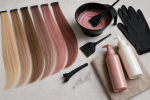
Select hair that matches the porous or pale zone. Apply the filler exactly as directed, then complete the planned color sequence on that strand. Keep a similar unfilled control when practical.
Record filler amount, contact time, dry or damp state, color formula, developer or activator, processing, rinse, and fully dry result. Compare depth, warmth, evenness, texture, elasticity, and transfer.
Test more than the immediate color
Check whether the strand becomes too dark, too warm, stiff, coated, or difficult to comb. If time allows, observe several washes to see how the filled and control strands fade. A first-day match can separate later if the underlying canvases differ.
Stop if the strand becomes weaker, rougher, or unpredictable. Do not repeat filler applications to force a result that the tested canvas does not support.
Map application zones
Mark where filler is needed: pale ends, a lightened panel, a band, or the complete length. Protect roots or healthy sections that do not need it. Use clean clips, gloves when directed, and measured application.
Apply evenly within the selected zone. Excess product or inconsistent saturation can create another variable. Follow drying or rinsing instructions before color rather than guessing from feel.
Coordinate with the target shade
A warm filler under brown, copper, red, or another deeper target can change the final undertone. Compare the plan with the Ulta hair dye guide for formula, shade, and safety checks. Use the green hair dye guide as a reminder that underlying warmth can shift a cool vivid result.
Do not select a filler color from a generic chart alone. Test the exact filler, target color, and canvas together.
Avoid using filler as damage permission
Protein language does not establish that hair can tolerate more lightening, stronger developer, longer timing, or repeated overlap. Assess strength independently. Severe breakage, gummy elasticity, or major bands is a reason to pause.
The at-home hair color guide provides a broader canvas, label, test, and stop framework. Use qualified professional assessment for complex corrections.
Document the post-color result
Dry the hair fully and compare roots, middle, and ends in neutral light. Record whether filled zones connect in depth and undertone without excessive darkness or stiffness. Save the product, lot if relevant, amount, sequence, timing, and photographs.
For later refreshes, reassess the canvas. Do not automatically repeat a filler if only roots have changed or if the previously filled lengths remain suitable.
Know when filler is not the next step
Filler is not the next step when the target level is still unresolved, the hair history is unknown, or representative strands fail the planned color. It also cannot replace removal decisions for incompatible old pigment. Pause and resolve the canvas before adding another variable.
If the strand already reaches coherent depth and undertone without filler, document that control result. Leaving an unnecessary product out can make the later formula easier to interpret and repeat.
Follow hair-color boundaries
The FDA hair-dye guidance explains label precautions, preliminary tests, reaction limits, and the restriction against using scalp hair dye on eyebrows or eyelashes. Follow every current color and filler label.
The American Academy of Dermatology coloring guidance recommends conservative shade changes and manufacturer testing directions. These sources do not establish that protein fillers repair damage or ensure even color.
Protein-filler checklist
- Name the exact problem and the filler’s labeled job.
- Verify tint, concentration, sequence, drying, rinsing, and compatibility.
- Map level, undertone, porosity, and condition by zone.
- Test filler plus the complete color sequence against a control.
- Judge depth, warmth, texture, strength, and early fade.
- Apply only to zones supported by the test.
- Do not use filler as permission for more aggressive chemistry.
- Reassess before every later color service.
A protein filler is useful only as a specific, tested step. Define its job, follow its directions, and approve the complete dry color result rather than relying on the word protein.