Honey Blonde Hair Color: Starting Level, Undertone, Formula, and Upkeep Guide

Direct answer: honey blonde is a warm blonde direction that combines golden brightness with enough beige, amber, or soft brown depth to keep the result dimensional. The right plan depends first on the current level and color history, then on the warmth already exposed, the desired depth, and whether the job requires lift, deposit, or both. Do not select a formula from the target photo alone. Map the starting canvas, test representative strands, assign a clear role to each product, and plan root, mid-length, and end maintenance separately.
Honey blonde is not one universal swatch. On a lighter base it may be a deposit-only tonal adjustment. On darker natural hair it may require controlled lightening before toning. On previously dyed hair, removing or shifting artificial pigment can be the limiting task. The goal is a repeatable decision process rather than a promised shade outcome.
Define the honey blonde target before choosing products
Describe the target with four variables: depth, warmth, balance, and placement. Depth identifies how light or dark the overall result should appear. Warmth identifies whether the visible direction is gold, amber, caramel, or a softer beige-gold. Balance describes how much neutral or beige influence prevents the color from reading as intensely yellow or orange. Placement determines whether the warmth is global, concentrated in highlights, blended through a dimensional base, or added only as a gloss.
Compare references in neutral daylight and include more than one angle. Edited photos, strong indoor lighting, and reflective styling can make the same hair appear much lighter or warmer. The blonde hair color ideas guide helps separate base depth, tonal direction, and placement before a formula is considered.
Record the real starting level and color history
Assess dry, cleanly separated hair at the roots, mid-lengths, and ends. Record natural depth, gray distribution, old permanent or direct dye, previous lightening, banding, porosity, density, strand thickness, and fragile areas. A single level number for the whole head is often too simple.
- Virgin lighter hair: may need only tonal deposit or modest lift, depending on the target.
- Virgin darker hair: may expose strong warm underlying pigment as it lightens.
- Previously lightened hair: may accept warmth quickly but show uneven porosity.
- Artificially darkened hair: can resist predictable lifting and reveal bands.
- Gray or white hair: can create a different depth and reflectivity pattern from pigmented strands.
Do not assume a stronger developer or longer processing time solves an unsuitable canvas. Significant lift, dark artificial color, repeated overlap, or fragile hair is a reason to use a qualified colorist and a staged plan.
Read undertone instead of viewing warmth as one color
Honey blonde usually needs visible warmth, but the type and amount matter. Yellow-gold can look bright and light. Amber can make the result richer. Soft copper can add depth but may move the result away from the intended honey balance. Beige or neutral influence can moderate warmth without erasing it.
Evaluate the undertone that appears during a strand test, not just the starting surface color. A target that looks softly golden on one base may look orange on another because the exposed background differs. Undertone also interacts with the wearer, but no complexion rule is universal. The hair color for olive skin guide provides a broader framework for comparing undertone and contrast without promising one shade for everyone.
Separate lift, deposit, and tonal correction
A formula is easier to evaluate when every component has one stated job. Lightener or a lifting color changes depth within the product’s labeled capabilities. A permanent or demi-permanent color may provide deposit and, in some cases, limited lift as directed. A toner or gloss adjusts visible tone on a suitable base. These roles are not interchangeable.
If the hair is already light enough, adding more lift may create unnecessary stress. If the hair is too dark, a depositing gloss cannot create blonde brightness. If the exposed background is very uneven, one toner cannot create a predictably even result. Write the sequence as a decision tree: current canvas, required depth change, exposed warmth, deposit goal, and stopping rule.
Never improvise ratios, developer strength, additives, heat, or processing time. Use only combinations explicitly supported by the current product instructions.
Use strand tests to build a formula plan
Test more than one strand when the history varies. A useful set may include a natural root, an old colored mid-length, a pale porous end, and a resistant or gray area. Reproduce the intended product, ratio, section thickness, saturation, support material, timing, rinse, and after-color process allowed by the label.
After the strands are fully dry, compare achieved depth, gold-to-amber balance, evenness, shine, texture, and elasticity. Record the exact test conditions. A wet strand can look darker and cooler than the finished result, so do not judge tone only at the sink.
A test is evidence for that sampled strand, not proof of the whole-head outcome. Stop if the hair becomes excessively elastic, rough, fragile, or otherwise unsuitable. Do not repeat lightening immediately simply because the first test did not reach the reference shade.
Plan roots, mid-lengths, and ends as different zones
Scalp heat, natural new growth, old color, and porous ends can process differently. A uniform full-length application can therefore create hot roots, dark bands, or over-deposited ends. Mark each zone and state whether it needs lift, deposit, refresh, or protection from overlap.
For dimensional honey blonde, also map the amount of natural or darker depth that remains. Honey ribbons beside a deeper base can look brighter than the same shade applied globally. Placement can reduce the amount of hair that needs lightening and create a clearer regrowth plan, but it does not remove product safety requirements.
Use enough product for even saturation, but keep it off skin and away from the eyes. Protect previously lightened lengths when the new task concerns only regrowth.
Choose depth and contrast with a shade chart carefully
Manufacturer shade charts are useful within the context of that color system. They are not universal translations across brands or product families. Read the level, tonal family, gray-coverage instructions, developer pairing, mixing ratio, and starting-level limitations together.
The AGEbeautiful hair color chart guide explains how to interpret chart labels as a decision aid rather than a fixed outcome. When moving between systems, compare the full instructions and ingredient information instead of assuming matching names mean matching formulas.
Prepare enough supplies and an application sequence
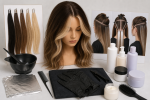
Estimate product from hair length, density, section size, and the planned zones. Prepare gloves, clips, timer, cape, towels, nonmetallic bowl and brush when required, foil or another approved support if used, and enough product to complete the mapped application without stretching the mixture.
Plan where application begins and ends, how long it should take, and how every section stays inside the labeled timing window. Complex corrections, multiple formulas, very long dense hair, or a major depth change can exceed what one person can apply consistently at home.
Keep all packages and ingredient lists available. Protect clothing and surfaces, maintain suitable ventilation, and prevent access by children or pets.
Follow hair-color safety boundaries
The U.S. Food and Drug Administration hair dye guidance advises following package directions, wearing gloves, completing directed preliminary tests, observing stated time, keeping dye away from the eyes, and rinsing the scalp well. It warns against using scalp hair dye on eyebrows or eyelashes.
Do not color an irritated, scratched, or sunburned scalp. Stop use if a reaction occurs and obtain appropriate professional guidance. A previous uneventful use does not replace the current label’s preliminary-test directions. This article does not diagnose reactions or provide medical care.
The American Academy of Dermatology coloring guidance notes that greater lightening generally requires more peroxide and can increase damage. It also recommends caution around chemical services. These sources support precautions, not a particular honey blonde formula or assured result.
Evaluate depth, warmth, and condition separately
Rinse and complete the after-color steps exactly as directed. Dry the hair before judging the final shade. Check roots, mid-lengths, and ends in neutral daylight and ordinary indoor light. First assess whether the achieved depth is appropriate. Then assess the warmth balance. Finally inspect texture, elasticity, and visible evenness.
A result can have the intended gold direction but still be too dark, too light, or uneven. It can also reach the target tone while leaving the hair too compromised for another service. Do not regard every mismatch as a reason for immediate corrective color.
Build an upkeep plan around the actual color structure
There is no universal honey blonde refresh calendar. Regrowth visibility depends on starting depth, gray, contrast, and placement. Tonal fade depends on porosity, cleansing, heat, water exposure, sun, and the color system used. Track changes in comparable lighting instead of relying on a fixed promise.
- Save the starting map, formulas, ratios, section sizes, timing, and strand-test notes.
- Keep future lightener on appropriate new growth and away from fragile pale lengths.
- Use gentle cleansing and conditioning products suitable for color-processed hair.
- Limit avoidable high heat and prolonged sun exposure.
- Strand-test a gloss or tonal refresh on porous areas before broad application.
- Separate a tone refresh from a lift service when the depth is already suitable.
Honey blonde decision checklist
- Define target depth, gold-to-amber balance, contrast, and placement.
- Map natural roots, old color, lightened areas, porosity, and fragile zones.
- Decide whether each zone needs lift, deposit, tonal correction, or protection.
- Test representative strands with the exact intended process.
- Judge the tests fully dry for depth, undertone, evenness, and condition.
- Use only label-supported products, ratios, developer, heat, and timing.
- Prepare enough product and a realistic application sequence.
- Protect skin, eyes, surfaces, and previously lightened lengths.
- Evaluate final depth, warmth, evenness, and condition separately.
- Record the map so regrowth and tonal upkeep remain distinct tasks.
Honey blonde planning succeeds when warmth is viewed as a controlled design variable, not as a shortcut around starting-level limits. A documented canvas, clear formula roles, representative strand tests, exact label use, and zone-specific upkeep create a more useful and repeatable decision than copying a single shade name.
Sources and scope
The FDA source supports label-following, preliminary-test, glove, timing, eye-area, scalp-condition, rinsing, and reaction boundaries. The AAD source supports conservative lightening and chemical-service decisions. Neither source provides one universal honey blonde level, formula, developer, processing time, maintenance interval, or cosmetic outcome. Follow the current instructions for every exact product.