Dimensional Brunette Color: Placement, Sectioning, and Upkeep Guide

Direct answer: dimensional brunette color combines a dominant brown base with intentionally placed lighter, darker, warmer, or cooler ribbons so the hair does not read as one flat block. Plan it by choosing a clear depth hierarchy, mapping contrast to the haircut and usual part, testing each formula on the actual canvas, preserving enough base between ribbons, and setting separate upkeep for roots, light pieces, dark pieces, and overall tone.
Dimension does not require many colors. Two well-related depths can be more coherent than several formulas without a placement purpose. The base should remain identifiable as brunette, while the secondary tones create movement, contour, or softness from the chosen viewing angles.
Set a depth hierarchy before choosing shades
Name the dominant base, the supporting light or medium ribbon, and any deepest shadow. For example, a medium neutral brunette may keep dark-brown interior depth and use restrained caramel pieces around movement points. A dark brunette may use subtle chestnut ribbons with minimal lightness change. A lighter brunette may rely on deeper lowlights to create structure.
Choose a contrast ceiling. Low contrast keeps adjacent levels close and reads as natural movement. Medium contrast creates visible ribbons without shifting the overall identity away from brunette. High contrast uses pale or very dark pieces and requires stricter placement and fade planning. A clear ceiling prevents the project from drifting into an unrelated blonde-highlight or color-block design.
Map dimension to the haircut and daily part
Photograph the hair dry, loose, tucked, and gathered. Identify face framing, crown movement, surface layers, interior weight, perimeter, and nape. Short layers can display more ribbon than long interior hair. A center part needs balanced visibility on both sides, while a stable side part can support asymmetrical placement.
Place brightness where it should create movement or emphasis, and keep depth where it should create shadow or visual density. Fine surface pieces can diffuse light. Wider interior ribbons can appear through waves or curls. A darker nape can preserve a brunette anchor while selected lighter ends add movement.
The oil slick hair color guide provides a comparison for planning several ribbons on a deep base. Dimensional brunette usually stays within brown-related depths and undertones, but both designs depend on deliberate separation and movement-aware placement.
Audit the base and every proposed ribbon zone
Record natural root level, gray distribution, earlier permanent color, highlights, lowlights, direct dye, warm bands, and porous ends. Previously colored dark hair may not lift predictably with another color formula. Old highlights may absorb brunette deposit more strongly than natural hair. Roots, mid-lengths, and ends can therefore require different jobs.
Separate lift, deposit, and tone decisions. A light ribbon may require lift on a natural canvas but correction on an artificially dark canvas. A dark ribbon may need supported filling on very pale hair. A gloss can refine tone but cannot create missing placement or reliably lighten a dark band.
Choose undertones that form one palette
Brown can lean neutral, cool, golden, caramel, chestnut, copper, or red. Select one dominant temperature and use secondary tones that either reinforce it or create controlled contrast. Randomly combining ash, gold, and red formulas can make the result fragmented even when every depth is technically brunette.
Warm ribbons can add visible movement through a neutral or warm base. Cool ribbons can reduce a strongly warm impression but may look flat if overused on porous hair. Red-brown or copper-brown pieces need a fade endpoint because they may stay warm after intensity decreases. The ginger hair color guide offers additional context for copper and red undertones, starting canvas, and maintenance.
Strand-test every materially different canvas
Test a natural root or virgin section when root color is part of the plan, a previously colored mid-length, a former highlight, and a porous end when those zones differ. Record product, shade, ratio, developer or activator, subsection thickness, saturation, timing, rinse method, and fully dry result.
Compare depth, undertone, evenness, shine, and fiber condition. A formula that creates a suitable caramel ribbon on natural brunette may become too pale or too warm over an old highlight. A lowlight that looks balanced at the mid-length may grab nearly opaque at the end. Revise the zone plan from the tests rather than forcing one mixture through every section.
Design spacing and section size as visible variables
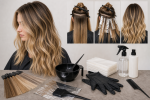
Dimension needs base-colored negative space. Count how many sections remain untouched between light or dark ribbons. Fine weaves create diffuse sparkle. Medium weaves create readable movement. Slices create stronger blocks and should be reserved for a deliberate graphic effect.
Vary starting height to avoid a horizontal band. Use diagonal or curved sections when they follow movement, and vertical sections when the target is lengthwise ribboning. Release the hair after each area is mapped. The correct foil pattern is the one that produces the intended dry shape, not the one that looks most symmetrical on the scalp.
Coordinate multiple formulas and clocks
Prepare separate bowls, brushes, gloves as needed, clips, foils or supported barriers, towels, and timers for each formula zone. Label the plan before active application. Keep lightener away from lowlight sections and dark deposit away from brightness intended to remain.
Use only compatible products and follow their current labels. Do not borrow a ratio or processing time from another line. If the root, light ribbons, lowlights, and ends require different starts, write the sequence and use the strand-test evidence to control timing. More formulas increase the need for a clear rinse order and transfer plan.
Preserve brunette identity during application
Check the base between every ribbon. If too much hair is isolated for lightening, the result can become highlight-dominant and lose the intended brunette anchor. If too much dark deposit is added, the movement can disappear. Photograph the mapped sections before applying so the ratio can be compared at the next service.
At the hairline, use placement that fits the desired contrast and grow-out. Strong light pieces create emphasis but become visible sooner as roots grow. Softer related-tone ribbons can create a lower-contrast transition. Avoid repeated overlap on previously processed lengths unless the selected product directions and condition assessment support it.
Evaluate the dry result before global toning
Dry the hair and inspect it in natural and indoor light. Confirm that the base remains dominant, the ribbons are visible from the intended angles, and the undertones form one palette. An automatic all-over toner or gloss can reduce the difference between zones or darken porous brightness more than expected.
Use a finishing deposit only for a defined task supported by the canvas. The hair gloss guide explains how to compare deposit, shine, processing, and washout before adding that step.
Maintain four components separately
Track natural regrowth, light-ribbon tone, dark-ribbon fade, and overall condition. Roots may need reconnection before the lengths need color. Light pieces may expose warmth as toner releases. Dark deposit can fade faster from old highlights. Porous ends may change more quickly than the interior.
Set visual decision points instead of repeating the full design on a rigid calendar. Refresh placement when the ribbon pattern no longer supports the haircut. Refresh tone when the palette shifts outside the target. Use conditioning and moderate heat habits throughout, and record what changed so the next service addresses only the zones that need work.
Follow hair-color safety boundaries
Follow every current product label, including preliminary test instructions, gloves, timing, rinsing, and restrictions. The FDA hair-dye guidance states that reactions can occur even after earlier uneventful use and that scalp hair dye is not intended for eyebrows or eyelashes. Do not apply over an irritated or damaged scalp.
The American Academy of Dermatology coloring guidance recommends conservative shade changes and following manufacturer testing directions. These sources support precautions, not one dimensional-brunette formula or an assured cosmetic outcome. Seek qualified professional assessment for extensive dark artificial pigment, severe bands, substantial breakage, or a major lightness change.
Dimensional-brunette checklist
- Name the dominant base, secondary ribbon, deepest shadow, and contrast ceiling.
- Map the haircut, usual part, face frame, crown, interior, and perimeter.
- Record natural level, previous color, gray, bands, porosity, and fragile zones.
- Choose one coherent undertone palette.
- Test every materially different root, mid-length, highlight, and end canvas.
- Specify ribbon width, spacing, starting height, and retained-base ratio.
- Separate formulas, barriers, application order, clocks, and rinse steps.
- Maintain roots, light tone, dark deposit, and condition as distinct variables.
Dimensional brunette is successful when the base remains clearly brown and every lighter or darker ribbon has a structural purpose. A depth hierarchy, haircut-aware map, representative tests, and component-specific upkeep create movement without turning the result into an uncontrolled collection of shades.