Hidden Rainbow Hair Color: Placement, Sectioning, and Upkeep Guide

Direct answer: hidden rainbow hair places multiple vivid colors beneath a natural or deeper top veil so the pattern can be concealed when the hair is down and revealed by movement, parting, braids, or updos. Plan it by defining the reveal views, measuring the cover layer, mapping stripe order, testing the underlying canvas, isolating every color section, and maintaining each shade according to its own fade.
The design succeeds only when concealment and reveal are both deliberate. A cover veil that is too thin may show color constantly, while one that is too heavy can hide the rainbow in every practical style. The correct depth depends on density, haircut, texture, placement, and how the wearer wants to reveal it.
Define concealment and reveal views
Photograph the hair in its usual part, loose position, half-up style, ponytail, braid, and any side part used regularly. Mark which views should look mostly natural and which should expose the full spectrum. Decide whether a small flash during movement is acceptable when the hair is otherwise down.
Choose whether the rainbow sits at the nape, through a horizontal interior panel, along one side, or in several hidden panels. A nape panel works well for gathered styles, while a wider interior panel can reveal more color during movement. The map should name the intended reveal action rather than only the location.
Measure the top cover veil
Section the proposed veil on dry hair and release it repeatedly. Check coverage from the back, sides, crown, and usual part. Dense straight hair may conceal a panel with a different veil depth than fine hair, curls, short layers, or a heavily textured cut.
Record the veil boundary and minimum coverage needed to hide the brightest stripe. Preserve enough uncolored hair around the panel to prevent accidental exposure at the part or perimeter. If the veil contains short layers, confirm that their ends do not reveal the upper edge of the rainbow.
Design stripe order and width
Choose the color sequence, number of stripes, width of each stripe, and whether transitions should be clean or blended. Consider how the order reads when the panel hangs down and when it is flipped upward. A sequence that looks correct on the sectioning board may reverse in a reveal style.
Use a written map and label each stripe position. Preserve clear boundaries when a graphic rainbow is intended. If adjacent colors are allowed to blend, identify which combinations produce acceptable transitions and which could turn muddy if they cross during application or rinsing.
Audit the hidden canvas
Record natural level, previous permanent color, direct dye, lightening history, undertone, banding, porosity, elasticity, and condition across the entire panel. A hidden location is not a reason to accept unsafe overlap or unpredictable lift.
Bright yellow, green, blue, and violet may require different degrees of canvas evenness to read clearly. Existing orange or yellow can alter cool shades, while porous areas may absorb deep pigment quickly. Adjust the target saturation, stripe order, or panel size when the canvas differs across the section.
Test the canvas and colors separately
First test representative lightening where required, using the same section thickness and previous-color history as the panel. Record product, mixture, timing, saturation, insulation, rinse, fully dry level, warmth, elasticity, and breakage. Do not rely on a loose swatch alone when the actual hair has a complex history.
Then test the intended vivid shades on the achieved canvases. Evaluate saturation, boundary control, transfer, rinse behavior, and several-wash fade when practical. The rainbow hair dye guide provides related questions for comparing multicolor placement, canvas, and upkeep without supplying a universal formula.
Prepare an isolated application system
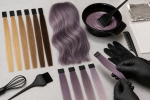
Use gloves, clean clips, separate bowls and brushes, foils or other label-supported barriers, towels, and timers. Assign one tool set to each color or clean tools thoroughly according to directions before reuse. Protect the cover veil and surrounding natural hair from stray deposit.
Section the panel cleanly and secure every stripe before mixing. Apply enough product for complete saturation without flooding across boundaries. Follow current label directions for use area, mixing, processing, and rinsing. Do not place scalp hair dye on eyebrows, eyelashes, or irritated skin.
Control cross-color transfer
Keep neighboring stripes separated throughout processing. When rinsing, follow product directions and use a planned order that reduces contact between incompatible shades. Some colors can transfer into pale neighboring sections or the natural veil, especially during the first rinses.
Do not assume cold water alone prevents bleeding. Product type, saturation, porosity, barrier quality, rinse time, and towel contact all matter. Use dark or protected towels where appropriate and dry the panel before evaluating whether the stripe boundaries remain clear.
Check the reveal in real hairstyles
After the hair is fully dry, release the veil and inspect concealment in the usual part. Then test each intended reveal style with low tension. Check whether the panel sits in the planned direction and whether stripe order remains readable.
The long hair styles guide can help compare braids, half-up arrangements, and gathered shapes that expose interior color differently. Avoid relying on one tightly staged photograph that does not represent routine wear.
Track every shade’s fade separately
Rainbow shades rarely fade at one rate or toward one undertone. Pink may soften before blue, yellow may stay bright on some canvases, and green or violet can leave a visible residual cast. Record each stripe after comparable wash intervals instead of describing the whole panel as simply faded.
Wash frequency, water temperature, mineral exposure, shampoo, heat, sun, porosity, and color transfer can change the pattern. A multitone related design such as oil slick hair uses different shade relationships but raises similar questions about dark-canvas visibility, neighboring colors, and uneven fade.
Refresh only the changed part of the system
Separate root growth, canvas lightness, stripe saturation, boundary clarity, and hair condition. If only one shade has faded, test a targeted deposit rather than repeating every color. If roots have grown but the lengths remain vivid, reconnect the root portion without pulling lightener or dye through all ends.
Keep the original panel and stripe map, product notes, dry-result photographs, and fade record. Review the cover veil before every refresh because haircut changes can expose or hide the panel differently. Prioritize condition when the panel has been lightened repeatedly.
Follow hair-color safety boundaries
Follow every label and enclosed instruction, including preliminary test directions, gloves, timing, rinsing, and restrictions. The FDA hair-dye guidance notes that reactions can occur after earlier uneventful use and that scalp hair dye is not intended for eyebrows or eyelashes. Do not apply color over an irritated or damaged scalp.
The American Academy of Dermatology coloring guidance recommends conservative shade changes and following manufacturer testing directions. These sources establish precautions, not one multicolor formula or an assured hidden-rainbow result. Fragile hair, old dark color, severe bands, or major lightening calls for qualified professional assessment.
Hidden rainbow checklist
- Define the concealed views and exact reveal styles.
- Measure and photograph the dry top-veil boundary.
- Map stripe order, width, and acceptable transitions.
- Audit previous color, level, undertone, porosity, and condition across the panel.
- Test representative lightening and then test every intended shade.
- Use separate tools, barriers, and clocks for controlled application.
- Plan the rinse to reduce transfer between incompatible colors.
- Track root growth, each shade’s fade, boundaries, veil coverage, and condition separately.
Hidden rainbow hair is a placement system rather than just a group of bright dyes. A tested canvas, measured cover veil, numbered stripe map, strict isolation, and shade-specific maintenance keep concealment and reveal under deliberate control.