Cream Hair Lightener: Formula, Directions, and Compatibility Guide

Direct answer: use a cream hair lightener only with the developer, ratio, scalp or off-scalp placement, enclosure method, and maximum processing time named for that exact product. “Cream” describes texture, not a standard strength or universal technique. Confirm whether the container is a lightener concentrate, ready-to-activate cream, component in a kit, or another product class; map prior color and hair condition; then complete directed preliminary testing and exact strand tests before a wider application.
Cream lightener is an oxidative pigment-removal system. It is not permanent hair color, toner, conditioner, or hair-lightening spray. Its viscosity may support controlled application, but a smooth texture does not establish low damage, scalp suitability, even lift, or a predictable level change.
Identify what the cream actually is
Read the product identity, ingredient list, directions, warnings, components, and technical chart. Some cream lighteners are supplied in a tube or tub and require a named developer. A kit may contain multiple numbered components. Do not assume the cream is ready to use because it already looks mixed.
Check whether the product is a standalone lightener, a high-lift color component, a lightening booster, or a premeasured kit part. Similar white cream can represent different chemistry. Do not combine components from separate products to replace a missing tube or bottle.
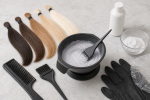
The opaque cup in the editorial image demonstrates measurement only. It does not identify water, developer, oil, or another ingredient. Add only the component explicitly named in the directions.
Compare cream lightener with other lightening formats
Powder, clay, oil, and cream lighteners can differ in mixing ratio, texture, expansion, drying behavior, lift range, application surface, and scalp restrictions. Do not turn powder into “cream” with conditioner or thicken cream lightener with powder from another system.
The hair-lightening spray guide covers a separate gradual or leave-in product category. Spray, permanent color, and oxidative cream lightener are not interchangeable simply because each can make hair appear lighter.
High-lift permanent color combines natural-pigment lift and dye deposit in a named oxidative color line. Cream lightener primarily exposes a lighter underlying canvas; any later toner or color is a separate compatibility decision.
Map the full starting canvas
Record natural level, permanent and demi-permanent color, direct dye, henna or other plant color, metallic or compound dye if known, highlights, prior lightener, perms, relaxers, smoothing services, gray, banding, elasticity, breakage, and porosity. Separate root, midlength, end, hairline, and fragile zones.
Natural pigment and artificial color can respond differently. Previously lightened ends may change quickly while a dark artificial band remains warm or resists change. Direct-dye residue can shift unpredictably. Unknown chemical history is a reason to stop, not to raise developer strength.
If the hair is gummy, breaking, extremely rough, or unable to withstand gentle manipulation, do not proceed. A creamy base, conditioner-like feel, or added bond component does not prove that another oxidative process is suitable.
Confirm scalp and off-scalp permissions
Check whether the exact product permits on-scalp use, off-scalp use, both, or only a named technique. Follow any developer-strength difference, minimum scalp distance, heat restriction, and maximum time associated with that placement.
Do not use an off-scalp formula at the root because the cream seems controlled. Do not place an on-scalp-approved formula inside foil unless enclosure is also allowed. Scalp heat, section enclosure, and open-air exposure can change product behavior.
Never use scalp lightener on eyelashes or eyebrows. Avoid application on an irritated, abraded, sunburned, or otherwise damaged scalp.
Match the named developer and ratio
Use the developer family and strength listed for the cream lightener and intended placement. A volume number does not make developers from different systems equivalent. Dedicated developers can differ in formulation even when the nominal strength matches.
Measure the cream and developer by weight or volume as directed. Keep one unit system and document the batch. If the instructions provide a ratio range for different techniques, choose only the option that matches the approved placement; do not select the thickest or strongest mixture by preference.
A stronger developer does not guarantee more usable lift. Adding extra developer can change viscosity, saturation, drying, spread, and chemical exposure. Adding water, shampoo, conditioner, oil, or unrelated developer to adjust consistency is outside the formula unless expressly directed.
Mix for uniformity, not appearance
Use a nonmetallic bowl and the specified mixing tool. Add components in the stated order and blend until the directed uniformity is reached. Scrape the sides and bottom so concentrated cream is not left unmixed.
Do not judge activation from color, warmth, bubbles, or smell alone. Do not seal a mixed oxidative batch in a closed container unless the directions provide a compatible applicator and method. Prepare only the amount that can be applied within the allowed working period.
Work in the ventilation and protective conditions specified on the label. Wear gloves and keep the mixture away from the eyes, face, clothing, and surfaces.
Complete safety testing and exact strand trials
Follow all preliminary tests and precautions supplied with the lightener. The U.S. Food and Drug Administration’s hair-dye guidance advises following package directions, wearing gloves, observing timing, rinsing thoroughly, avoiding a damaged scalp, and completing directed preliminary testing.
A strand test evaluates lift, warmth, and condition. Select hidden samples representing natural roots, artificial-color bands, direct-dye residue, resistant sections, old highlights, porous ends, and gray. Mix the exact cream, developer, ratio, additives, and batch size intended for the service.
Apply with the planned section thickness, saturation, backing material, and enclosure condition. Check only at permitted intervals. Rinse at the target or maximum time, whichever comes first, and dry fully before evaluating level, warmth, banding, breakage, elasticity, roughness, and later tonal options.
Decide whether hair should be dry, damp, or washed
Follow the exact preparation directions. Do not assume cream lightener belongs on wet hair because the texture spreads easily, or on unwashed hair because a generic color rule says so. Water in the hair changes dilution and placement unless the product is designed for that surface.
The wet-versus-dry hair color guide explains why the formula label, not the product category alone, determines the application surface.
Control saturation and section geometry
Divide the hair before mixing. Use consistent, manageable sections and enough product to cover the intended hair according to the directions. A creamy coating on the surface does not prove complete interior saturation.
For selected highlights or painted pieces, define width, depth, spacing, transition, and preserved natural hair. For a full application, identify root heat, old lightened lengths, bands, and fragile ends. Do not drag fresh lightener through established pale sections without a strand-supported direction.
The long hair placement guide helps plan visible sections and upkeep on longer lengths while leaving chemical decisions to the product directions.
Follow enclosure and heat limits
Foil in an editorial image does not authorize foil for every cream formula. Verify whether the product permits foil, film, mesh, cotton, open air, or another separator. Use only the specified backing and closure method.
Do not add external heat, place the hair under a dryer, wrap the entire head, or cover an open-air formula unless directed. Heat and enclosure can change moisture, temperature, expansion, and processing speed.
Never extend the maximum time because the mixture still appears moist or the target has not been reached. A slower-than-expected strand result is evidence to revise the plan, not permission to override the limit.
Separate exposed warmth from the finished shade
Lightening can reveal yellow, orange, or red-orange depending on the starting canvas and level reached. Decide before application which dry level would support the intended later tone. Do not continue processing solely to erase visible warmth.
When zones finish at different levels, one toner can respond differently across the head. Record the dry result and assess toner compatibility separately. Do not mix toner into the cream lightener unless the manufacturer provides that exact system.
Recognize stop conditions
Stop before mixing if the product class, components, developer, ratio, scalp permission, enclosure, maximum time, starting history, or target is unknown. Stop when hair condition is unacceptable or representative strand tests show severe banding, breakage, gummy texture, excessive roughness, or a result incompatible with the plan.
During use, rinse as directed for intense burning, swelling, blistering, breathing difficulty, spreading rash, eye exposure, unexpected heat, product leakage toward the scalp, severe breakage, or another concerning reaction. Seek appropriate medical help for a serious reaction. The American Academy of Dermatology’s hair coloring guidance supports manufacturer testing and conservative spacing of chemical changes.
Rinse, assess, and document
Remove separators carefully and rinse at the directed time and water temperature, keeping runoff away from the eyes. Use only the named cleanser, conditioner, or finishing component.
After complete drying, record starting level and history by zone, cream and developer amounts, ratio, additives, placement, section size, enclosure, check times, rinse time, dry level, warmth, and hair condition. Discard mixed lightener according to the label; never store it for later use.
Cream lightener checklist
- The exact cream product, components, developer, ratio, placement, enclosure, and maximum time are known.
- Natural hair, artificial color, direct dye, bands, prior highlights, gray, and fragile ends are mapped.
- The scalp or off-scalp permission matches the planned technique and developer.
- No water, conditioner, unrelated powder, oil, toner, or developer is added outside the directions.
- Directed preliminary testing and fully dried representative strand trials are complete.
- Application surface, section geometry, saturation, overlap, separator, and timing are documented.
- Scalp, reaction, heat, leakage, breakage, elasticity, texture, banding, and maximum-time stop conditions are defined.
Cream lightener is appropriate only when its exact formula system and placement rules fit the mapped canvas. If identity, history, compatibility, or strand evidence remains uncertain, stop rather than changing the developer or processing time.