Dust-Free Powder Hair Lightener: Formula, Directions, and Compatibility Guide

Direct answer: “dust-free” powder hair lightener is still a powder product that must be handled, measured, mixed, and ventilated according to its exact directions. The term may describe reduced airborne dispersion compared with another powder format; it does not mean zero particles, inhalation-safe handling, or freedom from protective precautions. Use only the named developer and ratio, confirm scalp or off-scalp permission, and complete directed preliminary testing plus exact strand tests.
Powder lightener is an oxidative pigment-removal system. The dry powder, developer, mixture consistency, starting canvas, section geometry, enclosure, temperature, saturation, and processing time all influence the result. The word “dust-free” does not state lift level, scalp suitability, or expected hair condition.
Read what dust-free means on the exact label
Review the product identity, warnings, ventilation directions, measuring method, developer family, ratio, application surfaces, and cleanup instructions. Do not assume that another brand’s “dust-free,” “low-dust,” or compact powder uses the same handling rules.
Keep the container low and stable when opening. Scoop or pour by the method supplied with the product, avoid dropping powder from height, and do not place the face over the bowl. Close the container promptly as directed.
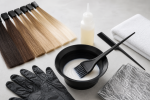
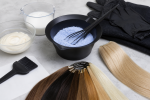
The accepted editorial image shows powder contained in a bowl with no airborne cloud. It does not suggest that exposed powder can be inhaled or handled without care.
Separate powder lightener from color deposit
Powder lightener removes pigment through an activated oxidative mixture. Direct dye deposits ready-made pigment and has different compatibility rules. The direct hair color formula guide helps distinguish deposit from lightening.
Do not add direct dye, toner, permanent color, shampoo, conditioner, or cosmetic pigment to powder lightener unless the manufacturer publishes that exact system. Plan the finished tone only after the lightened canvas has been rinsed, dried, and assessed.
Identify the starting canvas
Map natural level, permanent and demi-permanent color, direct dye, plant color, metallic or compound dye if known, previous lightening, highlights, gray, bands, breakage, elasticity, and porosity. Separate roots, midlengths, ends, hairline, old highlights, and fragile sections.
Natural pigment and artificial color can respond differently. Dark artificial bands may remain warm while natural sections change more readily. Direct-dye residue can shift color. Porous pale ends can sustain unnecessary overlap. Unknown history is a stop condition, not a reason to increase developer.
The warm hair color guide helps identify gold, orange, and red directions that can appear as pigment is removed. Visible warmth is not permission to exceed processing limits.
Check scalp and hair condition
Do not proceed on an irritated, abraded, sunburned, or otherwise damaged scalp. Confirm whether the exact powder permits on-scalp use, off-scalp use, or both, along with any developer and timing limits for each placement.
Inspect hidden strands for severe roughness, gummy texture, excessive stretch, or breakage. A bond additive, lower developer, or dust-free format does not establish that compromised hair can tolerate another oxidative process.
Use the approved developer
Match the powder with the developer family and strength specified for the target and placement. A shared volume label does not make unrelated developers interchangeable. Do not select a stronger bottle to chase lift.
Developer affects activation, viscosity, spread, timing, scalp exposure, and hair condition. A lower strength does not authorize a longer time, and a higher strength does not establish a better dry result.
The opaque white bottle in the image represents an unbranded developer. It does not identify strength, ratio, or brand. Add no water or transparent liquid unless the exact directions explicitly name it.
Measure powder without creating a cloud
Use the scoop, scale, or volume method specified on the label. Keep the bowl near the container and transfer the powder gently. Avoid shaking the scoop, tapping it near the face, or using a fan that can move particles.
Add developer in the order directed. Initial wetting can help contain powder when done according to instructions, but do not pour aggressively or whisk dry powder at high speed. Mix until the directed uniform consistency is reached.
Clean powder residue with the method provided by the manufacturer. Do not blow it from the counter or sweep it into the air.
Keep the ratio exact
Record powder and developer in one unit system. If the directions provide different ratios for scalp, foil, open-air, or freehand techniques, choose only the ratio approved for the intended placement. Do not select a ratio because it appears creamier or spreads farther.
Do not thin the bowl with extra developer, water, conditioner, shampoo, or oil. Do not thicken it with more powder after estimating by eye. When the measurement is wrong, remake the batch under the directions.
Complete preliminary and strand testing
Follow all preliminary tests and precautions supplied with the product. The U.S. Food and Drug Administration’s hair-dye guidance advises following package directions, wearing gloves, observing timing, rinsing thoroughly, avoiding a damaged scalp, and completing directed preliminary testing.
For strand testing, select hidden samples representing natural root, old permanent color, direct-dye residue, dark bands, resistant areas, prior highlights, and porous ends. Use the exact powder, developer, ratio, section size, saturation, enclosure, and timing intended for use.
Rinse by the maximum time or earlier when the target or a stop condition is reached. Dry fully and evaluate level, exposed warmth, banding, breakage, elasticity, roughness, and whether the planned toner would fit the actual canvas.
Prepare sections before mixing
Arrange gloves, timer, clips, protective covering, nonmetallic bowl, compatible brush, separators, and enough product. Divide the hair before activating the lightener so sectioning does not consume the working period.
Use consistent subsections and the saturation level specified for the technique. A surface coating does not prove interior contact, while excessive pressure can push product beyond the intended placement.
The long hair placement guide helps plan visible sections and upkeep without replacing the powder-lightener directions.
Follow enclosure and heat restrictions
Confirm whether foil, film, mesh, cotton, open air, or another separator is allowed. Do not assume every powder works in foil or on the scalp. Enclosure and scalp heat can change temperature, moisture, expansion, and processing speed.
Do not add external heat, wrap the entire head, mist drying product, or place fresh mixture over a slow section unless directed. Foil in an editorial setup is a possible tool, not universal authorization.
Control timing and overlap
Start timing at the event named by the manufacturer and inspect only at allowed intervals. Avoid repeated scraping, stretching, or wiping that can disturb the strand.
Do not overlap fresh powder lightener onto established pale or fragile lengths without exact strand-supported directions. When roots, bands, and ends need different plans, separate them or obtain qualified color assistance.
Stop at the maximum time even when the desired level has not been reached. Do not immediately repeat the process or use a stronger developer to force the target.
Recognize stop conditions
Stop before mixing if powder identity, developer, ratio, dust controls, scalp permission, enclosure, maximum time, prior chemistry, or target is unknown. Also stop for a damaged scalp, weak hair, incompatible history, or strand tests showing severe banding, breakage, gummy texture, excessive roughness, or insufficient condition.
During use, rinse as directed for intense burning, swelling, blistering, breathing difficulty, spreading rash, eye exposure, unexpected heat, powder or mixture inhalation concern, leakage toward the scalp, severe breakage, or another concerning reaction. Seek appropriate medical help for a serious reaction. The American Academy of Dermatology’s hair coloring guidance supports manufacturer testing and conservative spacing of chemical changes.
Rinse and document
Remove separators carefully and rinse at the directed time and temperature, keeping runoff away from the eyes. Use only the named cleanser, conditioner, or finishing step.
After complete drying, record starting level and history by zone, powder and developer amounts, ratio, placement, section size, saturation, enclosure, check times, rinse time, dry level, warmth, and hair condition. Discard mixed lightener according to the label.
Dust-free powder checklist
- Dust-free is understood as a product-specific handling description, not zero airborne-particle risk.
- Powder identity, developer, ratio, measuring method, ventilation, placement, enclosure, and maximum time are known.
- Natural hair, artificial color, direct dye, bands, highlights, and fragile ends are mapped.
- No water, conditioner, shampoo, household powder, oil, toner, or unrelated developer enters the formula.
- Directed preliminary testing and fully dried representative strand tests are complete.
- Transfer, mixing, cleanup, sectioning, saturation, overlap, heat, and timing controls are documented.
- Reaction, inhalation concern, heat, leakage, banding, breakage, texture, and maximum-time stop conditions are defined.
A dust-free powder still requires deliberate powder control and one complete approved formula. When the identity, handling directions, history, or strand evidence is uncertain, stop rather than increasing developer or exposure.