Henna Powder for Hair: Formula, Directions, and Compatibility Guide

Direct answer: use henna powder for hair only after confirming the complete ingredient list, the exact mixing liquid, resting or dye-release directions, application time, and compatibility warnings. Pure henna is powdered Lawsonia inermis leaf and deposits a translucent warm copper-to-red-orange color. It does not lighten natural or artificial pigment, and it does not produce brown or black by itself.
A package described as brown henna, black henna, neutral henna, herbal color, or henna blend may contain other plants, direct dyes, oxidative colorants, metallic salts, or undisclosed additives. Do not transfer pure-henna directions to a blend, and do not assume a plant-based description proves formula identity or future chemical compatibility.
Read the complete ingredient list
Start with the botanical name and every added ingredient. A single-ingredient pure henna powder should identify Lawsonia inermis. A blend may also list indigo, cassia, amla, other botanicals, colorants, salts, fragrance, acids, gums, or conditioning ingredients.
If the package has no complete ingredient list, the powder identity conflicts across the label and seller description, or loose powder was transferred into an unmarked bag, stop. Color, scent, fineness, and green-brown appearance cannot prove purity.
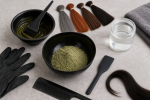
The green-brown powder and paste in the editorial image represent an ingredient-check and mixing context. The image does not identify a brand, confirm purity, prescribe a water amount, or predict the swatch result.
Separate pure henna from blends and misleading color names
Pure henna adds a transparent orange-to-copper-red layer over the starting canvas. On pale or gray hair, that layer can look bright copper. On medium brown hair, it may appear auburn in strong light. On very dark hair, visible change may be limited to warmth and shine. It cannot remove pigment or turn dark hair blonde.
Brown or black results generally require another colorant or a multi-step botanical system. “Neutral henna” commonly refers to a different plant used without henna’s red-orange dye profile. These products need their own directions and should not be represented as interchangeable shades of one powder.
The ginger hair color guide helps distinguish copper, orange, auburn, and red directions. It should be used to describe the target, not to predict that one henna powder will reproduce a photograph.
Reject unknown black-henna shortcuts
A powder sold as black henna is not pure henna solely because “henna” appears in the name. Verify every ingredient and the approved use. Products may obtain dark results from indigo, another documented color system, or ingredients that require different warnings.
Do not apply a product containing an undisclosed dye, an unapproved skin-coloring instruction, or a formula that tells the user to ignore preliminary testing. The U.S. Food and Drug Administration’s hair-dye guidance explains label-directed precautions, preliminary testing, gloves, timing, rinsing, damaged-scalp limits, and adverse-reaction boundaries.
Map the starting canvas before mixing
Record natural level, gray percentage and distribution, permanent and demi-permanent color, direct dye, lightener, highlights, prior henna, indigo or other plant color, metallic or compound color if known, and unknown history. Separate roots, gray temples, pigmented midlengths, porous ends, resistant strands, and fragile sections.
Henna is translucent, so each zone can display the same deposit differently. White strands may look much brighter than brown lengths. Porous ends may collect more color or become deeper after repeated full-length applications. Dark artificial bands remain dark because henna does not lift them.
If the goal is to preserve part of a silver pattern, the gray hair transition guide offers a separate framework for contrast, care, and selective blending.
Follow the exact mixing-liquid directions
Use only the liquid and amount range specified for the exact powder. Some products call for water at a stated temperature; others provide a different line-specific method. Do not assume that lemon juice, vinegar, tea, coffee, wine, milk, yogurt, oil, conditioner, peroxide, developer, or another household ingredient improves every formula.
Highly acidic mixtures can be uncomfortable or leave hair feeling rough, while oils and conditioners can change paste handling or deposit. Extra ingredients also make a failed strand result harder to interpret. Start with the simplest manufacturer-directed mixture.
Use a clean bowl and compatible nonmetallic mixing tool when directed. Add liquid gradually until the specified consistency is reached. Do not use the photograph as a ratio reference; bowl size and paste depth are illustrative.
Respect rest and dye-release instructions
Some powders are applied after mixing, while others require a covered rest at a stated temperature or within a time window. Follow the exact method. Do not borrow a release schedule from a different crop, blend, acidic liquid, or room temperature.
Record powder amount, liquid, temperature, mix time, rest start, rest end, and paste appearance. Discard a mixture that develops an unexpected odor, contamination, mold, separation outside the stated behavior, or unknown storage history.
Do not store mixed paste unless the directions explain how and for how long. A household freezer or refrigerator is not automatically an approved storage method.
Complete preliminary and repeated strand tests
Follow every package-directed patch, allergy, sensitivity, or other preliminary test. Avoid an irritated, abraded, sunburned, or otherwise damaged scalp. Wear gloves and keep hair color away from eyebrows, eyelashes, and eyes.
Test hidden strands from gray, natural, artificially colored, previously lightened, and porous zones. Use the exact powder batch, liquid, amount, rest method, saturation, enclosure, and application time planned for the full service.
Rinse and allow the strand to dry fully. Evaluate it immediately and again after the label’s stated settling or oxidation period. Freshly rinsed henna can look different after exposure to air, so the wet paste or first damp result is not the final decision.
When maintenance may involve repeated applications, test buildup across the intended number and spacing of uses. Stop if the strand becomes too dark, too warm, rough, tangled, brittle, uneven, or difficult to separate.
Apply with controlled sections and saturation
Prepare gloves, clips, protective covering, a clean bowl, tint brush or directed applicator, timer, and a pathway to the rinse area. Henna paste can stain skin, fabrics, grout, porous counters, and tools, so protect only as the package recommends and clean spills promptly.
Apply to the hair condition specified by the label. Use consistent subsections and enough paste for directed saturation without forcing product into the eyes or abrading the scalp. Do not let a thick section hide dry interior strands.
Follow the stated enclosure and time. Do not add heat, extend the maximum, allow the paste to dry solid on the scalp, or keep it overnight unless the exact directions explicitly allow that method.
Plan gray coverage as translucent blending
Pure henna can make gray strands visibly copper or orange rather than matching adjacent brown or black hair. That contrast may be the intended effect, but it should be established by a fully dried gray-strand test.
A darker botanical plan may require a documented henna-and-indigo sequence or another exact blend. Do not improvise powder percentages from a desired color name. Ingredient strength, starting gray, water, timing, and prior buildup can change the outcome.
If opaque gray matching is essential, compare formula classes before committing to henna. The direct color formula guide describes a different deposit system; it does not authorize mixing direct dye into henna paste.
Avoid automatic full-length reapplication
Henna can remain visible for a long time and can accumulate with repeated use. When new growth is the only uncolored area, determine whether the product directions and strand evidence support a root-focused application.
Do not drag every maintenance batch through the ends by habit. If a refresh is permitted, define where it starts, how long it remains, and how overlap will be limited. Document each full-length and root application so color history is not lost.
Preserve compatibility information for future services
Keep the original package or photograph the complete ingredient list, directions, date, and batch information. Tell a stylist about every henna, indigo, cassia, compound plant color, and unknown powder before permanent color, lightener, a perm, relaxer, or smoothing service.
Do not assume that fading, clarifying shampoo, or several months of growth removes all color from the lengths. Do not place lightener or oxidative color over unknown plant powder without exact ingredient review and representative strand testing.
Unexpected heat, smoke, odor, discoloration, gummy texture, severe tangling, or breakage during a compatibility strand test is an immediate stop signal. The American Academy of Dermatology’s coloring and perming guidance supports manufacturer testing and conservative spacing around chemical changes.
Rinse and evaluate without forcing removal
At the directed time, loosen and rinse the paste using the stated water temperature and finishing method. Keep runoff out of the eyes. Do not scratch the scalp or pull tangled hair to remove dried material.
Use only the directed cleanser or conditioner. After the hair is completely dry and the stated settling period has passed, assess gray brightness, root-to-length balance, copper or auburn direction, staining, tangling, roughness, and breakage.
Henna powder checklist
- The exact botanical and every additive are documented from the package.
- Pure henna, henna-indigo blends, cassia, compound powders, and unknown black-henna products are not treated as interchangeable.
- The starting level, gray pattern, artificial color, prior plant color, lightener, porous ends, and unknown history are mapped.
- The mixing liquid, consistency, rest period, temperature, enclosure, and time follow the exact directions.
- Directed preliminary testing and fully dried strand tests cover all important zones and repeated-use buildup.
- No peroxide, developer, direct dye, household ingredient, or unlisted powder is added.
- Root maintenance and full-length overlap are planned separately.
- The ingredient history is preserved before any later color, lightener, perm, relaxer, or smoothing service.
- Reaction, contamination, unexpected heat, discoloration, roughness, tangling, and breakage have clear stop rules.
Henna powder is most predictable when its identity, translucent color behavior, mixing method, and long-term compatibility are documented before the full application. If the ingredient list or strand evidence is uncertain, do not use the powder as an experiment on the full head.