Bond-Care Treatments: Product Category, Directions, and Claim Limits

Direct answer: bond-care is a broad cosmetic marketing category, not one standardized formula or proof of permanent repair. Identify whether the product is a shampoo, conditioner, mask, leave-in, salon step, or multi-part system; follow its exact sequence, dose, timing, and rinse directions; keep companion products within the same permitted system; and judge slip, flexibility, residue, stiffness, and breakage without extending claims beyond the label and supporting evidence.
Identify the category before the claim
A bond-care name can appear on cleansing, conditioning, styling, color-service, or professional-only products. Read intended user, hair condition, application site, sequence, mixing, timing, rinsing, frequency, and warnings. The FDA hair-products overview supplies cosmetics context without confirming a bond mechanism or permanent outcome.
Separate mechanism language from observable finish
Words such as rebuild, reconnect, strengthen, protect, or repair may describe a brand’s intended cosmetic result, but they do not let a reader see internal bonds. Observable checks include wet slip, dry flexibility, tangling, roughness, snapping, coating, and styling response. The healthy-looking hair guide keeps appearance and health claims separate.
Map the entire companion system
Some products are designed to work with a matching cleanser, conditioner, mask, primer, activator, or post-service step. Confirm which companions are required, optional, or prohibited. Do not combine similarly named systems or substitute an activator from another brand. More steps can increase deposit or stiffness without showing which product changed the result.
Record chemical and heat history
List color, bleach, relaxer, perm, smoothing, repeated heat, and previous bond-care use by date and section. Fresh services may impose a wait period or salon-only sequence. The red-hair guide offers color-placement and care context without proving compatibility.
Follow professional-only boundaries
A salon additive or service concentrate is not automatically suitable for home use. Do not buy a component without its full system, improvise a ratio, or add it to bleach, developer, dye, relaxer, or perm solution. If directions require a licensed professional or specific service, preserve that boundary rather than converting it into a household recipe.
Use exact wet-or-dry directions
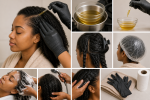
Confirm whether hair must be unwashed, clean, damp, towel-dried, or dry and whether the product belongs before, during, or after another step. Divide hair into controlled sections and apply only to permitted zones. Do not concentrate extra product on the most damaged-looking area without label support.
Control dose, contact time, and heat
Measure the stated amount or dispenser strokes and start timing from the defined point. Longer contact does not prove deeper action. Add a cap, dryer, steam, or hot towel only when expressly directed. Keep product away from eyes, broken skin, and unintended surfaces, and stop for significant discomfort.
Rinse and finish in the stated sequence
Follow whether the product must be shampooed, rinsed with water, conditioned, or left in. Check the hairline, crown, nape, underside, lengths, and ends. Do not add a protein mask, acidic rinse, oil, and strong styler automatically after bond care, because overlapping deposits can mask both benefit and buildup.
Compare wet and dry results
Observe slip, detangling force, wet stretch, dry flexibility, section separation, root lift, end feel, stiffness, snapping, and tool residue under a consistent routine. A smoother surface can be useful while remaining temporary. It does not establish that every weakened area has been permanently changed.
Set frequency from one product system
Use the product interval and account for matching products used between applications. Do not repeat early because the first result was subtle or because a service is planned. Track dates, dose, service history, finish, residue, and breakage so accumulated exposure is visible before another full-system session.
Keep low-tension handling in the routine
No cosmetic product cancels mechanical stress from tight styles, forceful detangling, rough towels, or repeated hot tools. The long-hair guide supplies low-tension organization. Adjust handling separately from the bond-care formula.
Review washout and residue
Inspect combs, towels, pillowcases, roots, underside, and ends for film. Verify wetting, sectioning, cleanser dose, and rinsing before adding a stronger wash. Stop repeated use when stiffness, dull coating, rapid heaviness, tangling, or snapping increases. Change one variable rather than stacking corrective products.
Preserve product identity and storage
Keep each component in its original labeled package and within stated temperature, light, and closure limits. Do not refill, decant, dilute, or combine leftovers. Record the opening date and system step without covering required warnings or batch information. Replace a leaking, swollen, separated, malodorous, expired, or unidentifiable component rather than attempting to restore the system.
Respect ingredient and breakage boundaries
The FDA cosmetics-allergen guidance supports ingredient review without predicting response. The AAD hair-care guidance supports gentle chemical and heat practices without endorsing bond care. Stop for hives, swelling, sores, marked shedding, or worsening breakage and follow appropriate guidance.
Decision table
| Question | Useful evidence | Stop or revise when |
|---|---|---|
| What category is it? | A complete shampoo, mask, leave-in, salon, or system label | Bond-care wording substitutes for directions |
| Are companions required? | Only the maker’s named compatible steps | Components from different systems are mixed |
| What can be observed? | Slip, flexibility, residue, stiffness, and breakage | Internal permanent repair is assumed |
| When should use stop? | The interval ends or adverse feel and symptoms appear | Subtle results lead to more dose or time |
Final checklist
- Product category, sequence, companions, and professional boundaries are explicit.
- Chemical, heat, and prior system history are recorded.
- Dose, zones, timing, heat, rinsing, and frequency follow the exact system.
- Wet and dry finish is separated from unsupported internal claims.
- Reaction symptoms, stiffness, and worsening breakage stop repeated use.
Bond-care products should be evaluated as label-specific cosmetic systems. Preserve their sequence and companion rules, compare observable finish under controlled conditions, and do not convert marketing mechanism language into a permanent repair conclusion.