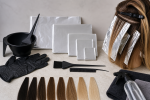
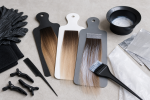
How to Choose and Use Pre-Cut Hair Color Foil Sheets at Home

Direct answer: choose pre-cut hair color foil sheets that are slightly wider than your planned sections and long enough to extend beyond the coated hair. Select a weight that folds securely without tearing, a texture you can control, and a dispensing format that releases one clean sheet at a time. Count and organize the sheets before mixing. Pre-cut foil saves preparation time, but it does not make an unapproved formula suitable for enclosed processing or make a difficult correction appropriate for home use.
This guide focuses on the pre-cut format: fixed dimensions, stack design, pop-up dispensing, sheet count, storage, and waste control. For section thickness, product placement, folding, monitoring, and removal, use the companion guide on highlighting foil after confirming that the exact product permits foil.
Start with the section map
Do not choose a sheet by package size alone. Decide where the highlights or isolated color sections will sit, how wide each slice will be, and how much hair length the sheet must support. A face-framing placement may use narrower sheets than broad interior panels. Long hair may require extended sheets even when the selected slice is narrow.
The hair section should sit within the foil with usable margins on both sides. If the selected hair is wider than the sheet, reduce the section or choose a wider format. Letting strands hang over the edge increases leakage and makes the packet harder to fold. If the hair extends beyond the bottom, use a longer sheet rather than leaving coated ends unsupported.
Use the at-home hair color planning guide to assess starting condition, product quantity, timing, and whether the placement is manageable before opening a foil stack.
Compare common pre-cut dimensions
Width controls the maximum practical section and side margins. Narrow sheets suit small detail pieces. Standard sheets accommodate many conventional highlight sections. Wide sheets support panels or dense slices but become bulky when folded around a small section.
Length should cover the working distance from the starting point to beyond the ends. Short sheets reduce excess material on cropped hair. Standard lengths fit many shoulder-length applications. Extra-long sheets reduce the need to join or overlap foil on long hair, but they add weight and can be harder to stabilize close to the head.
A mixed-size kit is useful only when the placement plan genuinely contains several section types. Otherwise, multiple dimensions add sorting decisions during a time-sensitive application. Choose one primary size and a smaller supplemental size when there is a defined purpose for each.
Choose sheet weight and texture
Light foil is flexible and adds less weight, but it wrinkles and tears more readily. Heavy foil keeps its shape and can support long sections, but a large number of packets can feel bulky. Medium-weight foil is a practical balance when it bends cleanly and stays closed without excessive pressure.
Smooth foil lets hair and tools move easily across the surface. Embossed foil adds grip that can help hold a section during loading. Deep texture can make product harder to spread uniformly or create a stiff packet. The surface should support the chosen technique rather than simply look more professional.
Colored foil can identify formulas, placement zones, or application order. Use color only as an organizational code established before mixing. The coating must be intended for hair-color foil and compatible with the product. Decorative color does not change processing time or product performance.
Decide between stacked and pop-up sheets
Flat stacked sheets
Flat stacks are easy to count and divide into work zones. They can be placed on a clean dry tray in exact application order. The drawback is that thin sheets may cling together, especially when handled with damp or contaminated gloves. Separate the needed quantity before active application.
Interleaved pop-up sheets
Pop-up boxes present the next sheet as one is removed. They reduce cutting and can keep unused foil contained. Test the dispenser with clean dry hands: it should release one full sheet without tearing, dragging out several sheets, or requiring contact with the inside stack.
Pre-folded sheets
A manufactured leading fold can create a stable edge near the root and reduce preparation. Confirm that the fold depth suits the placement. A thick fold may create distance from the root or become bulky on short sections. Do not assume every pre-folded edge should be placed directly against the scalp.
Estimate the sheet count
Build the count from the section map, not from a generic claim on a box. Count planned foils by zone, add a small number for torn or contaminated sheets, and keep the rest sealed. Running out after mixing can extend application time and encourage oversized sections.
More sheets do not automatically create a more blended result. Density depends on section spacing, weave or slice pattern, hair included in each packet, and placement. If the count required exceeds what you can apply and monitor within the product’s timing limits, simplify the design or use professional service.
Record the actual number used and where each size was placed. That information is more useful for a future maintenance plan than the original package count.
Prepare and stage the foil
Set up clean, dry zones for unopened foil, ready sheets, active packets, and used foil. Keep towels, water, and product away from the unused stack. Put on the label-directed gloves before handling active color, but separate the sheets first when practical so contaminated gloves do not touch the supply.
Orient every sheet the same way. If different colors represent different formulas or zones, write the code in the work plan rather than on the foil. Place shorter and longer sheets in distinct stacks that cannot be confused from the top view.
The hair color selection and application guide helps determine whether the chosen product and application route belong in a foil workflow.
Use each sheet without defeating the format
Remove one sheet with dry control. If two sheets cling together, separate them before positioning; an accidental double layer changes stiffness and wastes material. Support the selected hair on the foil and keep the side margins visible while applying the label-directed mixture.
Fold according to the product and technique requirements. Pre-cut dimensions save cutting time, but they do not dictate the correct fold. Do not force a short sheet to cover long ends with repeated tight folds. Do not extend a narrow sheet by overlapping another sheet unless the method explicitly supports that construction.
Keep the remaining sheets away from drips. Once a sheet contacts product, hair, or contaminated gloves, do not return it to the clean stack. Used foil is single-use.
Respect processing and safety limits
The U.S. Food and Drug Administration advises consumers to follow every label and package direction, complete the directed skin test before each use, wear gloves, keep dye away from the eyes, observe the stated processing time, and rinse the scalp well. Foil cannot make irritation impossible or justify exceeding time limits.
The American Academy of Dermatology notes that lightening more than three shades generally requires stronger peroxide and can cause more damage. Major lift, overlapping bleach, uneven dark color, fragile hair, and hard-to-see back sections are reasons to use professional help rather than adding more pre-cut packets.
Do not apply unapproved external heat. Do not use foil on eyebrows or eyelashes. Do not proceed on an irritated, sunburned, scratched, or damaged scalp. If a packet leaks or shifts, correct the section rather than hiding it inside another sheet.
Store unused sheets
Keep unused foil dry, flat, and protected from bent corners, dust, moisture, and product residue. Close the pop-up box or reseal the stack. Store colored sizes so the identification system remains clear. Do not place heavy tools on foil that must remain flat.
Discard sheets that are torn, heavily wrinkled, contaminated, stuck together, or damaged at the edge. Foil itself is not cleaned and reused. Clean the dispenser exterior if it was handled with contaminated gloves without wetting or contaminating the remaining stack.
Common pre-cut foil mistakes
- Buying a popular size before planning section width and hair length.
- Using a short sheet that leaves coated ends unsupported.
- Letting a pop-up dispenser release several hidden layers.
- Using colored foil without a written zone code.
- Opening the full stack inside the active product area.
- Increasing section thickness to reduce the number of sheets.
- Returning contaminated sheets to the clean supply.
- Assuming pre-cut convenience makes complex lightening easier.
Placement should support the desired pattern and maintenance plan. The red hair color ideas guide provides a broader example of how color placement changes visibility and upkeep, even when the planned shade is different.
Final pre-cut foil checklist
- Verify that the exact formula permits foil.
- Map every section before choosing dimensions.
- Select width for the slice plus side margins.
- Select length that extends beyond the coated ends.
- Choose a weight and texture you can fold securely.
- Test the stack or pop-up dispenser before mixing.
- Count and stage sheets by zone and size.
- Keep unused foil clean, dry, flat, and separate.
Pre-cut sheets remove a preparation step. They do not replace section planning, formula compatibility, timing control, monitoring, or careful removal.
Sources and scope
The FDA hair dyes guidance supports the label, skin-test, glove, timing, eye-area, scalp-condition, service-spacing, and adverse-reaction boundaries used here. The American Academy of Dermatology coloring guidance supports conservative shade changes and damage-reduction limits. Neither source ranks pre-cut foil dimensions or dispensing formats.