Preparing for Hair Color in Hard Water: Product Checks and Practical Safety Boundaries

Direct answer: prepare for hair color in a hard-water setting by confirming that hardness is actually present, documenting the hair’s current feel, tone, porosity, and color history, checking any clarifying or chelating product directions, and strand-testing the planned color on the prepared canvas. Do not assume every dull, rough, warm, or resistant result is caused by minerals, and do not combine removal products or color chemicals without label support.
Hard water describes water with higher concentrations of dissolved minerals, commonly calcium and magnesium. A household water report or appropriate test provides better evidence than appearance alone. Hair symptoms are nonspecific and can also reflect product residue, weathering, previous color, heat, or damage.
Confirm the water condition
Look for a current municipal or utility water-quality report and identify whether it reports hardness or related mineral measures. Private-well users may need an appropriate laboratory or water-professional test. Record the units and collection date rather than relying on a generic city ranking or shower-door scale.
Separate water hardness from other water concerns. Hardness does not establish contamination, and a cosmetic hair decision is not a substitute for drinking-water or plumbing advice. If the report is unclear, ask the utility or a qualified water professional what the value represents.
Document the hair before changing the routine
Photograph roots, mid-lengths, and ends fully dry in neutral light. Record dullness, visible warmth, surface residue, tangling, roughness, elasticity, breakage, porosity, and how the hair responds to ordinary washing. Note previous permanent color, direct dye, lightening, smoothing, and recent product changes.
Do not diagnose mineral buildup from one observation. Compare a representative section after the normal wash routine and, if label-supported, after a carefully selected cleansing test. Severe breakage, scalp irritation, unexplained shedding, or a sudden texture change is a reason to pause cosmetic experimentation and seek appropriate professional assessment.
Separate buildup from underlying color
Warmth may come from the natural undertone exposed by earlier lightening, faded cool deposit, oxidation, or uneven previous color. A clarifying wash cannot change an underlying level in the way lightening does. Likewise, removing some surface residue does not mean every band or dark area will disappear.
Compare dry strands from roots, middle, and ends. If the apparent warmth remains in the internal color after cleansing, plan around that canvas rather than repeatedly washing in search of a different level.
Read cleansing and chelating labels closely
Products marketed for clarifying, mineral removal, or chelating can differ in purpose, contact time, frequency, required follow-up, and compatibility with color-treated hair. Read the current label and manufacturer directions. Check whether the product is intended before color, after swimming, for salon use, or for routine cleansing.
Do not assume stronger or longer is better. Repeated cleansing can change feel and may remove some direct deposit. Do not mix a mineral-removal product with lightener, developer, permanent color, or another treatment unless the directions explicitly support the combination.
Run a bounded preparation test
Select a representative hidden section and record its starting feel, visible tone, porosity, and color. Use the candidate preparation product exactly as directed, including amount, contact time, rinse, and conditioning steps. Dry the strand fully and compare it with an untreated control.
Evaluate residue, combing, roughness, color loss, elasticity, and tonal change. Stop if the hair becomes unusually rough, weak, tangled, or if the scalp becomes irritated. A preparation step that improves one strand does not establish that repeated whole-head use is appropriate.
Strand-test the planned hair color afterward
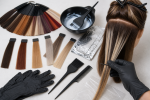
The meaningful test is the planned color on the canvas that will actually be colored. Use a section that represents the level, previous color, porosity, and preparation method. Record color product, ratio, developer or activator, saturation, timing, rinse, and fully dry result.
Judge level, undertone, evenness, deposit, elasticity, and fade. Compare prepared and unprepared tests when the preparation itself is uncertain. Revise the color target, preparation, timing, or decision to seek a qualified colorist from those results.
Check the complete product sequence
Write the order of cleansing, drying, color application, rinsing, and conditioning. Confirm whether the color label expects freshly washed, dry, damp, or unwashed hair. A useful cleansing step can still be poorly timed if it conflicts with the color directions.
The at-home hair color guide provides a broader planning framework for separating canvas assessment, product directions, testing, and stop conditions. Use that framework without treating home color as equivalent to a professional correction.
Avoid unsupported water fixes
A shower filter may be designed for specific contaminants or conditions but is not automatically a water softener. Check independent specifications and the exact problem it claims to address. Do not promise that one filter, rinse, or shampoo will correct every color outcome.
Acidic kitchen ingredients, concentrated cleaners, plumbing chemicals, and improvised mixtures do not belong in a hair-color plan. Use products intended for hair and follow their directions. If a whole-home water issue needs correction, consult a qualified water professional rather than changing cosmetic chemistry.
Plan shade and fade with the tested canvas
After preparation, record the actual dry level and undertone. Vivid green, pink, red, and other deposits can shift differently over residual warmth. The green hair dye guide explains how base color can affect a cool vivid direction, while the red hair dye guide covers related base, saturation, and fade decisions for a warm direction.
Do not choose a shade from an idealized swatch while ignoring the tested canvas. Record how the strand changes over several washes if the schedule allows, especially when the preparation step removed some existing direct pigment.
Set stop and escalation conditions
Stop preparation when the scalp is irritated, the hair loses strength, tangling rises sharply, or the dry result becomes less predictable. Pause color when representative strands do not reach a coherent level or show unacceptable breakage.
Old dark dye, metallic-salt uncertainty, severe bands, repeated lightening, or a major level change can require professional assessment. Bring the water report, product labels, color history, and test strands so the decision is based on evidence rather than the phrase hard water alone.
Follow hair-color safety boundaries
The FDA hair-dye guidance explains label precautions, preliminary testing, reaction limits, and the restriction against using scalp hair dye on eyebrows or eyelashes. Follow every current product label, use gloves where directed, observe timing, and avoid coloring irritated or damaged scalp skin.
The American Academy of Dermatology coloring guidance recommends conservative shade changes and following manufacturer testing directions. Neither source establishes a universal mineral-removal method or a predictable color outcome in every water condition.
Hard-water preparation checklist
- Obtain current local hardness evidence and record its units.
- Photograph and assess roots, middle, ends, scalp, and color history.
- Distinguish possible surface residue from underlying level and undertone.
- Read the exact clarifying or chelating product directions and compatibility.
- Test preparation on a hidden section with an untreated control.
- Strand-test the planned color on the prepared representative canvas.
- Write the complete product sequence and verify every label expectation.
- Stop for irritation, loss of strength, severe tangling, or unpredictable tests.
Hard-water preparation is strongest when it begins with evidence and ends with a representative color test. Confirm the water condition, change one variable at a time, and let the dry canvas and product directions determine whether preparation helped.