Split-End Sealers: Cosmetic Finish, Application, and Claim Boundaries

Direct answer: use a split-end sealer as a temporary cosmetic film or styling finish, not proof that a split fiber has permanently rejoined. Follow wet-or-dry directions, start with the minimum amount on the stated length or end zones, keep it off roots unless permitted, inspect dry movement and transfer, and wash out as directed. Reduce or stop when ends become stiff, tacky, clumped, dull, or increasingly difficult to detangle.
Define the product from its format
A split-end sealer may be a serum, cream, balm, oil blend, leave-in, heat-activated styler, or rinse-out product. Read application condition, zones, dose, drying, heat, washout, and frequency. The FDA hair-products overview provides cosmetics context without confirming permanent fiber repair.
Understand the temporary film task
Film formers, silicones, oils, conditioning agents, and wax-like materials can change surface friction, shine, alignment, or the visibility of frayed ends. These effects may be useful while present but can diminish with washing and handling. Do not interpret a smoother appearance as proof that the original split no longer exists.
Inspect ends before application
Separate representative sections and note visible branching, white dots, roughness, knots, tangling, dryness, and snapping. Use consistent light and do not pull fibers apart to test them. A cosmetic sealer cannot identify why damage occurred or determine whether shedding and breakage have another cause.
Keep trimming as a separate decision
A haircut can remove a visibly split section, while a sealer changes its temporary appearance or feel. The two tasks are not interchangeable. Do not postpone all cutting indefinitely because a product makes ends look smoother, and do not cut at home with unapproved tools or technique merely because a sealer did not hide every split.
Apply only to permitted zones
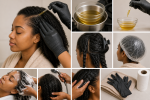
Follow whether hair must be wet, damp, towel-dried, or dry and whether the product belongs on ends only or broader lengths. Divide hair into small sections and keep the formula away from eyes and broken skin. Root application can create heaviness or buildup when the product is designed only for lengths.
Start with the minimum amount
Warm or emulsify between hands only when directed, then distribute a small repeatable dose. Add product only where coverage is incomplete. Excess can make ends stringy, tacky, stiff, dark-looking, or prone to collecting lint. More coating does not prove more sealing or longer durability.
Control heat and drying
If heat activation is permitted, use only the stated tool type, hair condition, temperature range, pass method, and protectant sequence. Do not add a flat iron or dryer to force a finish. The long-hair guide supports low-tension styling without replacing heat directions.
Judge the finish after full drying
Observe end alignment, movement, clumping, tack, stiffness, shine, static, tangling, and transfer to fingers, combs, clothing, or pillowcases. Compare the same section before adding oil or another styler. A useful result should not require repeated layers throughout the day to keep ends separated.
Separate finish from hold
A sealer may add slip without providing styling hold. The hair-wax guide separates hold, texture, and washout decisions. Stacking wax, gel, mousse, oil, and sealer can make the source of stiffness or residue impossible to identify.
Plan washout and buildup checks
Follow the normal wash method and inspect underside lengths, ends, combs, towels, and drainable tools for residue. Verify wetting, cleanser placement, and rinsing before choosing a stronger wash. Do not use household detergent or solvent. Reduce frequency when coating returns quickly or ends become harder to wet and detangle.
Account for color and service history
Lightened, permanently colored, relaxed, permed, or heat-styled sections may have uneven porosity and deposit. The red-hair guide adds color and care context. A sealer label does not establish color protection or compatibility with a fresh service.
Track breakage without a prevention claim
Record where snapping occurs, whether knots increase, and how ends respond after washout. Stop if brushing force, stiffness, roughness, matting, or breakage increases. Adjust handling, heat, styling layers, and trim planning as separate variables rather than asking the sealer to compensate for every source of mechanical stress.
Record repeated-use evidence
Log the date, hair condition, product amount, placement, drying method, other stylers, wash count, end feel, transfer, and residue. Compare the same representative sections under similar light before another application. This record can reveal whether a smaller dose, narrower placement, longer interval, different styling layer, or trim discussion is the more useful next change.
Review ingredient and hair boundaries
The FDA cosmetics-allergen guidance supports ingredient review without predicting response. The AAD hair-care guidance supports gentle handling without endorsing sealers. Stop for burning, swelling, hives, sores, marked shedding, or worsening breakage and follow appropriate guidance.
Decision table
| Question | Useful evidence | Stop or revise when |
|---|---|---|
| What can it change? | Temporary surface alignment, slip, shine, or feel | Permanent rejoining is assumed |
| Where does it go? | The stated end or length zones | Roots are coated without permission |
| Is the dose suitable? | Ends move separately without tack or stiffness | Clumps, residue, or repeated layering appears |
| What happens after washing? | Finish and buildup are reassessed | Household stripping is considered |
Final checklist
- The sealer format, zones, dose, drying, heat, and washout are known.
- Visible splits, tangles, and breakage are recorded without destructive testing.
- Temporary finish is kept separate from trimming and permanent repair claims.
- Dry movement, transfer, residue, and washout are checked.
- Increasing stiffness, matting, reaction, or breakage stops use.
Split-end sealers can provide a temporary cosmetic finish while the film remains. Use the smallest effective dose, protect movement and washability, and keep trimming, heat, breakage, and permanent repair claims as separate decisions.