Folding Wig Stands: Selection, Use, Cleaning, and Replacement

Direct answer: Choose a folding wig stand by its fully assembled height, top support diameter, leg spread, joint engagement, material, permitted load, and folded dimensions. Assemble it on a level dry surface, confirm every joint is seated, and center a lightweight wig without pulling the cap over an undersized frame. A folding stand is mainly for supported storage or label-permitted air exposure; it is not a substitute for a pinnable block, a heated styling head, or a human fit check.
Record the frame before the first assembly
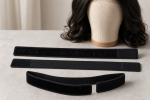
Lay every rib flat and photograph tabs, hinges, top supports, feet, and material marks. Measure the packed profile, then record assembled height and leg spread on a level surface. This frame record makes later warp, joint whitening, missing feet, or incomplete opening visible.
Measure the stand in both states
Record packed length and width, assembled height, top-ring diameter, widest leg spread, number of interlocking ribs, and clearance under the wig ends. A compact folded profile does not establish useful working height. Compare the assembled frame with the wig cap depth and fiber length so ends do not bunch on the table or pull the stand off balance.
Inspect the lattice and joints
Open the stand slowly and identify every hinge, slot, tab, collar, and top support. Each connection should seat without forcing, whitening plastic, cracking, or leaving a rib twisted. Check for molding flash, rough corners, loose pins, warped sections, and a top ring that cannot sit level. Never tape over a structural crack and call the frame restored.
Test stability before adding hair
Place the empty stand on the intended counter, shelf, or floor. Press lightly downward at the center and observe all feet. Then apply a small sideward touch at top-ring height. Rocking, sliding, a narrowing leg spread, or a joint beginning to fold means the location or stand is unsuitable. Keep it away from edges, doors, pets, children, fans, and traffic.
Center only a compatible wig
Support the wig cap with both hands, lower it over the top support, and let the fiber fall around the frame. Do not stretch a small cap over a large ring, hang weight from one rib, or use the hair as a handle. Center the part and cap, then confirm the stand remains upright from front, side, and rear views.
Define the stand's job
Use it for the tasks permitted by its directions: temporary storage, shape support, display, or airflow around a compatible wig. Do not assume a plastic folding frame tolerates pins, clamps, adhesives, solvents, hot tools, steam, heavy wet hair, vigorous brushing, cutting pressure, or chemical processing. Move construction and intensive styling to equipment designed for those loads.
Handle dampness conservatively
If the wig directions permit stand drying, remove excess water by the stated method before placement and keep the stand on a water-tolerant stable surface with airflow. Do not place a dripping wig near electricity or on a surface that becomes slippery. Recheck balance as water distribution changes. A stand's open frame does not establish a drying time.
Brush without loading the frame
When light grooming on the stand is expressly allowed, support the hair above the working point and use short low-force passes from the ends. Hold the stand base rather than twisting the top. Stop if legs spread, joints flex, the top ring tilts, or the cap shifts. Dense detangling belongs on a more suitable support or according to the wig directions.
Fold in the designed sequence
Remove the wig first. Clear hair from joints and identify the release direction before applying force. Collapse ribs evenly so tabs do not shear and fingers do not enter pinch points. Do not twist one side flat while another remains locked. Confirm the folded stand stays together without a strap compressing or bending its structural parts.
Clean the frame, not an imagined waterproof product
Remove loose hair with a dry soft method, then use only the cleaner, water exposure, and wiping process allowed for the disclosed material. Keep liquid away from metal pivots or hidden joints unless permitted. Open the stand after cleaning so slots, collars, feet, and overlapping ribs dry fully before folded storage.
Replace a frame that no longer assembles predictably
Retire it for cracks, white stress lines, broken tabs, sharp flash, warped ribs, loose or corroded pivots, a top ring that tilts, missing feet, repeated collapse, unstable leg spread, trapped odor, or joints that no longer seat. A stand that works only when propped against a wall has lost its independent support function.
Decision table
| Checkpoint | Continue when | Stop or replace when |
|---|---|---|
| Assembly | Every rib and tab seats without force | Twisting, gaps, stress whitening, or a loose joint |
| Base | All feet contact a level surface | Rocking, sliding, or narrowing leg spread |
| Support | Cap is centered without stretching | Top ring tilts or one rib carries the load |
| Folding | Parts collapse in the designed order | Pinch, shear, or forced twisting is required |
| Retirement | Frame repeatedly opens level and stable | Cracks, warp, collapse, or sharp damage |
Do not convert a support stand into a scalp claim
AAD guidance concerns hair and scalp tension, not stand engineering. It supports keeping the eventual wear system from depending on painful tightness. FDA hair-product information becomes relevant only if a cosmetic contacts the wig or frame and does not establish load or heat limits.
- FDA hair-product context: Use product directions when cosmetic residue reaches a wig; do not infer frame compatibility.
- AAD extension precautions: Carry gentle hair handling into the later wearing routine, outside stand engineering.
- AAD traction overview: Do not solve a wear-fit problem by tightening the system after it leaves the stand.
Route fiber and attachment questions to their own guides
The extension guides cover hair-format decisions that an empty support frame cannot answer. Use them when the unresolved question is fiber, shade, length, or attachment rather than stand geometry.
- extension format guide: routes format questions away from frame geometry
- hair crown extension guide: covers shade and placement after storage
- hair extension selection guide: separates attachment choices from stand stability
Final checklist
- Packed size, assembled height, top support, and leg spread are measured.
- Every joint seats and all feet remain stable before a wig is added.
- The wig cap rests centrally without stretching or loading one rib.
- Cleaning respects the frame material and every joint dries while open.
- Cracked, warped, sharp, or repeatedly collapsing stands are retired.
Limit conclusions to frame behavior
Observed assembly, balance, support, and drying access describe this stand under this load. They do not establish faster drying, fiber safety, heat resistance, professional durability, or scalp benefit. Recheck the frame whenever the wig, surface, or task changes.
A folding wig stand earns its place through repeatable assembly, stable geometry, compatible support, clean joints, and safe storage. Portability does not excuse a frame that rocks, warps, or collapses under ordinary use.