Wig Grip Bands: Selection, Use, Cleaning, and Replacement

Direct answer: choose a wig grip band by its surface material, backing, directional or non-directional texture, finished width, edge thickness, adjustable circumference, closure type and overlap, stretch recovery, color, wig compatibility, cleaning directions, and replacement signs. Compare velvet-style, textile-elastic, silicone-featured, and other disclosed constructions only by their exact labels and directions; similar shape does not establish the same grip mechanism. The band should remain stable with the least adjustment that avoids pain, headache, numbness, hairline pulling, deep marks, rolling, or a closure ridge.
Start with material disclosure
Record every disclosed fiber, pile or nap, elastic component, backing, silicone or other contact feature, seam, edge binding, and closure material. A soft-looking band can have a firm backing or rough join, while a smooth elastic band can behave differently from a directional textile surface. Do not infer hypoallergenic properties, cooling, breathability, scalp protection, or a certain hold from a material name or product photograph.
Separate surface grip from compression
A textured surface, directional nap, elastic stretch, silicone feature, and hook-and-loop closure create different contact and adjustment questions. Determine which face contacts the hair or liner and which contacts the wig. A band that only works when pulled very tight is relying on compression, not merely surface interaction. Pressure is not proof of better fit and can conceal an incorrectly sized wig or bulky hair preparation.
Measure usable circumference and closure overlap
Measure the intended band line and compare it with the maker’s adjustment range. Check the minimum required closure overlap and the thickness created where the ends meet. Too little overlap can release; excessive overlap can form a ridge, shorten the usable smooth area, or place hard material under a wig seam. Fixed-loop and adjustable designs require different fit checks, so do not transfer measurements between them.
Compare width with the contact zone
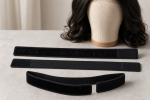
Record finished width at the front, temples, above the ears, and nape. A wider band spreads contact over more area but can conflict with lace depth, ear tabs, wig combs, cap seams, or the nape adjuster. A narrow band may fit under more constructions but can concentrate pressure or roll. Choose width by the exact wig underside and intended placement, not by a general wider-is-better rule.
Inspect edges, seams, and backing
Use bright light and a clean fingertip to inspect the complete front and back surfaces, binding, joins, stitches, closure hooks and loops, elastic ends, and any raised feature. Stop for loose thread, exposed hard material, sharpness, sticky residue, cracking, peeling, hardened backing, curled edges, uneven thickness, or a closure that scratches when normally overlapped. A comfortable center does not make a rough edge acceptable.
Prepare hair without using the band as a compressor
Arrange clean, dry hair in a low-profile, low-tension pattern. Keep hard pins, bulky knots, braid ridges, and fragile edges away from concentrated contact zones. The American Academy of Dermatology traction guidance explains that repeated pulling from tight styles and attachments can contribute to hair loss. It does not diagnose a wearer or prove that a particular grip prevents damage.
Place the band by its own orientation
Follow front, back, nap-direction, silicone-feature, or closure instructions when present. Keep the band at the intended hairline and nape, above rather than over the ears, and never across the eyes, face, or neck. Smooth twists and folded edges before lowering the wig. Place the closure where it does not sit on a braid knot, tender area, wig adjuster, or thick cap seam.
Map the wig underside before installation
Inspect lace depth, cap edge, ear tabs, combs, clips, straps, elastic, seams, and nape hardware. Decide which components may contact the band and which must remain clear. Do not force a comb through the grip, stack a clip over the closure, or assume the band replaces an attachment required by the wig directions. A grip-band decision cannot correct a cap that is too large or too small.
Check lace and part visibility
Band color, width, edge thickness, and placement can affect what is visible beneath lace or an open part. Inspect under neutral indoor light and indirect daylight without relying on screen color. Do not apply foundation, dye, bleach, adhesive, powder, or spray to the band unless the exact band, wig, and cosmetic-product directions permit the combination.
Run a short movement and pressure check
Turn the head, look down, and make ordinary facial movements while checking the front, temples, ears, crown, nape, closure, and wig hardware. Useful evidence is stable placement without increasing pressure or rolling. If movement occurs, recheck hair bulk, wig size, closure position, band orientation, and material compatibility before tightening. Stop for pain, burning, itching, swelling, headache, numbness, bumps, hairline pulling, or persistent marks.
Keep adhesives and grip bands separate unless directed
A grip band may be one attachment option, but it does not change the directions for tape, liquid adhesive, remover, lace, or skin preparation. Do not apply adhesive to an undisclosed textile, elastic, silicone feature, or closure. The FDA hair-products overview provides federal cosmetics context and does not certify a band, adhesive, cleaner, or combined wear method.
Remove the wig before releasing the band
Release wig attachments by their directions and lift the wig without dragging hardware across the band. Open or relax the grip closure, support nearby hair, and lift the band rather than sliding it around the full hairline. Free caught strands one at a time. Do not yank a closed band over the head or use a sharp tool to release hair or closure material.
Clean by the most restrictive material
Check whether the band is washable or single-use. For a washable multi-material band, follow the most restrictive compatible directions for fiber, elastic, silicone feature, backing, stitches, and closure. Secure hook-and-loop tabs when directed, use the stated water and cleanser, press gently, rinse completely, and avoid harsh brushing, wringing, solvents, bleach, or unapproved heat.
Dry flat and verify recovery
Arrange the band in its natural shape with airflow and prevent the closure from catching other textiles. Confirm that surface, backing, edge folds, seams, and closure are fully dry. Compare length, width, edge shape, stretch recovery, surface texture, and closure performance with the clean baseline. Do not store a damp band under a wig or inside a sealed bag.
Replace when the material or fit changes
Replace for permanent stretch, failed overlap, curled or frayed edges, split stitching, flattened or hardened texture, peeling or cracked contact features, roughness, sticky residue, staining, persistent odor, trapped moisture, repeated rolling, slipping, or uncomfortable fit. Extra tightening, adhesive, stitching through unknown materials, or doubling bands does not restore predictable function.
Use related guides for separate decisions
The hair extensions selection guide separates attachment and fiber questions from grip selection. The hair extensions type guide helps distinguish extension and wig formats. Use the hair crown extensions guide for separate shade, length, placement, and maintenance decisions.
Keep the claim boundary explicit
This page does not promise universal fit, a stated hold duration, irritation-free wear, hair or scalp protection, hair growth, damage-free use, or a certain cosmetic result. The AAD weave and extension precautions support gentle handling without endorsing a wig grip band.
Decision table
| Check | Useful evidence | Stop or revise when |
|---|---|---|
| Material | Surface, backing, elastic, edges, and closure are disclosed | Fit depends on an unknown coating or rough contact feature |
| Adjustment | Normal overlap holds without pulling to the limit | Closure releases or forms a painful ridge |
| Compatibility | Band clears lace, ears, cap seams, and hardware | Comb, clip, lace, or adjuster conflicts with placement |
| Comfort | Movement remains stable with light even contact | Headache, numbness, pulling, rolling, or deep marks |
| Care | All materials clean, dry, and recover predictably | Stretch, curl, peeling, odor, residue, or dampness remains |
Final checklist
- The surface material, backing, width, circumference, closure, and stretch are known.
- Hair preparation and band placement avoid concentrated pressure.
- The wig underside clears the band edges, closure, and contact features.
- Movement is checked before increasing adjustment.
- Cleaning, drying, and replacement follow every material limit.
A wig grip band is a material-system, width, adjustment, placement, compatibility, pressure, and care decision. Select the construction that fits the exact wig and wearer without depending on excessive compression or unsupported performance claims.